
How Green Tea Supports Metabolism, Hormonal Health, Energy & Healthy Aging Naturally
For thousands of years, green tea has been valued as more than a beverage.
Today, modern science has confirmed many of the traditional observations.
Green tea contains powerful plant compounds that may support:
- metabolism
- cardiovascular health
- cognitive function
- healthy aging
- insulin sensitivity
- inflammation regulation
For women, these effects may also indirectly support hormonal well-being, energy levels, and overall vitality.
What Is Green Tea?
Green tea comes from the leaves of:
Camellia sinensis
Unlike black tea, green tea is minimally oxidized after harvest, helping preserve many of its natural compounds.
Main Active Compounds
EGCG (Epigallocatechin Gallate)
The most studied green tea compound.
EGCG is responsible for many of green tea’s biological effects (Cabrera et al., 2006).
Catechins
Powerful polyphenol antioxidants.
Major catechins include:
- EGCG
- EGC
- ECG
- EC
(Cabrera et al., 2006)
L-Theanine
An amino acid almost unique to tea.
L-theanine promotes calm alertness and may balance caffeine’s stimulating effects (Juneja et al., 1999).
Caffeine
Provides energy and mental focus.
Green tea generally contains less caffeine than coffee.
Flavonoids
Support antioxidant and anti-inflammatory activity.
How Does Green Tea Affect Human Physiology?
1. Supports Cellular Protection
Green tea catechins neutralize free radicals and reduce oxidative stress.
Oxidative stress contributes to:
- aging
- inflammation
- metabolic dysfunction
(Cabrera et al., 2006)
2. Supports Metabolic Health
EGCG may:
- increase fat oxidation
- improve insulin sensitivity
- support glucose metabolism
(Hursel et al., 2009)
These effects may be relevant for women with metabolic syndrome or PCOS.
3. Supports Cardiovascular Health
Research suggests green tea consumption may support:
- healthy cholesterol levels
- vascular function
- blood pressure regulation
(Kuriyama et al., 2006)
4. Supports Brain Function
L-theanine and caffeine appear to work synergistically.
Together they may improve:
- attention
- concentration
- mental performance
(Giesbrecht et al., 2010)
5. May Support Healthy Hormonal Function Indirectly
Green tea is not a hormone replacement.
However, by supporting:
- insulin sensitivity
- inflammation regulation
- metabolic health
it may create conditions that support hormonal balance.
(Thielecke & Boschmann, 2009)
Green Tea and Women’s Health
Potential benefits include:
- metabolic support
- healthy aging
- energy support
- antioxidant protection
- cardiovascular support
Emerging research is also investigating its role in PCOS and endometriosis-related inflammation.
(Shen et al., 2018)
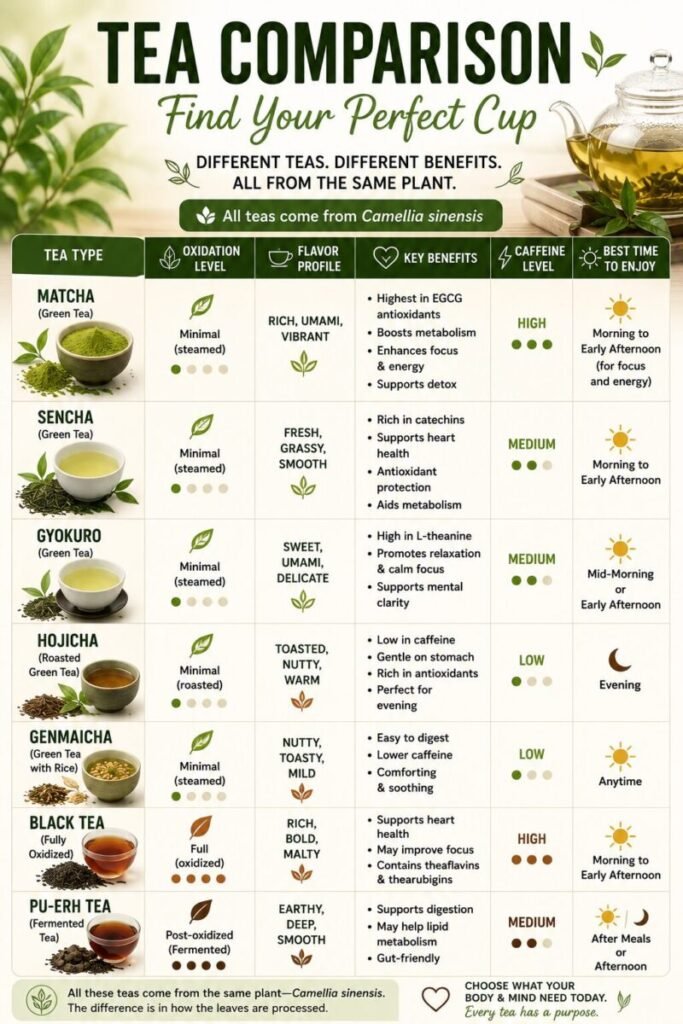
Types of Tea: What’s the Difference?
Matcha
Matcha is powdered green tea.
You consume the entire leaf.
Benefits:
- highest EGCG concentration
- highest antioxidant intake
- more caffeine
- more L-theanine
Sencha
Japan’s most common green tea.
Balanced flavor and moderate catechin content.
Gyokuro
Shade-grown before harvest.
Contains:
- more L-theanine
- less bitterness
Hojicha
Roasted green tea.
Contains:
- lower caffeine
- pleasant roasted flavor
Often preferred in the evening.
Genmaicha
Green tea blended with roasted rice.
Milder flavor.
Lower caffeine.
Black Tea
Fully oxidized.
Contains:
- theaflavins
- thearubigins
Different antioxidant profile than green tea.
Pu-erh Tea
Fermented tea.
May support:
- digestion
- lipid metabolism
Its compounds differ substantially from green tea.
(Zhang et al., 2013)
How to Prepare Green Tea Properly
One of the biggest mistakes is using boiling water.
Green Tea
- Water: 70–80°C
- Steep: 2–3 minutes
Matcha
- 1–2 grams powder
- 70–80°C water
- whisk until frothy
Gyokuro
- 50–60°C water
- longer steeping
When Is the Best Time to Drink Green Tea?
Best:
- morning
- early afternoon
Avoid:
- immediately before sleep
due to caffeine.
Can Green Tea Affect Nutrient Absorption?
This is one of the most important questions.
Iron
Tea polyphenols may reduce iron absorption.
(Hurrell et al., 1999)
Women with:
- heavy periods
- low ferritin
- iron deficiency
should avoid drinking tea with meals.
Instead:
✔️ wait 1–2 hours after meals.
Can Green Tea Interact with Medications?
Potential interactions include:
- blood thinners
- stimulant medications
- certain heart medications
Large amounts may affect drug metabolism.
Consult your physician or pharmacist if taking medication.
What Improves Green Tea Benefits?
Green tea does not require absorption enhancers like turmeric.
However:
Helpful Pairings
Vitamin C
May improve catechin stability.
Examples:
- lemon
- yuzu
- orange
(Nanjo et al., 1996)
Light Meals
May improve tolerance and reduce stomach irritation.
How Much Green Tea Can You Drink?
Moderate intake:
- 2–5 cups daily
is generally considered safe.
(Malik et al., 2010)
Environmental Benefits
Tea cultivation:
- supports perennial agriculture
- stores carbon in root systems
Choosing:
- organic
- shade-grown
may support biodiversity.
Additional Information Worth Knowing
Green tea may temporarily worsen symptoms in people with:
- caffeine sensitivity
- anxiety disorders
- insomnia
- severe iron deficiency
For these individuals:
- hojicha
- low-caffeine green teas
may be preferable.
Green Tea and the Aviva Method
Green tea supports the body primarily through:
- metabolism
- antioxidant protection
- inflammation regulation
The Aviva Method approaches women’s health from a physical perspective through movement, circulation, and neuromuscular activation.
Together, they may provide complementary support:
- Green tea → biochemical and metabolic support
- Aviva Method → circulation and movement support
References
Cabrera, C., Artacho, R., & Giménez, R. (2006). Beneficial effects of green tea—A review. Journal of the American College of Nutrition, 25(2), 79–99.
Giesbrecht, T., Rycroft, J. A., Rowson, M. J., & De Bruin, E. A. (2010). The combination of L-theanine and caffeine improves cognitive performance. Nutritional Neuroscience, 13(6), 283–290.
Hursel, R., Viechtbauer, W., & Westerterp-Plantenga, M. S. (2009). The effects of green tea on weight loss and weight maintenance. International Journal of Obesity, 33(9), 956–961.
Hurrell, R. F., Reddy, M., & Cook, J. D. (1999). Inhibition of non-heme iron absorption by tea. British Journal of Nutrition, 81(4), 289–295.
Juneja, L. R., Chu, D. C., Okubo, T., Nagato, Y., & Yokogoshi, H. (1999). L-theanine—a unique amino acid of green tea. Trends in Food Science & Technology, 10(6–7), 199–204.
Kuriyama, S., Shimazu, T., Ohmori, K., et al. (2006). Green tea consumption and mortality due to cardiovascular disease. JAMA, 296(10), 1255–1265.
Malik, V. S., Popkin, B. M., Bray, G. A., Després, J. P., & Hu, F. B. (2010). Sugar-sweetened beverages and metabolic disease. (Includes comparative discussion of tea consumption patterns.) Diabetes Care, 33(11), 2477–2483.
Nanjo, F., Goto, K., Seto, R., Suzuki, M., Sakai, M., & Hara, Y. (1996). Scavenging effects of tea catechins and their derivatives. Free Radical Biology and Medicine, 21(6), 895–902.
Thielecke, F., & Boschmann, M. (2009). The potential role of green tea catechins in prevention of metabolic syndrome. Phytochemistry, 70(1), 11–24.
Shen, C. L., Cao, J. J., Dagda, R. Y., Chanjaplammootil, S., Lu, C., & Chyu, M. C. (2018). Green tea and reproductive health: Emerging evidence and future directions. Nutrients, 10(11), 1654.
Zhang, L., Ho, C. T., Zhou, J., Santos, J. S., Armstrong, L., & Granato, D. (2013). Chemistry and biological activities of processed teas. Food Research International, 53(2), 600–607.