When Period Pain May Signal an Underlying Condition
In the previous article, we explored primary dysmenorrhea—the most common type of menstrual pain.
We learned that primary dysmenorrhea occurs when a structurally healthy uterus produces strong contractions during menstruation. Elevated prostaglandins, reduced blood flow, temporary oxygen deprivation, and nervous system responses all contribute to the characteristic menstrual cramps many women experience.
But not all menstrual pain is the same.
Sometimes period pain is not simply the result of normal menstrual physiology.
Sometimes it is a symptom of an underlying gynecological condition.
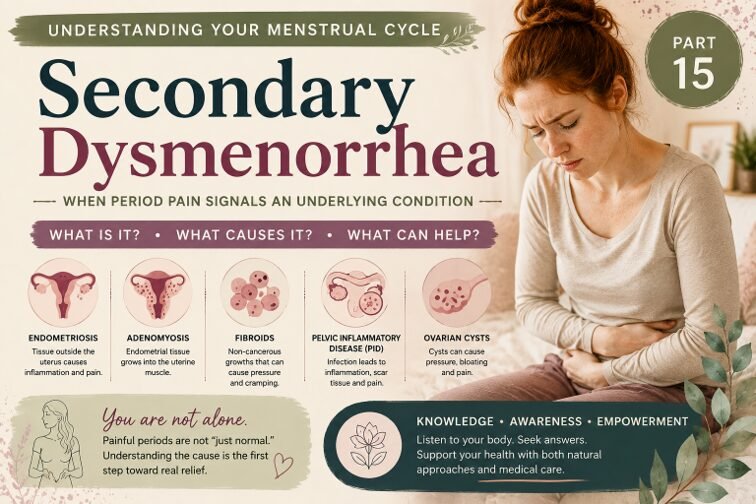
This type of menstrual pain is known as secondary dysmenorrhea.
Understanding the difference between primary and secondary dysmenorrhea is important because the underlying causes, treatment approaches, and long-term implications may be very different.
What Is Secondary Dysmenorrhea?
Secondary dysmenorrhea refers to menstrual pain that occurs because of an identifiable pelvic or gynecological condition.
Unlike primary dysmenorrhea, the pain is not caused solely by prostaglandin-driven uterine contractions.
Instead, pain arises because an underlying condition changes the structure, function, inflammation, blood flow, or mobility of tissues within the pelvis.
The menstrual cycle may then aggravate these abnormalities, leading to pain.
In other words:
Primary dysmenorrhea occurs when a healthy uterus menstruates painfully.
Secondary dysmenorrhea occurs when another condition makes menstruation painful.
Primary vs Secondary Dysmenorrhea
Although symptoms may overlap, there are often important differences.
Primary Dysmenorrhea
Typically:
-
begins within a few years after the first menstrual period
-
occurs during ovulatory cycles
-
pain starts shortly before or at the beginning of menstruation
-
strongest during the first one or two days of bleeding
-
improves as bleeding progresses
-
no underlying pelvic disease is present
Secondary Dysmenorrhea
Often:
-
develops later in life
-
may worsen over time
-
can begin several days before menstruation
-
may continue throughout the menstrual period
-
sometimes persists after bleeding ends
-
frequently accompanies an underlying gynecological disorder
However, these are general patterns rather than strict rules.
Only proper medical evaluation can determine the underlying cause of menstrual pain.
Menstruation Can Reveal Hidden Problems
One way to think about secondary dysmenorrhea is that menstruation acts as a monthly “stress test” for the reproductive system.
Every month the uterus must:
-
contract
-
shed tissue
-
remodel blood vessels
-
coordinate immune responses
-
regulate blood flow
If underlying abnormalities are present, these monthly processes may place additional strain on affected tissues.
The result is often pain.
Menstruation does not necessarily create the condition.
Instead, it may expose a problem that already exists.
Why Does Secondary Dysmenorrhea Cause Pain?
Although the specific mechanisms vary depending on the condition, most causes of secondary dysmenorrhea involve one or more of the following:
1. Chronic Inflammation
Inflammation plays a central role in many gynecological disorders.
Inflamed tissues release numerous chemical messengers, including:
-
prostaglandins
-
cytokines
-
growth factors
-
inflammatory mediators
These substances can:
-
increase pain sensitivity
-
stimulate uterine contractions
-
irritate nerves
-
promote swelling
As a result, menstruation often becomes significantly more painful.
2. Structural Changes
The female reproductive organs are designed to move, expand, contract, and adapt throughout the menstrual cycle.
Certain conditions alter the normal structure of these tissues.
Examples include:
-
fibroids
-
adenomyosis
-
scar tissue
-
congenital abnormalities
Structural changes may:
-
increase pressure within tissues
-
interfere with normal uterine contractions
-
obstruct menstrual flow
-
create mechanical stress
All of these factors may contribute to pain.
3. Reduced Tissue Mobility
Healthy pelvic organs glide smoothly against one another.
The uterus, ovaries, bladder, intestines, and surrounding connective tissues all require a degree of mobility.
When inflammation, scar tissue, or adhesions develop, this mobility may become restricted.
As tissues lose their ability to move freely:
-
tension increases
-
pulling forces develop
-
nerves may become irritated
Menstruation can amplify these mechanical stresses.
4. Nerve Irritation and Sensitization
Pain is not determined solely by tissue damage.
The nervous system also plays an important role.
Long-standing inflammation may make nerves more sensitive.
This process is known as sensitization.
Over time:
-
pain thresholds decrease
-
normal sensations may become painful
-
pain may spread beyond the original area
This helps explain why some women with chronic gynecological conditions experience pelvic pain throughout the month rather than only during menstruation.
Why Secondary Dysmenorrhea Often Becomes Worse Over Time
Primary dysmenorrhea often improves with age.
Secondary dysmenorrhea frequently follows a different pattern.
Many underlying conditions are progressive.
This means that structural changes, inflammation, or tissue damage may gradually increase over time.
As the condition progresses:
-
inflammation may increase
-
scar tissue may accumulate
-
blood flow may become altered
-
nerve sensitivity may increase
Consequently, menstrual pain often becomes more severe.
Many women describe a gradual worsening of symptoms over several years.
This pattern can be an important clue that an underlying condition may be present.
Symptoms That May Suggest Secondary Dysmenorrhea
Although every woman is different, certain symptoms warrant closer attention.
These may include:
-
menstrual pain that suddenly becomes much worse
-
pain that begins years after previously painless periods
-
pain that starts several days before menstruation
-
pain that continues after bleeding ends
-
pain during intercourse
-
chronic pelvic pain between periods
-
unusually heavy menstrual bleeding
-
fertility difficulties
-
bowel or bladder symptoms that worsen during menstruation
These symptoms do not automatically mean a serious condition is present.
However, they may indicate that further evaluation would be worthwhile.
The Most Common Causes of Secondary Dysmenorrhea
Several gynecological conditions are particularly associated with painful menstruation.
These include:
-
endometriosis
-
adenomyosis
-
uterine fibroids
-
pelvic inflammatory disease
-
ovarian cysts
-
pelvic adhesions
-
congenital uterine abnormalities
Each condition produces pain through somewhat different mechanisms.
Understanding the biological mechanisms behind these conditions can help explain why menstrual pain sometimes becomes unusually severe, persistent, or progressive.
Endometriosis
Among all causes of secondary dysmenorrhea, endometriosis is one of the most common and most misunderstood.
Researchers estimate that approximately 10% of reproductive-aged women may be affected by endometriosis, although many remain undiagnosed for years.
What Is Endometriosis?
Endometriosis occurs when tissue similar to the uterine lining develops outside the uterus.
These endometriosis lesions may be found on:
-
the ovaries
-
fallopian tubes
-
pelvic peritoneum
-
bladder
-
bowel
-
ligaments supporting the uterus
Less commonly, they may appear elsewhere in the body.
Importantly, these lesions are not simply misplaced endometrium.
They are biologically active tissues with their own blood supply, inflammatory activity, and nerve connections.
Why Does Endometriosis Cause Pain?
Several mechanisms contribute simultaneously.
Chronic Inflammation
Endometriosis lesions release inflammatory substances throughout the menstrual cycle.
These include:
-
prostaglandins
-
cytokines
-
growth factors
The resulting inflammatory environment increases pain sensitivity and tissue irritation.
Unlike primary dysmenorrhea, inflammation may continue throughout the month rather than only during menstruation.
Bleeding Within Lesions
Endometriosis tissue responds to hormonal fluctuations.
During menstruation, lesions may undergo bleeding and breakdown similar to the uterine lining.
However, unlike menstrual blood inside the uterus, this blood cannot easily leave the body.
The result may be:
-
irritation
-
inflammation
-
swelling
-
pain
within the surrounding tissues.
Nerve Growth
One fascinating discovery is that endometriosis lesions often contain nerve fibers.
Researchers have identified increased nerve density around lesions.
This means the lesions themselves may become highly sensitive to pain.
The nervous system is literally drawn into the disease process.
Adhesions and Tissue Restriction
Repeated inflammation may stimulate scar tissue formation.
Over time, organs may become partially attached to one another.
These attachments are called adhesions.
Adhesions may restrict normal movement between:
-
uterus
-
ovaries
-
bowel
-
bladder
As mobility decreases, pulling forces and mechanical tension may contribute to pain.
Typical Symptoms of Endometriosis
Women with endometriosis may experience:
-
severe menstrual pain
-
pelvic pain between periods
-
pain during intercourse
-
painful bowel movements
-
painful urination
-
fertility challenges
-
fatigue
However, symptom severity does not always correlate with disease severity.
Some women with extensive endometriosis have surprisingly mild symptoms, while others with relatively small lesions may experience significant pain.
Adenomyosis
Adenomyosis is sometimes described as the “sister condition” of endometriosis.
Although they share similarities, the location of the abnormal tissue is different.
What Is Adenomyosis?
In adenomyosis, endometrial-like tissue grows into the muscular wall of the uterus.
Instead of remaining within the endometrial cavity, tissue infiltrates the myometrium.
The uterus often becomes:
-
enlarged
-
heavier
-
thicker
-
more vascular
Many women with adenomyosis describe a sensation of pelvic heaviness or pressure.
Why Does Adenomyosis Cause Menstrual Pain?
The uterus functions as a muscle.
During menstruation it contracts rhythmically to expel the uterine lining.
When endometrial tissue is embedded inside the muscle itself, several problems arise.
Increased Inflammation
The abnormal tissue generates inflammatory signals.
This contributes to:
-
swelling
-
tissue irritation
-
increased prostaglandin production
As a result, contractions often become more painful.
Increased Uterine Pressure
The uterine wall may become thickened and less flexible.
When contractions occur, pressure inside the uterus may rise significantly.
Researchers have found that women with adenomyosis often experience elevated intrauterine pressure during menstruation.
Higher pressure frequently means greater pain.
Reduced Blood Flow
As contractions compress blood vessels, oxygen delivery may decrease.
The resulting ischemia can contribute to cramping.
Because the uterine muscle is already structurally altered, this process may become even more pronounced.
The Role of Estrogen
Adenomyosis is considered an estrogen-sensitive condition.
Estrogen stimulates tissue growth and vascular development.
When estrogen exposure is relatively stronger compared with progesterone, adenomyotic tissue may become more active.
This may contribute to:
-
tissue growth
-
increased bleeding
-
stronger inflammatory responses
-
more severe menstrual pain
This is one reason symptoms often improve after menopause, when estrogen levels decline significantly.
Common Symptoms of Adenomyosis
Women with adenomyosis often report:
-
severe menstrual cramps
-
heavy menstrual bleeding
-
prolonged bleeding
-
pelvic pressure
-
enlarged uterus
-
pain during intercourse
Many women initially assume their symptoms are simply “normal periods” until symptoms become progressively worse.
Uterine Fibroids
Fibroids are among the most common benign tumors affecting women.
Despite the word “tumor,” fibroids are non-cancerous growths composed primarily of smooth muscle and connective tissue.
What Are Fibroids?
Fibroids can develop in various locations within the uterus.
Some grow:
-
within the uterine wall
-
beneath the outer uterine surface
-
inside the uterine cavity
Their size may range from tiny nodules to masses large enough to significantly enlarge the uterus.
Why Do Fibroids Cause Menstrual Pain?
Several mechanisms may be involved.
Increased Uterine Contractions
The uterus may attempt to contract around fibroids.
This can create stronger and less coordinated contractions.
The result may be increased cramping.
Increased Prostaglandin Production
Fibroids are associated with elevated levels of inflammatory mediators.
This may contribute to stronger uterine contractions and greater pain.
Distortion of Uterine Anatomy
Fibroids can physically alter the shape of the uterus.
This may interfere with normal menstrual flow and contraction patterns.
The uterus must often work harder to expel menstrual tissue.
Reduced Blood Supply
Large fibroids may compress nearby blood vessels.
Some fibroids may even outgrow their own blood supply.
Reduced oxygen delivery can create localized ischemia and pain.
Estrogen and Fibroid Growth
Fibroids are strongly influenced by hormones.
Both estrogen and progesterone play roles in their growth.
However, estrogen is a particularly important growth-promoting factor.
This is why fibroids often:
-
grow during reproductive years
-
enlarge during pregnancy
-
shrink after menopause
When estrogen stimulation is relatively stronger, fibroid growth may accelerate.
This relationship is one reason discussions about “estrogen dominance” frequently arise in connection with fibroids.
Common Symptoms of Fibroids
Depending on their size and location, fibroids may cause:
-
painful periods
-
heavy menstrual bleeding
-
prolonged bleeding
-
pelvic pressure
-
urinary frequency
-
constipation
-
fertility difficulties
Some women experience no symptoms at all.
Others experience significant impairment in quality of life.
Endometrial Polyps
Although polyps are more commonly associated with abnormal bleeding than severe pain, they may occasionally contribute to secondary dysmenorrhea.
Polyps are localized overgrowths of endometrial tissue.
When large enough, they may:
-
disrupt normal shedding of the uterine lining
-
increase inflammation
-
alter uterine contractions
This can contribute to cramping in some women.
Looking Beyond the Uterus
Although endometriosis, adenomyosis, and fibroids account for a large proportion of secondary dysmenorrhea, they are not the only causes.
Several additional gynecological factors may alter pelvic function, influence inflammation, or affect how the uterus contracts during menstruation.
Understanding these conditions can help women recognize when menstrual pain may warrant further investigation.
Ovarian Cysts
Ovarian cysts are fluid-filled structures that develop within or on the ovaries.
Most ovarian cysts are benign and many disappear spontaneously without treatment.
In fact, some cysts are a normal part of the menstrual cycle.
For example:
- follicular cysts develop from follicles that do not release an egg
- corpus luteum cysts develop after ovulation
These are often referred to as functional cysts.
Why Can Ovarian Cysts Cause Menstrual Pain?
Small cysts often produce no symptoms.
However, larger cysts may contribute to discomfort through several mechanisms.
Mechanical Pressure
As a cyst enlarges, it may place pressure on surrounding tissues.
This pressure can affect:
- ligaments supporting the ovary
- pelvic connective tissue
- nearby nerves
The result may be pelvic discomfort that becomes more noticeable around menstruation.
Increased Sensitivity
The ovary itself contains pain-sensitive structures.
Stretching of the ovarian capsule may trigger pain signals.
Inflammatory Responses
Certain cysts may stimulate localized inflammation, increasing sensitivity within the pelvis.
Can Hormones Influence Cyst Formation?
Yes.
The development of many functional ovarian cysts is closely linked to hormonal signaling.
Ovulation depends upon a carefully coordinated balance involving:
- FSH
- LH
- estrogen
- progesterone
When these hormonal patterns become disrupted, follicles may occasionally fail to ovulate normally, increasing the likelihood of cyst formation.
Pelvic Inflammatory Disease (PID)
Pelvic inflammatory disease occurs when infection affects the upper reproductive tract.
The condition may involve:
- the uterus
- fallopian tubes
- ovaries
- surrounding pelvic tissues
PID requires medical evaluation and treatment.
Why Does PID Cause Pain?
Inflammation is the primary reason.
Infection triggers the release of inflammatory chemicals that may:
- irritate nerves
- increase tissue sensitivity
- promote swelling
- alter pelvic mobility
Repeated inflammation may also lead to scar tissue formation.
Even after the infection resolves, residual adhesions may continue contributing to pain.
Pelvic Adhesions
Adhesions are bands of scar tissue that develop between structures that normally move freely.
They may occur following:
- endometriosis
- infection
- surgery
- inflammatory conditions
Why Do Adhesions Cause Menstrual Pain?
Healthy pelvic organs glide smoothly against one another.
The uterus, ovaries, bladder, bowel, and surrounding connective tissues all move slightly during daily activities and throughout the menstrual cycle.
Adhesions can restrict this movement.
As the uterus contracts during menstruation, tissues that should move freely may pull against one another.
This mechanical tension can contribute to pain.
Some women describe this as:
- pulling
- tugging
- deep pelvic aching
rather than classic cramping.
Congenital Uterine Abnormalities
Some women are born with structural differences in the uterus.
Examples include:
- septate uterus
- bicornuate uterus
- unicornuate uterus
- cervical narrowing
Many women never experience symptoms.
Others may experience painful menstruation.
Why Can Structural Abnormalities Increase Pain?
Menstrual flow must pass through the uterus and cervix.
If normal outflow becomes partially restricted, the uterus may need to generate stronger contractions.
Stronger contractions often mean:
- higher uterine pressure
- reduced blood flow
- greater pain
The mechanism becomes somewhat similar to primary dysmenorrhea, but an anatomical factor contributes to the problem.
Endometrial Hyperplasia and Excessive Endometrial Growth
Many women have heard the term “estrogen dominance.”
Although this is not an official medical diagnosis, the concept often refers to situations in which estrogenic stimulation is relatively greater than progesterone influence.
To understand why this matters, we must first understand the normal menstrual cycle.
Estrogen Builds, Progesterone Organizes
During the first half of the cycle, estrogen stimulates the growth of the uterine lining.
This is an important and healthy process.
After ovulation, progesterone helps regulate and mature the endometrium.
The two hormones work together.
You can think of estrogen as the builder and progesterone as the architect who organizes the construction.
When this balance changes, excessive endometrial growth may occur.
What Happens When the Endometrium Becomes Excessively Thick?
A thicker endometrium means:
- more tissue
- more blood vessels
- more cellular material
When menstruation begins, all of this tissue must be broken down and removed.
As a result:
- more inflammatory mediators may be released
- prostaglandin production may increase
- stronger contractions may be required
This can contribute to:
- heavier bleeding
- larger menstrual clots
- stronger cramps
In some women, prolonged estrogen stimulation may contribute to conditions such as:
- endometrial hyperplasia
- endometrial polyps
- heavy menstrual bleeding
all of which may increase menstrual discomfort.
When Should Menstrual Pain Be Evaluated?
Painful periods are common.
However, certain symptoms deserve medical attention.
Consider speaking with a healthcare professional if:
- pain suddenly becomes much worse
- pain interferes with normal daily life
- symptoms progressively worsen over time
- bleeding becomes unusually heavy
- pain occurs between periods
- intercourse becomes painful
- fertility difficulties arise
Seeking evaluation does not mean something serious is wrong.
It simply helps ensure that potentially treatable conditions are not overlooked.
Can Movement Help Secondary Dysmenorrhea?
Secondary dysmenorrhea is different from primary dysmenorrhea because an underlying condition is present.
This means that movement cannot be expected to “cure” every cause of menstrual pain.
For example:
- movement cannot remove extensive endometriosis lesions
- movement cannot guarantee fibroid shrinkage
- movement cannot eliminate severe adenomyosis
However, this does not mean movement has no role.
Many women report that regular physical activity helps improve their overall quality of life.
Potential benefits may include:
- improved circulation
- reduced muscular tension
- improved pelvic mobility
- better stress regulation
- enhanced body awareness
- reduced pain perception
The Aviva Method and Secondary Dysmenorrhea
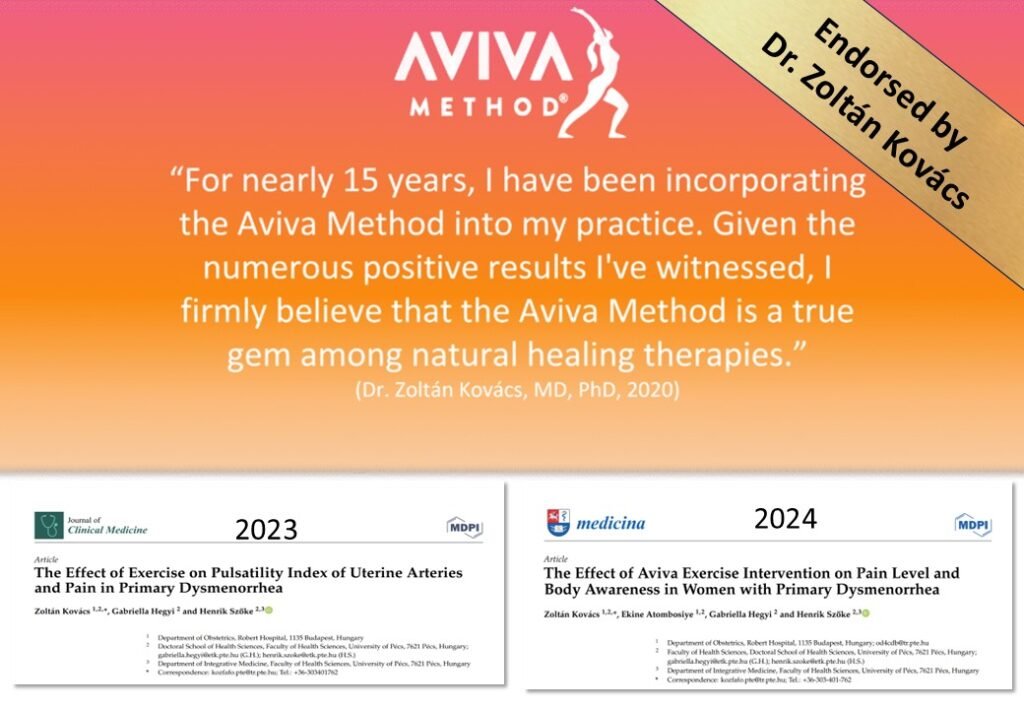
For decades, women have incorporated the Exercises of the Aviva Method into a broader health-supportive lifestyle.
Many practitioners report improvements in:
- pelvic comfort
- menstrual symptoms
- body awareness
- overall well-being
Some women with fibroids, polyps, ovarian cysts, or other gynecological conditions have reported that although surgery was ultimately necessary, their symptoms became significantly more manageable and their quality of life improved during practice.
Others have reported changes observed during follow-up examinations, such as:
- small reductions in fibroid size
- changes in fibroid structure
- resolution of small ovarian cysts
At the same time, experiences vary greatly.
Not every woman observes the same changes.
These outcomes cannot be guaranteed and should not be viewed as predictable treatment results.
The scientific evidence currently supports improvements in factors such as:
- menstrual pain
- body awareness
- uterine artery circulation
while many additional observations come from the experiences reported by practitioners over decades of use.
For this reason, the Aviva Method is best viewed as a supportive, movement-based practice that may complement—but not replace—appropriate medical care.
A Final Thought
Secondary dysmenorrhea is not a diagnosis itself.
It is a sign.
A signal that menstruation may be interacting with an underlying condition.
Whether the cause is endometriosis, adenomyosis, fibroids, cysts, adhesions, inflammation, or excessive endometrial growth, the pain is real and has biological explanations.
Understanding these mechanisms allows women to move beyond the belief that they simply need to “put up with it.”
The menstrual cycle provides valuable information about reproductive health.
Listening to those signals—and seeking support when needed—is an important part of caring for the body throughout the reproductive years.