Let’s talk about Menstrual Pain. Why do period cramps happen?
Many women have been told that painful periods are simply part of being female.
Perhaps you have heard statements like:
“Period pain is normal.”
“Just take a painkiller.”
“You’ll get used to it.”
Yet for many women, menstrual pain is much more than a minor inconvenience. It can interfere with work, school, exercise, sleep, social activities, and overall quality of life.
In fact, painful menstruation is one of the most common gynecological complaints worldwide. Studies suggest that between 50% and 90% of menstruating women experience menstrual pain at some point during their reproductive years (Ju et al., 2014).
The good news is that menstrual pain is not random.
There are biological mechanisms behind it.
When we understand what is happening inside the body, we can better understand why pain occurs and what may help reduce it.
In this article, we will explore the science of primary dysmenorrhea—the most common type of menstrual pain.
What Is Dysmenorrhea?
Dysmenorrhea is the medical term for painful menstruation.
The word comes from Greek:
-
dys = difficult or painful
-
meno = month
-
rrhea = flow
Literally, it means “painful monthly flow.”
Symptoms may include:
-
cramping pain in the lower abdomen
-
pelvic pain
-
lower back pain
-
pain radiating into the thighs
-
nausea
-
diarrhea
-
headaches
-
dizziness
-
fatigue
The severity varies enormously from one woman to another.
Some women experience only mild discomfort.
Others experience pain severe enough to miss work, school, or daily activities.
Primary vs Secondary Dysmenorrhea
Before discussing the mechanisms of menstrual pain, it is important to understand that not all period pain is the same.
Dysmenorrhea is generally divided into two categories.
Primary Dysmenorrhea
Primary dysmenorrhea refers to menstrual pain that occurs without an underlying gynecological disease.
The uterus is structurally healthy.
There are no fibroids.
No endometriosis.
No adenomyosis.
No pelvic inflammatory disease.
The pain results primarily from the physiological processes involved in menstruation itself.
Primary dysmenorrhea usually:
-
begins within a few years after the first menstrual period
-
occurs in ovulatory cycles
-
is most common during adolescence and young adulthood
-
is strongest during the first one or two days of menstruation
-
often improves with age
Primary dysmenorrhea is the focus of this article.
Secondary Dysmenorrhea
Secondary dysmenorrhea occurs when menstrual pain is associated with an identifiable medical condition.
Common causes include:
-
endometriosis
-
adenomyosis
-
uterine fibroids
-
pelvic inflammatory disease
In these cases, pain is not caused solely by normal menstrual physiology.
We will explore secondary dysmenorrhea in detail in the next article of this series.
Menstruation Is Not Passive Bleeding
Many people imagine menstruation as blood simply leaving the body.
In reality, menstruation is a highly active biological process.
Throughout the menstrual cycle, the uterus prepares for the possibility of pregnancy.
Under the influence of estrogen and progesterone, the endometrium—the uterine lining—thickens and becomes rich in blood vessels.
If pregnancy does not occur, hormone levels begin to decline.
Progesterone falls rapidly.
This hormonal withdrawal signals that the endometrium is no longer needed.
The body must now remove the tissue that was built during the cycle.
This is where menstruation begins.
The uterus must:
-
break down tissue
-
remodel blood vessels
-
remove cellular debris
-
expel menstrual fluid
To accomplish this task, the body activates a sophisticated system involving hormones, inflammatory mediators, immune cells, blood vessels, and muscular contractions.
Menstruation is therefore not merely bleeding.
It is a controlled tissue-remodeling process.
The Central Role of Prostaglandins
The most important molecules involved in primary dysmenorrhea are substances called prostaglandins.
Prostaglandins are hormone-like signaling molecules produced within the endometrium.
When the uterine lining begins to break down, prostaglandin production increases dramatically.
Their role is essential.
Without prostaglandins, the uterus could not effectively shed its lining.
Prostaglandins help:
-
stimulate uterine contractions
-
regulate blood vessel constriction
-
coordinate tissue breakdown
-
participate in inflammatory signaling
In other words, prostaglandins help orchestrate menstruation.
The problem arises when prostaglandin levels become excessively high.
Research consistently shows that women with primary dysmenorrhea often produce significantly higher levels of prostaglandins than women who experience little or no menstrual pain (Dawood, 2006).
Why the Uterus Needs to Contract
To understand menstrual pain, it is important to understand why the uterus contracts in the first place.
The uterine lining cannot simply dissolve and disappear.
The tissue must be physically expelled.
The muscular wall of the uterus, known as the myometrium, generates rhythmic contractions that help remove menstrual tissue through the cervix and vagina.
These contractions are completely normal.
In fact, every menstruating woman experiences them.
The difference lies in their intensity.
When prostaglandin levels are elevated:
-
contractions become stronger
-
contractions become more frequent
-
uterine pressure increases
This is where pain begins to develop.
The Real Source of Menstrual Cramping Pain
Many women assume that cramps hurt simply because the uterus is squeezing.
The reality is slightly more complex.
Pain occurs largely because strong contractions temporarily reduce blood flow to the uterine muscle.
Like every muscle in the body, the uterus requires oxygen.
Blood vessels continuously deliver oxygen and nutrients to the uterine tissue.
However, during powerful contractions, these blood vessels become compressed.
Blood flow decreases.
Oxygen delivery drops.
Researchers refer to this process as uterine ischemia.
The word ischemia simply means inadequate blood supply to a tissue.
As oxygen levels fall, the uterine muscle begins producing pain signals.
This mechanism is remarkably similar to what happens when:
-
a calf muscle cramps during exercise
-
a muscle is held in a contracted position for too long
-
tissue temporarily receives insufficient oxygen
The uterus is essentially working harder while receiving less oxygen.
The result is pain.
Why Is Pain Usually Worst on the First Day?
Many women notice that cramps are strongest during the first 24–48 hours of menstruation.
This pattern is not accidental.
The highest prostaglandin concentrations are usually present during the earliest phase of menstruation.
This is when:
-
the largest amount of endometrial tissue is breaking down
-
uterine contractions are strongest
-
blood vessel changes are most active
As menstrual flow progresses:
-
prostaglandin levels decline
-
less tissue remains to be expelled
-
contractions gradually become less intense
As a result, pain often improves after the first one or two days.
Why Do Some Women Experience More Pain Than Others?
If menstrual pain is caused by normal physiological processes, an obvious question arises:
Why do some women experience only mild discomfort while others struggle with severe cramps every month?
The answer lies in the complex interaction between hormones, prostaglandins, inflammation, blood flow, and individual sensitivity to pain signals.
Although primary dysmenorrhea occurs in a structurally healthy uterus, the intensity of these biological processes can vary significantly from one woman to another.
Why Do Some Women Produce More Prostaglandins?
One of the strongest predictors of menstrual pain is the amount of prostaglandins released during menstruation.
Research has consistently shown that women with primary dysmenorrhea often have significantly higher prostaglandin concentrations in both the endometrium and menstrual fluid compared to women who experience little or no pain (Dawood, 2006).
But why?
Several factors may contribute.
1. A Thicker Uterine Lining
Prostaglandins are released as the endometrium breaks down.
The more tissue that must be shed, the more prostaglandins may be produced.
Think of it as a demolition project.
A small building requires less demolition work than a large one.
Similarly, a thicker endometrium contains:
-
more cells
-
more blood vessels
-
more tissue that must be dismantled
As this tissue breaks down, larger quantities of inflammatory mediators and prostaglandins may be released.
This can result in:
-
stronger contractions
-
increased uterine pressure
-
greater pain intensity
2. Hormonal Influences Throughout the Cycle
The development of the uterine lining is strongly influenced by estrogen and progesterone.
During the first half of the cycle, estrogen stimulates growth of the endometrium.
After ovulation, progesterone stabilizes and matures this tissue.
The balance between these hormones helps determine how the lining develops.
When estrogen stimulation is relatively stronger, the endometrium may become thicker.
As a result:
-
more tissue must be shed
-
more prostaglandins may be produced
-
contractions may become more intense
This is one reason menstrual symptoms can vary from cycle to cycle.
Even subtle changes in hormonal patterns can influence how the uterus behaves during menstruation.
The Often Forgotten Hormone: Vasopressin
For many years, prostaglandins received most of the scientific attention in dysmenorrhea research.
Today, researchers recognize that another hormone may also play an important role:
vasopressin.
Vasopressin is primarily known for regulating fluid balance and blood pressure.
However, it also affects the uterus.
Studies suggest that women with primary dysmenorrhea may have elevated vasopressin activity during menstruation.
Vasopressin can:
-
increase uterine contractions
-
increase uterine muscle tone
-
constrict uterine blood vessels
-
reduce uterine blood flow
In other words, vasopressin may amplify many of the same mechanisms already triggered by prostaglandins.
Researchers now believe that menstrual pain often results from the combined effects of prostaglandins and vasopressin rather than either factor alone (Iacovides et al., 2015).
Menstruation Is Also an Inflammatory Process
Inflammation is often viewed negatively.
However, inflammation is a normal and necessary part of tissue repair and remodeling.
Menstruation itself involves a carefully controlled inflammatory response.
As the uterine lining breaks down, immune cells enter the tissue and release various signaling molecules.
These include:
-
prostaglandins
-
cytokines
-
chemokines
-
growth factors
Together, these substances help coordinate:
-
tissue breakdown
-
blood vessel remodeling
-
tissue repair
-
regeneration of the next endometrium
Without inflammation, menstruation could not occur properly.
However, when inflammatory activity becomes excessive, symptoms may intensify.
This can contribute to:
-
stronger pain
-
increased sensitivity
-
heavier bleeding
-
greater fatigue
Why Do Some Cycles Hurt More Than Others?
Many women notice something interesting:
One month may be relatively comfortable, while another feels significantly more painful.
This is a common experience.
Menstrual cycles are not identical from month to month.
Numerous factors can influence the physiological processes involved in menstruation.
These include:
-
hormone fluctuations
-
stress levels
-
sleep quality
-
physical activity
-
inflammatory status
-
nutritional factors
-
illness or infection
-
emotional stress
Because these influences affect prostaglandin production, nervous system sensitivity, and blood flow, they can alter the intensity of menstrual pain.
This helps explain why a woman may experience severe cramps one month and much milder symptoms the next.
Why Do Stress and Tension Sometimes Make Period Pain Worse?
Many women report that menstrual pain feels worse during stressful periods of life.
Scientific research suggests this observation may have a physiological basis.
When the body perceives stress, the nervous system activates protective responses.
These responses can lead to:
-
increased muscle tension
-
altered blood vessel function
-
heightened pain sensitivity
-
changes in inflammatory signaling
The body essentially shifts into a state of increased vigilance.
While this response is useful during emergencies, it may create less favorable conditions for menstruation.
The uterus must continue performing its monthly work while operating within a more stressed physiological environment.
This may contribute to increased discomfort.
Why Can Period Pain Cause Nausea and Digestive Symptoms?
One of the most surprising aspects of dysmenorrhea is that symptoms often extend beyond the reproductive organs.
Many women experience:
-
nausea
-
diarrhea
-
vomiting
-
digestive discomfort
How can a process occurring in the uterus affect the digestive tract?
The answer again involves prostaglandins.
Although prostaglandins are produced within the uterus, they do not remain exclusively there.
Some enter the bloodstream and influence smooth muscles throughout the body.
The digestive tract is lined with smooth muscle tissue.
Elevated prostaglandins can stimulate these muscles, increasing intestinal contractions.
As a result, some women experience:
-
loose stools
-
diarrhea
-
abdominal discomfort
-
nausea
This is why digestive symptoms often occur alongside menstrual cramps.
Why Can Period Pain Cause Headaches and Fatigue?
Prostaglandins influence many systems beyond the uterus.
The inflammatory response associated with menstruation may affect:
-
blood vessels
-
nervous system signaling
-
pain perception pathways
As a result, some women experience:
-
headaches
-
migraines
-
dizziness
-
fatigue
-
generalized body aches
For women with severe dysmenorrhea, the experience can feel like a whole-body event rather than simply pelvic pain.
This is because the biochemical signals involved in menstruation have effects throughout the body.
Menstrual Pain Is Not “Just in Your Head”
Historically, menstrual pain was sometimes dismissed as psychological or exaggerated.
Modern science clearly shows otherwise.
Primary dysmenorrhea involves measurable physiological changes, including:
-
elevated prostaglandins
-
increased uterine pressure
-
reduced blood flow
-
temporary oxygen deprivation
-
inflammatory activation
-
hormonal influences
The pain experienced by women with dysmenorrhea is real.
It is produced by identifiable biological mechanisms that researchers have studied for decades.
Understanding these mechanisms allows us to move beyond myths and toward a more informed understanding of menstrual health.
In Part 3, we will explore another important piece of the puzzle: the role of the nervous system, pelvic circulation, and why movement-based approaches such as the Aviva Method may help reduce menstrual pain.
The Nervous System: An Overlooked Piece of the Puzzle
When discussing menstrual pain, most people focus exclusively on the uterus.
However, pain is never produced by an organ alone.
Pain is created through communication between the body and the nervous system.
The uterus contains sensory nerves that continuously send information to the spinal cord and brain.
During menstruation, signals generated by uterine contractions, inflammation, and reduced blood flow travel through these nerve pathways.
The brain then interprets these signals as pain.
This means that menstrual pain is influenced by two factors:
-
What is happening inside the uterus.
-
How the nervous system processes those signals.
Both matter.
Why Some Women Feel More Pain Than Others
Researchers have discovered that women with primary dysmenorrhea often show increased sensitivity to painful stimuli, even outside of menstruation (Iacovides et al., 2015).
This phenomenon is sometimes referred to as central sensitization.
Central sensitization occurs when the nervous system becomes more responsive to incoming pain signals.
Imagine a smoke detector.
A normally functioning smoke detector activates when there is a significant amount of smoke.
A hypersensitive smoke detector may activate when someone simply burns toast.
The nervous system can behave similarly.
When sensitivity increases, pain signals may be amplified.
This does not mean the pain is psychological.
It does not mean the pain is imagined.
The pain is real.
It simply means that the nervous system has become more responsive to the signals arriving from the uterus.
Researchers increasingly recognize that primary dysmenorrhea involves not only uterine contractions but also changes in pain processing pathways.
The Relationship Between Blood Flow and Pain
We often think about the uterus as a muscular organ.
However, it is also a highly vascular organ.
An extensive network of blood vessels continuously supplies oxygen and nutrients to the uterine tissue.
During menstruation, this vascular system undergoes remarkable changes.
Blood vessels constrict.
The endometrium breaks down.
The uterus contracts repeatedly.
All of these processes influence circulation.
When contractions become particularly strong, blood vessels within the uterine wall can become compressed.
This temporarily reduces blood flow.
As discussed earlier, reduced blood flow means reduced oxygen delivery.
The result is ischemic pain.
Research has shown that women with primary dysmenorrhea often demonstrate alterations in uterine blood flow compared with women who experience little menstrual pain (Dawood, 2006).
This finding has important implications because it suggests that improving circulation may help reduce discomfort.
Why Pelvic Circulation Matters
Good circulation supports every tissue in the body.
The uterus is no exception.
Adequate blood flow helps:
-
deliver oxygen
-
remove metabolic waste products
-
support tissue repair
-
maintain healthy cellular function
When circulation is compromised, tissues may experience greater physiological stress.
This does not mean poor circulation causes dysmenorrhea.
Primary dysmenorrhea is a complex condition with multiple contributing factors.
However, blood flow appears to be one important piece of the puzzle.
Researchers increasingly view menstrual pain not simply as a problem of contractions, but as an interaction between:
-
contractions
-
blood vessel function
-
oxygen delivery
-
nervous system activity
Why Movement May Help Reduce Menstrual Pain
For generations, women experiencing menstrual pain were often advised to rest completely.
While rest is sometimes necessary, research increasingly suggests that appropriate movement in the other phases of the cycle may provide important benefits.
Exercise appears to influence several mechanisms involved in dysmenorrhea.
Regular movement may:
-
improve circulation
-
reduce muscular tension
-
support nervous system regulation
-
increase endorphin production
-
reduce inflammatory activity
-
improve overall pain tolerance
A large body of scientific evidence now supports exercise as an effective non-pharmacological approach for reducing menstrual pain (Armour et al., 2019).
Importantly, exercise does not necessarily need to be too intense.
In fact, moderate-intensity targeted movement may be particularly beneficial.
The goal is not to force the body.
The goal is to support physiological function.
Understanding Endorphins: The Body’s Natural Pain Relievers
One reason movement may help reduce pain involves substances called endorphins.
Endorphins are natural chemicals produced by the brain and nervous system.
They function as the body’s internal pain-relief system.
When endorphin levels increase:
-
pain perception may decrease
-
mood may improve
-
stress responses may be reduced
This is one reason many people feel better after physical activity.
Movement affects not only muscles and circulation but also the biochemical systems involved in pain regulation.
The Aviva Method and Menstrual Pain
The Exercises of the Aviva Method are based on rhythmic, repetitive movements specifically designed to activate the pelvis, hips, lower abdomen, and reproductive organs.
Unlike many conventional exercise programs, the focus is not on fitness performance.
The focus is on supporting reproductive and hormonal health through movement.
The exercises aim to:
-
activate the pelvic region
-
increase circulation
-
improve body awareness
-
promote mobility within the hips and pelvis
-
support natural physiological processes
For women with primary dysmenorrhea, these mechanisms are particularly relevant because many of the factors involved in menstrual pain relate to circulation, tension, and pelvic function.
What Does the Research Say?
For many years, evidence supporting movement-based approaches for menstrual pain came primarily from general exercise studies.
More recently, specific research has examined the Aviva Method itself.
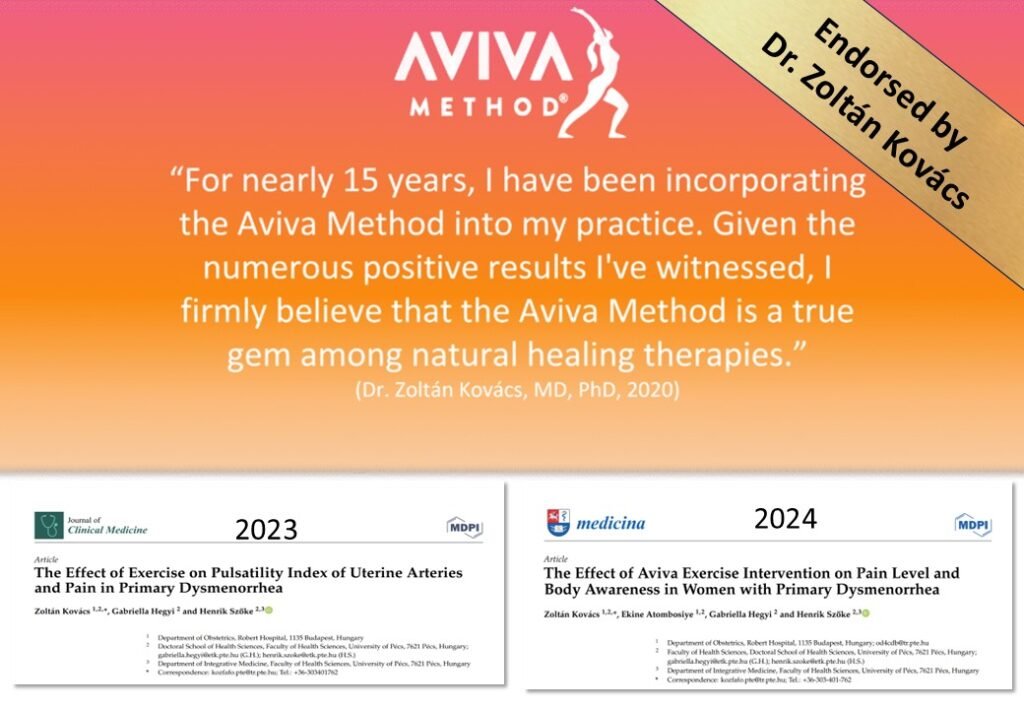
A seven-year scientific research project conducted between 2018 and 2025 investigated the effects of Aviva exercises on women experiencing primary dysmenorrhea.
Researchers observed:
-
significant reductions in menstrual pain
-
improvements in body awareness
-
measurable changes in uterine artery blood flow
(Kovács et al., 2024; Kovács, 2025)
The findings suggest that regular practice may support several physiological systems involved in menstrual comfort.
Importantly, benefits were associated with consistent practice over time rather than occasional use.
This highlights an important principle:
The body often responds best to regular support rather than crisis management.
Body Awareness: An Often Forgotten Benefit
One particularly interesting finding from Aviva research was the improvement in body awareness.
Body awareness refers to the ability to notice and interpret signals coming from the body.
Women with greater body awareness may become more sensitive to:
-
changes during the menstrual cycle
-
early signs of tension
-
stress-related physical responses
-
fluctuations in energy levels
-
emerging discomfort
This awareness can allow earlier intervention and more responsive self-care.
Rather than waiting until pain becomes overwhelming, women may learn to recognize subtle changes before symptoms intensify.
A Different Way of Viewing Menstrual Pain
For many women, menstrual pain feels like an enemy.
Something to fight.
Something to suppress.
Something to endure.
Yet from a physiological perspective, menstrual pain often represents the body attempting to complete a demanding biological process.
The uterus is:
-
shedding tissue
-
remodeling blood vessels
-
coordinating muscular contractions
-
repairing itself
-
preparing for the next cycle
This process requires enormous coordination.
Pain does not necessarily indicate that the body is failing.
In many cases, it reflects the body’s effort to perform its monthly work under challenging physiological conditions.
Understanding this distinction can fundamentally change how we relate to menstrual symptoms.
Final Thoughts
Primary dysmenorrhea is the most common form of menstrual pain.
Although the uterus is structurally healthy, several biological mechanisms can combine to create discomfort:
-
elevated prostaglandin production
-
increased uterine contractions
-
reduced blood flow
-
temporary oxygen deprivation
-
inflammatory activity
-
vasopressin effects
-
nervous system sensitization
Together, these processes create the cramping pain that millions of women experience every month.
The encouraging news is that menstrual pain is not random.
The more we understand the physiology behind dysmenorrhea, the more opportunities we have to support the body through informed choices, healthy habits, and targeted approaches such as movement.
Rather than viewing menstrual pain as something mysterious or inevitable, we can begin to see it as a biological signal—one that offers valuable information about the complex and remarkable processes taking place within the female body.
References
Armour, M., Parry, K., Manohar, N., Holmes, K., Ferfolja, T., Curry, C., MacMillan, F., & Smith, C. A. (2019). The prevalence and academic impact of dysmenorrhea in young women: A systematic review and meta-analysis.
Dawood, M. Y. (2006). Primary dysmenorrhea: Advances in pathogenesis and management. Obstetrics & Gynecology, 108(2), 428–441.
Iacovides, S., Avidon, I., & Baker, F. C. (2015). What we know about primary dysmenorrhea today. Human Reproduction Update, 21(6), 762–778.
Ju, H., Jones, M., & Mishra, G. (2014). The prevalence and risk factors of dysmenorrhea. Epidemiologic Reviews, 36(1), 104–113.
Kovács, Z., Atombosiye, E., Hegyi, G., & Szőke, H. (2024). The effect of Aviva exercise intervention on pain level and body awareness in women with primary dysmenorrhea. Medicina, 60(1), 184.
Kovács, Z. (2025). The effects of Aviva exercise on premenstrual syndrome symptoms, primary dysmenorrhea, body awareness and uterine artery circulation. PhD research program, University of Pécs.