Persistent bloating.
Inflammation in the body.
Cycle irregularities or PMS symptoms.
These are not isolated issues.
They are often connected to:
- digestion
- inflammation
- liver function
- hormonal signaling
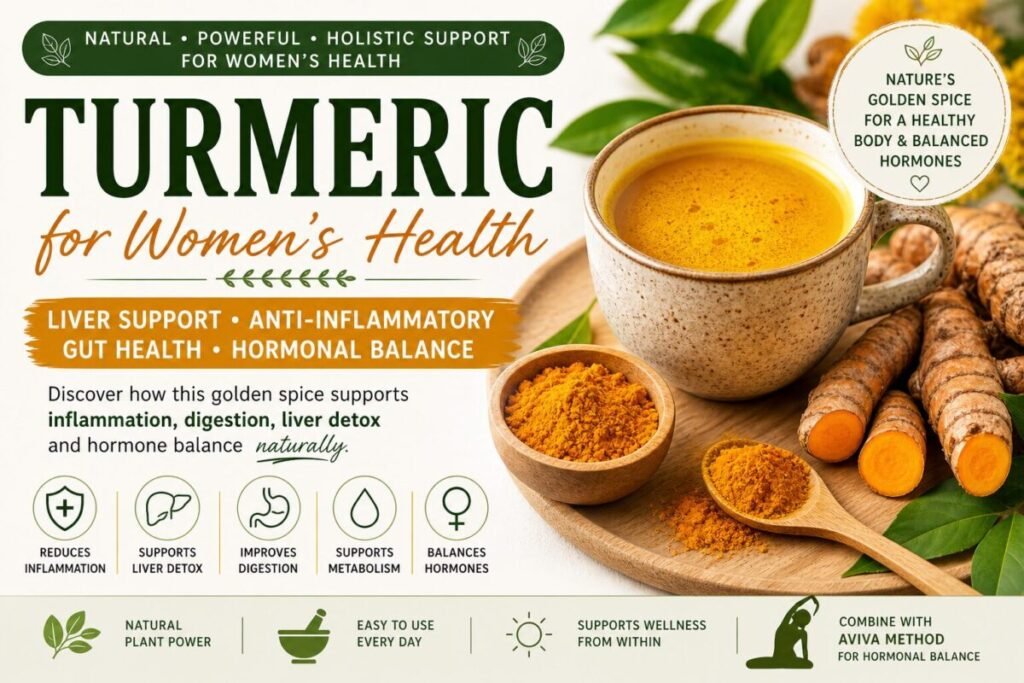
One powerful natural support that works across all these systems is Curcuma longa (turmeric / kurkuma).
What Is Turmeric?
Turmeric is a bright yellow spice made from the rhizome (root) of the plant.
 It is both:
- a culinary spice
- a medicinal herb
It has been used for centuries in traditional medicine systems for inflammation, digestion, and liver support.
 Key Active Compounds
 Key Active Compounds
The primary active compounds are:
- Curcumin (main bioactive compound)
- Demethoxycurcumin
- Bisdemethoxycurcumin
Together known as curcuminoids
Additional components:
- essential oils (turmerone)
- polysaccharides
- antioxidants
(Aggarwal & Harikumar, 2009; Prasad et al., 2014)
How Does Turmeric Work in the Body?
Turmeric acts through multiple biological pathways, making it a multi-target compound.
1. Anti-Inflammatory Mechanism
 1. Anti-Inflammatory Mechanism
Curcumin inhibits key inflammatory pathways:
- NF-κB (central inflammation regulator)
- COX-2 and LOX enzymes
Result:
- reduced systemic inflammation
- improved inflammatory-related symptoms
(Aggarwal & Harikumar, 2009; Jurenka, 2009)
2. Supports Liver Function and Detox Pathways
 2. Supports Liver Function and Detox Pathways
Curcumin has shown hepatoprotective effects:
- enhances bile secretion
- supports phase I and II detoxification enzymes
- protects liver cells from oxidative damage
(Navarro et al., 2017; Farzaei et al., 2018)
3. Antioxidant Activity
 3. Antioxidant Activity
Curcumin:
- neutralizes free radicals
- increases antioxidant enzymes (e.g. glutathione)
This helps:
- protect cells
- reduce oxidative stress
(Hewlings & Kalman, 2017)
4. Improves Insulin Sensitivity and Metabolism
 4. Improves Insulin Sensitivity and Metabolism
Curcumin has been shown to:
- improve insulin sensitivity
- reduce blood glucose levels
- influence adipokines and metabolic signaling
Particularly relevant for:
- PCOS
- metabolic-related hormonal imbalance
(Panahi et al., 2017; Chuengsamarn et al., 2012)
5. Supports Hormonal Balance (Indirectly)
 5. Supports Hormonal Balance (Indirectly)
By acting on:
- inflammation
- metabolism
- liver detox pathways
Curcumin helps create conditions for:
- improved hormone regulation
- better estrogen metabolism
(Farzaei et al., 2018)
6. Gut and Microbiome Interaction
 6. Gut and Microbiome Interaction
Curcumin interacts with the gut by:
- modulating microbiota composition
- reducing intestinal inflammation
- improving gut barrier function
This is important because:
gut health is closely linked to hormone metabolism
(Peterson et al., 2018)
How to Use Turmeric
 How to Use Turmeric
As a Spice
- add to meals daily
- combine with fat for better absorption
As Tea
- ½ teaspoon turmeric powder
- hot water
- add black pepper
Bioavailability Matters
 Bioavailability Matters
Curcumin has low natural absorption.
To improve absorption:
- combine with piperine (black pepper)
- consume with fat
(Hewlings & Kalman, 2017)
How Much Can You Consume?
 How Much Can You Consume?
- Food use → daily safe
- Tea → 1–2 cups/day
- Powder → ~½–1 teaspoon/day
 Food use → daily safe
Clinical studies often use:
- 500–1500 mg curcumin/day (supplement form)
How Long Can You Use It?
 How Long Can You Use It?
- Safe long-term in culinary doses
- Therapeutic use → cycles of several weeks.
Safety and Interactions
Generally safe, but caution:
Avoid or consult if:
- gallstones or bile obstruction
- bleeding disorders
Interactions:
- anticoagulants
- antidiabetic drugs
- liver-metabolized medications
(Navarro et al., 2017)
Can You Grow Turmeric at Home?
 Can You Grow Turmeric at Home?
Turmeric is:
- widely cultivated in tropical regions
- relatively sustainable when grown traditionally
Choosing organic sources supports:
- soil health
- reduced chemical exposure
Turmeric can be also grown in pots.
Growing Requirements
- warm environment
- indirect sunlight
- moist, well-drained soil
Care
- regular watering (not waterlogged)
- harvest after 8–10 months.
A Holistic Approach to Hormonal Balance
Turmeric supports:
- inflammation
- liver function
- metabolism
But hormonal balance also depends on physical processes.
The Aviva Method supports:
- pelvic circulation
- hormonal gland stimulation
- nervous system balance
Why This Combination Works
- Turmeric → biochemical support
- Movement → circulation + signaling
Together:
they support hormonal balance from multiple directions.
Final Thoughts
Turmeric is more than a spice.
It is a scientifically supported, multi-target compound that helps:
- reduce inflammation
- support liver detox pathways
- improve metabolic balance
And through this, it may support hormonal health.
Not by forcing change—but by helping your body function more efficiently.
References (APA Style)
 References (APA Style)
Aggarwal, B. B., & Harikumar, K. B. (2009).
Potential therapeutic effects of curcumin. International Journal of Biochemistry & Cell Biology, 41(1), 40–59.
Chuengsamarn, S., et al. (2012).
Curcumin extract for prevention of type 2 diabetes. Diabetes Care, 35(11), 2121–2127.
Farzaei, M. H., et al. (2018).
Curcumin in liver diseases. Phytotherapy Research, 32(5), 855–870.
Hewlings, S. J., & Kalman, D. S. (2017).
Curcumin: A review of its effects on human health. Foods, 6(10), 92.
Jurenka, J. S. (2009).
Anti-inflammatory properties of curcumin. Alternative Medicine Review, 14(2), 141–153.
Navarro, V. J., et al. (2017).
Liver injury from herbal and dietary supplements. Hepatology, 65(1), 363–373.
Panahi, Y., et al. (2017).
Curcuminoids modify lipid profile and glycemic status. Complementary Therapies in Medicine, 33, 1–5.
Peterson, C. T., et al. (2018).
Turmeric and gut microbiota. Journal of Evidence-Based Integrative Medicine, 23.
Prasad, S., Gupta, S. C., Tyagi, A. K., & Aggarwal, B. B. (2014).
Curcumin, a component of turmeric. Biotechnology Advances, 32(6), 1053–1064