Sleep and Your Menstrual Cycle: How Sleep Regulates Your Hormones, Ovulation, and Fertility
SEO Keywords: sleep and menstrual cycle, poor sleep and periods, sleep hormones, hormonal balance and sleep, sleep and fertility, insomnia and hormones
Have You Ever Wondered Why Your Period Changes After a Few Bad Nights of Sleep?
Maybe your period arrived late after a stressful week.
Perhaps your PMS felt worse than usual after several nights of poor sleep.
Or maybe you’ve noticed that whenever you’re exhausted, your entire cycle seems “off.”
If so, you’re not imagining it.
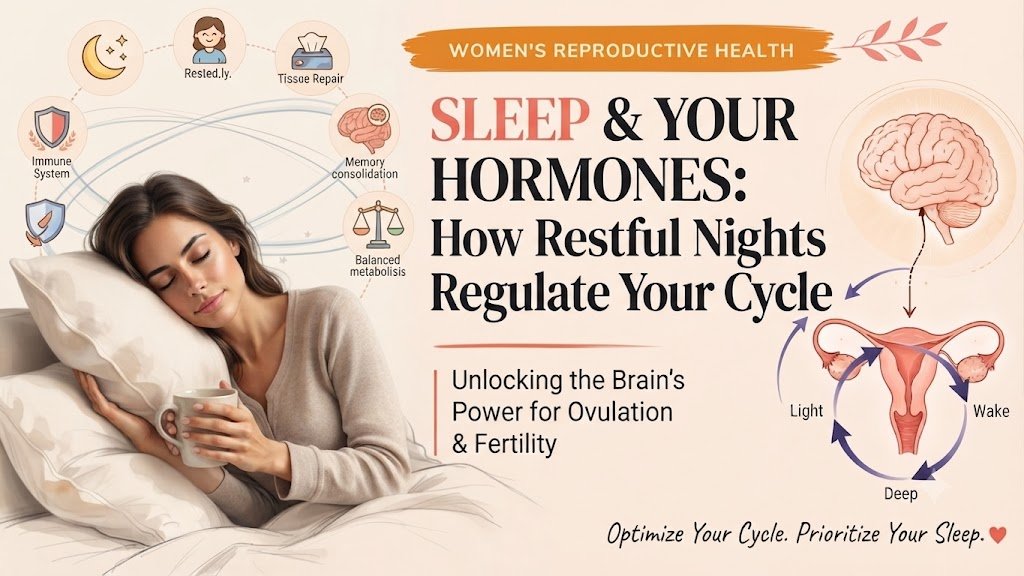
Many people think of sleep as simply a time when the body “switches off.” In reality, the opposite is true. While you sleep, your brain and hormones are incredibly active. During those hours of rest, your body repairs tissues, regulates metabolism, strengthens the immune system, consolidates memories, and carefully coordinates the hormones that control your menstrual cycle.
Sleep is not simply about feeling rested the next day—it is one of the body’s most important hormonal regulators.
When sleep is consistently shortened or disrupted, the effects extend far beyond fatigue. Your body may produce more cortisol, become less sensitive to insulin, struggle to regulate reproductive hormones, and even delay or suppress ovulation. Over time, these changes can contribute to irregular cycles, worsening PMS, reduced fertility, and a greater risk of hormonal imbalance.
The encouraging news is that sleep is also one of the most powerful lifestyle factors you can improve. Even small changes in sleep habits can support healthier hormone function and help your body work the way it was designed to.
In this article, we’ll explore:
-
Why sleep is much more than rest
-
How your brain controls sleep
-
What happens during each stage of sleep
-
Why sleep is essential for hormone production
-
How poor sleep affects estrogen, progesterone, cortisol, insulin, LH, and FSH
-
Why sleep influences ovulation, PMS, and fertility
-
Practical ways to improve your sleep naturally
Let’s begin by understanding what actually happens when you fall asleep.
Sleep Is an Active Biological Process
Although your body appears still while you’re asleep, your brain is remarkably busy.
Sleep is a carefully orchestrated biological process controlled by specialized areas of the brain that continuously communicate with each other. Rather than simply turning consciousness on and off, these brain regions coordinate when you sleep, how deeply you sleep, when you dream, and when you wake.
At the center of this system is the hypothalamus, a small but incredibly important region located deep within the brain. Despite its size, the hypothalamus acts as one of the body’s master regulators, controlling body temperature, appetite, stress responses, hormone production, and the sleep–wake cycle.
Inside the hypothalamus lies a tiny group of nerve cells called the suprachiasmatic nucleus (SCN). Often referred to as the body’s master biological clock, the SCN keeps your internal timing synchronized with the 24-hour day.
Specialized cells in your eyes detect environmental light—even when you’re not consciously paying attention to it—and send this information directly to the SCN. As daylight changes throughout the day, the SCN adjusts countless biological processes, helping your body know when to stay alert and when it’s time to prepare for sleep.
This is why exposure to bright morning sunlight helps you wake up, while darkness in the evening naturally prepares your body for rest.
Your Brain Carefully Balances Wakefulness and Sleep
Falling asleep isn’t simply the absence of wakefulness.
Instead, sleep occurs because two powerful systems constantly compete with one another.
One system keeps you awake and alert.
The other encourages sleep and recovery.
During the day, areas within the brainstem continuously release stimulating neurotransmitters such as:
-
Noradrenaline
-
Histamine
-
Serotonin
-
Acetylcholine
These chemicals help you stay alert, focused, and responsive to your surroundings.
Meanwhile, another region of the hypothalamus—the ventrolateral preoptic area (VLPO)—acts as the brain’s sleep switch.
As the day progresses, a substance called adenosine gradually accumulates in your brain. Adenosine is produced as a natural by-product of cellular energy use. The longer you’ve been awake, the more adenosine builds up, creating increasing “sleep pressure.”
Eventually, adenosine activates the VLPO.
The VLPO then releases GABA, the brain’s primary calming neurotransmitter.
GABA suppresses the wake-promoting centers of the brain, allowing sleep to begin.
This is one reason caffeine can make it difficult to fall asleep. Rather than providing energy, caffeine blocks adenosine receptors, temporarily preventing your brain from recognizing how sleepy it actually is.
Sleep Happens in Cycles
Many people imagine sleep as one long continuous state.
In reality, your brain moves through several different stages approximately every 90 minutes throughout the night.
Each stage performs unique functions that are essential for physical, emotional, and hormonal health.
Stage 1: Light Sleep
This is the transition between wakefulness and sleep.
Heart rate slows.
Breathing becomes more regular.
Muscles begin to relax.
Brain activity starts to change.
This stage usually lasts only a few minutes.
Stage 2: Stable Sleep
Stage 2 occupies about half of a typical night’s sleep.
During this stage:
-
Heart rate slows further.
-
Body temperature decreases.
-
Muscles relax even more.
-
Brain activity becomes synchronized.
Although you’re asleep, your brain continues filtering sensory information, allowing important sounds—such as a baby’s cry—to wake you if necessary.
Stage 3: Deep Sleep
Deep sleep is often considered the body’s primary recovery stage.
During deep sleep:
-
Growth hormone is released.
-
Tissue repair accelerates.
-
Muscles recover.
-
Immune function strengthens.
-
Cellular repair increases.
-
Energy stores are replenished.
Deep sleep is also when many reproductive and metabolic hormones are carefully regulated.
Missing this stage night after night can gradually affect hormone balance throughout the body.
REM Sleep
REM stands for Rapid Eye Movement.
Although your body remains mostly still, your brain becomes highly active.
This is when:
-
Most vivid dreaming occurs.
-
Emotional memories are processed.
-
Learning is strengthened.
-
Creativity improves.
-
Emotional regulation develops.
REM sleep also appears to help the brain organize experiences, solve problems, and regulate emotional responses.
Both deep sleep and REM sleep are essential.
They perform different but complementary jobs, and both are necessary for healthy hormonal function.
Why Sleep Is Essential for Hormonal Health
Many hormones follow predictable daily rhythms.
Some rise during sleep.
Others fall.
Some are released in pulses only during specific sleep stages.
Without adequate sleep, these rhythms begin to lose their normal timing.
Think of your hormones as musicians performing in an orchestra.
Each hormone has its own moment to play.
Sleep acts as the conductor.
When sleep is disrupted, the orchestra falls out of rhythm.
The result isn’t simply one hormone changing—multiple hormonal systems begin influencing one another.
This is why poor sleep can affect:
-
Stress hormones
-
Blood sugar regulation
-
Appetite
-
Body weight
-
Mood
-
Immune function
-
Reproductive hormones
-
Ovulation
-
Menstrual cycles
-
Fertility
In the next section, we’ll explore exactly how sleep influences each of these hormones and why even chronic mild sleep deprivation can gradually disrupt your menstrual cycle.
Coming next in Part 2:
How Poor Sleep Changes Estrogen, Progesterone, Cortisol, Insulin, LH, FSH, Ovulation, PMS, and Fertility.