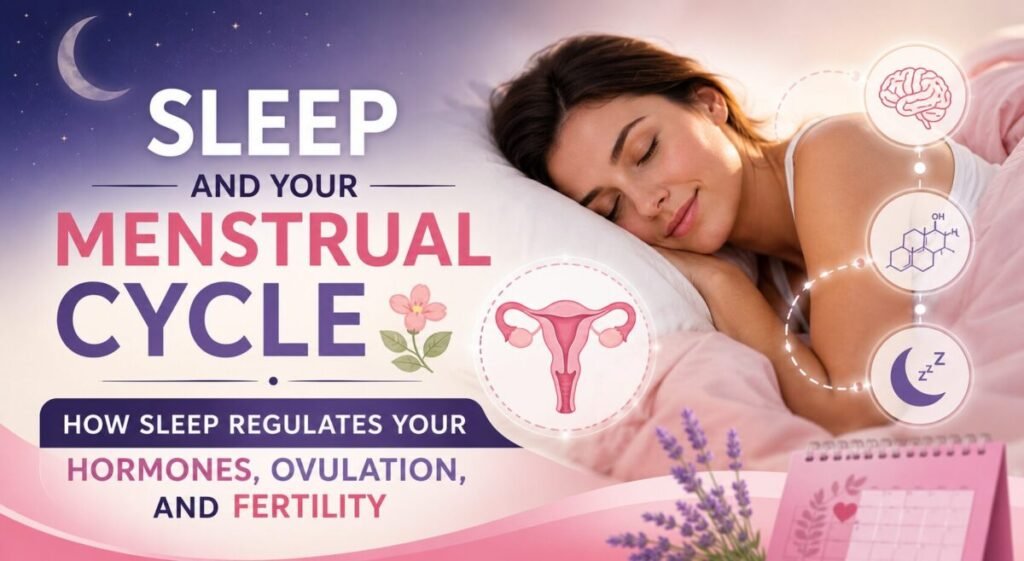
Sleep and Your Menstrual Cycle: How Sleep Regulates Your Hormones
In Part 1, we explored how your brain controls sleep and why sleep is an active biological process rather than simply “switching off” for the night.
Now let’s look at what many women don’t realize:
Sleep is one of the body’s most important hormone regulators.
Every night, your brain carefully coordinates dozens of hormones that influence your menstrual cycle, metabolism, mood, fertility, immune system, and overall health.
When sleep is regularly shortened, fragmented, or poor in quality, these finely tuned hormonal rhythms begin to lose their balance.
Fortunately, your body is remarkably adaptable. Improving sleep often helps restore healthier hormonal patterns over time.
Let’s explore the hormones most affected by sleep.
Cortisol: Your Stress Hormone Needs Sleep
Cortisol is often called the stress hormone, but it has many important jobs beyond responding to stress.
It helps regulate:
-
blood sugar
-
blood pressure
-
metabolism
-
immune function
-
inflammation
-
energy production
-
alertness
Under healthy conditions, cortisol follows a strong daily rhythm.
It begins rising several hours before you wake, peaks shortly after waking to help you feel alert, then gradually declines throughout the day before reaching its lowest level during the first part of the night.
This rhythm is essential because cortisol and melatonin work as partners.
When one is high, the other should be low.
When you don’t sleep enough—or your sleep is repeatedly interrupted—this rhythm becomes disrupted.
Instead of falling overnight, cortisol may remain elevated.
Chronically elevated cortisol signals to the brain that your body is under stress.
From an evolutionary perspective, reproduction is not a priority during times of danger.
As a result, the brain may reduce its investment in reproduction by altering the hormones that control ovulation.
This is one reason chronic stress and chronic sleep deprivation often produce similar menstrual symptoms.
Women with persistently elevated cortisol may notice:
-
irregular cycles
-
delayed ovulation
-
worsening PMS
-
heavier emotional symptoms
-
increased fatigue
-
reduced fertility
Even if you don’t feel particularly stressed, poor sleep itself acts as a biological stressor.
Why Cortisol Matters for Your Menstrual Cycle
High cortisol doesn’t directly stop your menstrual cycle.
Instead, it influences the hypothalamic-pituitary-ovarian (HPO) axis, the communication network connecting your brain and ovaries.
When cortisol remains elevated, the hypothalamus may reduce the release of gonadotropin-releasing hormone (GnRH).
GnRH acts as the starting signal for reproductive hormones.
Without normal GnRH signaling, the release of luteinizing hormone (LH) and follicle-stimulating hormone (FSH) may become less coordinated.
This can interfere with follicle development and ovulation.
Melatonin: More Than the “Sleep Hormone”
Melatonin is commonly called the sleep hormone, but its role extends far beyond making you feel sleepy.
Produced by the pineal gland in response to darkness, melatonin helps synchronize your internal biological clock with the day-night cycle.
As evening approaches and light levels decrease, melatonin production rises.
This signals to your brain and body that it’s time to prepare for sleep.
Melatonin also:
-
supports antioxidant defenses
-
helps regulate immune function
-
influences body temperature
-
communicates timing information to reproductive tissues
Interestingly, melatonin receptors are found in the ovaries, suggesting that melatonin may contribute to healthy follicle development and egg quality.
Exposure to bright artificial light late in the evening—especially the blue light emitted by phones, tablets, and computers—can suppress melatonin production.
Even relatively short periods of evening light exposure may delay melatonin release, making it more difficult to fall asleep and shifting your internal clock later.
Over time, this can contribute to circadian disruption and indirectly influence reproductive hormone rhythms.
Insulin: Sleep Also Influences Blood Sugar
Many people associate insulin only with diabetes.
In reality, insulin is also an important reproductive hormone.
Insulin helps move glucose from your bloodstream into your cells, providing energy for every organ in your body.
Research shows that even a few nights of restricted sleep can temporarily reduce insulin sensitivity.
This means your body must produce more insulin to keep blood sugar under control.
Persistently elevated insulin can contribute to:
-
increased inflammation
-
weight gain
-
increased androgen production
-
disrupted ovulation
This relationship is especially important for women with polycystic ovary syndrome (PCOS), where insulin resistance often plays a central role.
Poor sleep can worsen insulin resistance, while better sleep may support healthier glucose regulation alongside other lifestyle changes.
Estrogen Depends on Healthy Sleep
Estrogen is one of the primary hormones controlling the menstrual cycle.
It supports:
-
follicle development
-
growth of the uterine lining
-
bone health
-
cardiovascular health
-
brain function
-
skin health
Although sleep doesn’t directly “produce” estrogen, healthy sleep supports the brain signals that regulate ovarian hormone production.
When sleep becomes chronically poor, the communication between the brain and ovaries may become less efficient.
Rather than dramatically lowering estrogen overnight, poor sleep tends to increase hormonal variability and make normal monthly hormone patterns less predictable.
Some women notice:
-
longer cycles
-
irregular ovulation
-
more variable bleeding
-
increased breast tenderness
-
greater PMS symptoms
Progesterone Needs Ovulation
Progesterone is often called the calming hormone.
After ovulation, the corpus luteum produces progesterone, preparing the uterus for a possible pregnancy.
Progesterone also has natural calming effects on the nervous system because one of its metabolites enhances the activity of GABA—the brain’s primary inhibitory neurotransmitter.
This helps many women feel more relaxed during a healthy luteal phase.
However, if poor sleep contributes to delayed or absent ovulation, progesterone production may also decrease.
Lower progesterone can contribute to:
-
anxiety
-
sleep difficulties
-
PMS
-
spotting
-
shorter luteal phases
-
reduced fertility
Interestingly, this creates a cycle.
Poor sleep may contribute to lower progesterone.
Lower progesterone may then make sleep even more difficult.
LH and FSH: The Hormones That Trigger Ovulation
The menstrual cycle depends on two key hormones released by the pituitary gland.
Follicle-stimulating hormone (FSH) encourages follicles within the ovaries to mature.
Luteinizing hormone (LH) triggers ovulation once a dominant follicle has fully developed.
These hormones are released in carefully timed pulses controlled by the hypothalamus.
Sleep disturbances, chronic stress, shift work, and circadian disruption can interfere with this signaling.
If LH does not surge appropriately, ovulation may be delayed—or may not occur during that cycle.
Without ovulation, progesterone cannot rise normally, often leading to irregular or anovulatory cycles.
Growth Hormone: Overnight Repair
One of the largest releases of growth hormone occurs during deep sleep.
Although growth hormone is best known for supporting childhood growth, it remains important throughout adult life.
It helps:
-
repair tissues
-
maintain muscle
-
regulate metabolism
-
support bone health
-
assist cellular recovery
Poor sleep reduces time spent in deep sleep, limiting this nightly repair process.
Over months or years, insufficient recovery may contribute to chronic fatigue, slower healing, metabolic changes, and reduced resilience to stress.
Sleep Also Helps Control Inflammation
Sleep and the immune system constantly communicate with one another.
During healthy sleep, inflammatory activity is carefully regulated.
When sleep becomes restricted, the body often produces higher levels of inflammatory molecules called cytokines.
Chronic low-grade inflammation has been associated with many conditions that affect women’s reproductive health, including:
-
endometriosis
-
PCOS
-
obesity
-
insulin resistance
-
cardiovascular disease
Although inflammation has many causes, consistently poor sleep is one factor that may increase inflammatory activity over time.
One Bad Night Isn’t the Same as Chronic Sleep Loss
Fortunately, your body is resilient.
A single night of poor sleep will not usually disrupt your menstrual cycle.
Most healthy people recover quickly after one or two restless nights.
The greater concern is chronic sleep deprivation.
Sleeping too little night after night—or repeatedly waking throughout the night—can gradually alter hormone rhythms, stress responses, metabolism, and reproductive function.
These changes develop over weeks, months, or even years rather than overnight.
The encouraging news is that many of these hormonal changes can also improve when sleep becomes more consistent.
The Big Picture
Sleep doesn’t regulate just one hormone.
It coordinates an entire hormonal network.
When sleep is healthy:
✔ Cortisol follows a balanced daily rhythm.
✔ Melatonin rises naturally in darkness.
✔ Insulin works more efficiently.
✔ The brain communicates effectively with the ovaries.
✔ LH and FSH are released in appropriate patterns.
✔ Ovulation is more likely to occur normally.
✔ Progesterone can rise after ovulation.
✔ Inflammation remains better controlled.
Each of these systems supports the others, creating the conditions for a healthier menstrual cycle.
In Part 3, we’ll see what these hormonal changes actually look like in everyday life. We’ll explore how poor sleep can contribute to irregular periods, painful menstruation, PMS, fertility challenges, PCOS, endometriosis, and perimenopause—and, more importantly, why improving sleep can often support healthier cycles over time.