Understanding Your Cervix Throughout the Menstrual Cycle
Have you ever heard someone talk about checking their cervix and wondered what exactly they meant?
Many women are familiar with periods, ovulation, and cervical mucus, yet the cervix itself often remains a mystery.
Despite its small size, the cervix plays an important role throughout a woman’s life. It helps regulate fertility, protects the uterus from infection, remains firmly closed during pregnancy, and eventually opens during childbirth.
Learning about the cervix can help you better understand your menstrual cycle and appreciate the remarkable changes your body naturally goes through each month.
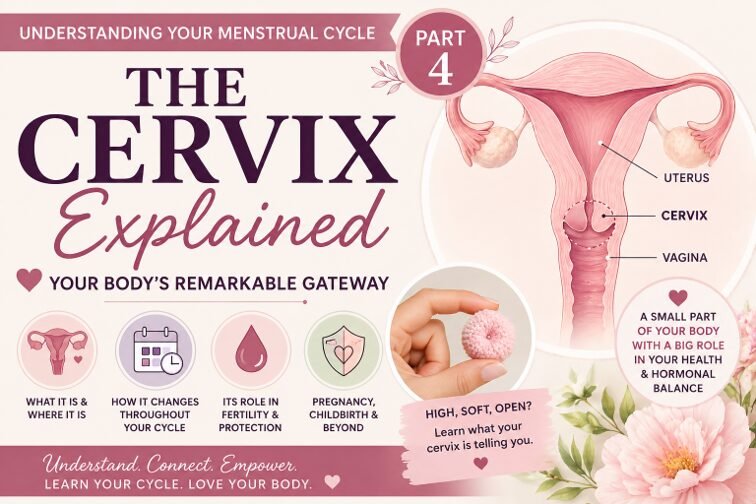
What Is the Cervix?
The cervix is the lower, narrow portion of the uterus that connects the uterus to the vagina.
You can think of it as a doorway between the vagina and the uterus.
In women of reproductive age, the cervix is typically about 3–4 cm (1–1.5 inches) long and 2–3 cm (about 1 inch) wide.
Although small, it performs several important functions:
-
Produces cervical mucus
-
Regulates sperm entry into the uterus
-
Helps protect the uterus from infection
-
Supports pregnancy
-
Opens during childbirth
The cervix is not a fixed structure. It responds continuously to changing hormone levels throughout the menstrual cycle.
Where Is the Cervix Located?
The cervix sits at the very top of the vaginal canal.
If you were to insert a clean finger into the vagina and reach upward, you may be able to feel it.
Many women describe the cervix as feeling somewhat like:
-
The tip of a nose
-
Firm lips
-
A small round button
In the center is a tiny opening called the cervical os.
This opening allows:
-
Menstrual blood to leave the uterus
-
Sperm to enter the uterus
-
Cervical mucus to pass through the cervix
The size and openness of this opening change throughout the cycle.
The Cervix Has Two Main Parts
The cervix consists of two sections:
The Endocervix
The endocervix is the inner portion that connects directly with the uterine cavity.
This area contains specialized glands responsible for producing cervical mucus.
These glands respond to estrogen and progesterone throughout the cycle.
The Ectocervix
The ectocervix is the outer portion that extends into the vagina.
This is the part that healthcare providers can see during a pelvic examination.
Together, these structures create an important barrier between the uterus and the vaginal environment.
The Cervix and Your Menstrual Cycle
Have you known that the cervix changes throughout the cycle?
Hormones influence:
-
Its position
-
Its firmness
-
How open or closed it feels
-
The amount of cervical mucus produced
These changes help support the body’s reproductive goals at different stages of the cycle.
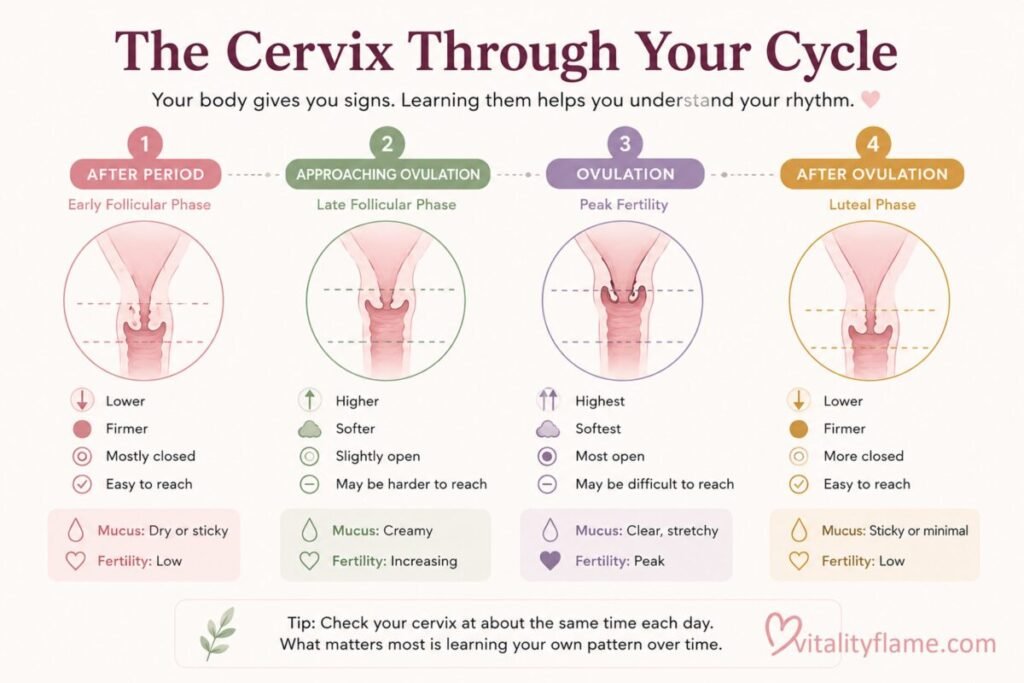
How the Cervix Changes During the Cycle
During Menstruation
During your period, the cervix is usually:
-
Relatively low
-
Firm
-
Slightly open
The small opening allows menstrual blood to leave the uterus.
Many women find the cervix easier to reach during this phase.
After Menstruation
Following menstruation, the cervix often becomes:
-
Lower
-
Firmer
-
More closed
This reflects the body’s transition into the early follicular phase.
Approaching Ovulation
As estrogen levels rise, the cervix begins to change.
It typically becomes:
-
Higher in the vagina
-
Softer
-
More open
Many women describe it as feeling more difficult to reach because it sits higher in the vaginal canal.
These changes help facilitate the movement of sperm toward the uterus.
After Ovulation
Once ovulation occurs and progesterone rises, the cervix usually becomes:
-
Lower
-
Firmer
-
More closed
The body shifts from supporting fertilization to protecting the uterus.
What Does “High, Soft, Open” Mean?
You may have heard people describe a fertile cervix as:
High, Soft, Open
This simply refers to the changes many women notice around ovulation.
High
The cervix moves upward in the vaginal canal and may be more difficult to reach.
Soft
Instead of feeling firm like the tip of a nose, it may feel softer, more like relaxed lips.
Open
The cervical opening becomes slightly more open than at other times in the cycle.
These changes occur under the influence of estrogen and are considered normal signs of approaching ovulation.
The Cervix and Cervical Mucus
The cervix produces cervical mucus.
This mucus changes dramatically throughout the cycle.
As ovulation approaches, mucus becomes:
-
More abundant
-
More watery
-
More slippery
-
More stretchy
After ovulation, mucus becomes:
-
Thicker
-
Stickier
-
Less abundant
These changes help either support or discourage sperm movement depending on the phase of the cycle.
The Cervix as a Protective Barrier
The cervix does much more than assist fertility.
It also helps protect the uterus.
Throughout much of the cycle, cervical mucus acts as a barrier that helps limit the movement of microorganisms from the vagina into the uterus.
After ovulation, progesterone promotes the production of thicker mucus, further strengthening this protective function.
In this way, the cervix serves as both a gateway and a guard.
The Cervix During Pregnancy
One of the cervix’s most important roles occurs during pregnancy.
Throughout pregnancy, the cervix remains:
-
Closed
-
Firm
-
Strong
This helps keep the developing baby safely inside the uterus.
As childbirth approaches, the cervix gradually begins to:
-
Soften
-
Shorten
-
Open
This process is known as cervical dilation.
During labor, the cervix opens to approximately 10 cm (4 inches), allowing the baby to pass through the birth canal.
Can You Check Your Own Cervix?
Some women choose to observe cervical position as part of fertility awareness.
If you decide to do so:
-
Wash your hands thoroughly
-
Use the same body position each time
-
Check at roughly the same time of day
-
Be patient while learning what feels normal for you
The goal is not to diagnose anything.
The goal is simply to become familiar with your body’s natural patterns.
Not every woman chooses to track cervical position, and that’s perfectly okay.
Cervical mucus and other cycle signs can also provide valuable information.
What If My Cervix Doesn’t Match the Textbook?
One of the most important things to remember is that every woman is unique.
The exact position, shape, and feel of the cervix can vary from person to person.
Previous pregnancies, childbirth, age, and natural anatomical differences all influence what feels normal.
Rather than comparing yourself to a chart, focus on learning your own patterns over several cycles.
Why Understanding the Cervix Matters
The cervix is often overlooked, yet it plays a central role in:
-
Menstruation
-
Fertility
-
Cervical mucus production
-
Pregnancy
-
Childbirth
-
Reproductive health
Understanding how it changes throughout the cycle can help you feel more connected to your body and better equipped to recognize your own unique patterns.
The more you learn about your cycle, the more you may discover that your body is constantly providing useful information about its changing rhythms.
Cycle Tracking: Turning Observations Into Insights
One of the most effective ways to learn about your cycle is to track it.
It helps reveal patterns that are difficult to notice day by day.
Keeping a cycle journal or menstrual calendar for several months can help you identify your own unique pattern.
Over time, you may notice when you typically ovulate, how long your luteal phase lasts, when certain symptoms tend to appear, and how lifestyle factors such as stress, sleep, exercise, illness, diet, or travel influence your cycle, emotions, and symptoms.
Cycle tracking can also help you recognize changes that may be worth discussing with a healthcare professional.
You can find free printable sheets here.
Key Takeaways
✓ The cervix is the lower portion of the uterus that connects to the vagina.
✓ It produces cervical mucus and helps regulate sperm entry into the uterus.
✓ The cervix changes position, firmness, and openness throughout the menstrual cycle.
✓ Around ovulation, it typically becomes higher, softer, and more open.
✓ After ovulation, it usually becomes lower, firmer, and more closed.
✓ The cervix protects the uterus, supports pregnancy, and plays an essential role during childbirth.
Important Note
This article is intended for educational purposes only and should not be used to diagnose or treat any medical condition. If you experience unusual bleeding, pelvic pain, abnormal discharge, or concerns about your reproductive health, consult a qualified healthcare professional.