When people think of healthy teas, green tea and matcha often come to mind first.
Yet one of the most fascinating teas in the world may be Pu-erh tea.
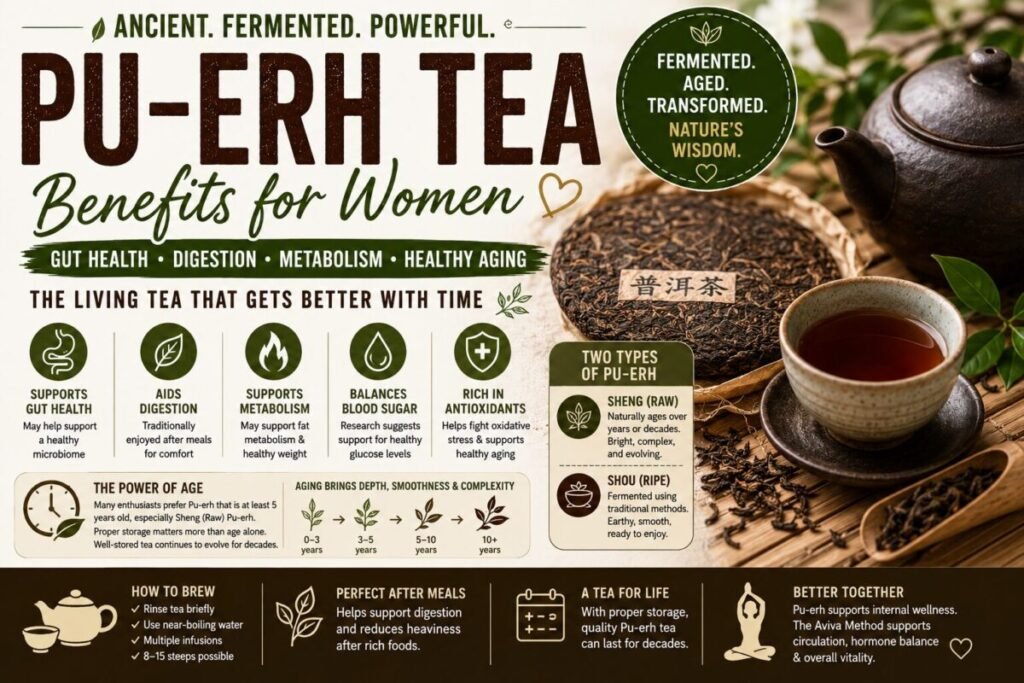
Unlike most teas, Pu-erh is intentionally fermented and aged. Some Pu-erh teas continue to develop for decades, creating complex flavors and unique bioactive compounds that cannot be found in fresh tea.
Modern research suggests Pu-erh tea may support:
-
digestive health
-
gut microbiome balance
-
cholesterol metabolism
-
blood sugar regulation
-
healthy aging
-
inflammation management
For women, these benefits may indirectly support overall wellness, metabolic health, and hormone processing through improved gut and liver function.
What Is Pu-erh Tea?
Pu-erh tea is made from the leaves of Camellia sinensis, the same plant used to produce:
-
green tea
-
white tea
-
oolong tea
-
black tea
The difference lies in the processing.
Unlike green tea, which is consumed relatively fresh, Pu-erh undergoes microbial fermentation and aging that transform both its flavor and chemical composition over time (Zhang et al., 2013).
Pu-erh originated in Yunnan Province, China, where tea has been cultivated for centuries.
Traditionally, compressed tea cakes were transported along ancient trade routes. During transportation and storage, the tea naturally aged and developed new flavors, eventually becoming highly valued.
The Two Main Types of Pu-erh
Understanding Pu-erh begins with understanding its two major categories.
Sheng Pu-erh (Raw Pu-erh)
Sheng means “raw.”
This is the traditional form of Pu-erh.
Freshly produced Sheng tea is often:
-
bright
-
grassy
-
floral
-
bitter
-
astringent
As the tea ages, microbial activity slowly transforms the leaves.
After several years, flavors often become:
-
smoother
-
sweeter
-
more complex
-
woody
-
honey-like
Aging can continue for decades.
Shou Pu-erh (Ripe Pu-erh)
Shou means “ripe.”
Developed during the 1970s, this method accelerates the aging process.
The leaves undergo a controlled fermentation process known as Wo Dui.
This creates:
-
dark liquor
-
earthy flavors
-
smoother taste
-
lower bitterness
within months rather than decades (Cui et al., 2020).
How Is Pu-erh Tea Made?
The production process is one of the reasons Pu-erh is unique among teas.
Step 1: Harvesting
Tea leaves are harvested from Camellia sinensis plants.
Premium Pu-erh is often produced from:
-
older tea trees
-
mountain-grown trees
-
ancient tea gardens
Older trees are believed to contribute greater complexity and depth of flavor.
Step 2: Withering
Fresh leaves are spread out to reduce moisture content.
This softens the leaves and prepares them for processing.
Step 3: Sha Qing (Kill Green)
The leaves are heated in large pans.
This step slows enzymatic oxidation and preserves desired compounds.
Unlike black tea, oxidation is not allowed to proceed extensively.
Step 4: Rolling
Leaves are rolled to:
-
break cell walls
-
release juices
-
encourage biochemical transformations
This step influences both flavor and future aging potential.
Step 5: Sun Drying
Unlike many other teas that are machine dried, traditional Pu-erh is sun dried.
The resulting tea is called:
“Maocha”
This is the raw material used for Pu-erh production.
(Lv et al., 2013)
Step 6: Compression
Maocha may be compressed into:
-
tea cakes
-
bricks
-
nests (tuocha)
-
mushrooms
-
loose leaf
Compression helps facilitate long-term aging.
Step 7: Aging or Fermentation
At this point, production differs depending on whether Sheng or Shou Pu-erh is being made.
Sheng Pu-erh
Natural aging begins.
Microorganisms slowly transform the tea over years or decades.
Shou Pu-erh
The tea undergoes Wo Dui fermentation.
Leaves are:
-
piled
-
moistened
-
turned regularly
to encourage microbial activity.
This process dramatically accelerates aging and creates the characteristic earthy flavor of ripe Pu-erh.
(Cui et al., 2020)
Is Older Pu-erh Always Better?
This is one of the most common questions.
The answer is:
Not always.
Many tea enthusiasts recommend buying Sheng Pu-erh that is at least 5 years old because younger teas can be:
-
bitter
-
harsh
-
highly astringent
However, age alone does not determine quality.
Storage conditions are equally important.
A properly stored 7-year-old tea may be superior to a poorly stored 20-year-old tea.
Many collectors consider the following age ranges useful guidelines:
Sheng Pu-erh
-
0–3 years: youthful, bitter, grassy
-
3–5 years: beginning to soften
-
5–10 years: often excellent value
-
10–20+ years: increasing complexity
Shou Pu-erh
Because it is already fermented:
-
2–5 years may be sufficient
-
decades of aging are not essential
Why Does Aging Change the Tea?
Unlike green tea, Pu-erh remains biologically active.
Microorganisms continue transforming:
-
catechins
-
amino acids
-
aromatic compounds
-
polyphenols
over time.
This creates entirely new compounds that contribute to:
-
flavor
-
aroma
-
potential health effects
In some ways, Pu-erh resembles:
-
wine
-
cheese
-
sourdough
-
miso
more than ordinary tea.
Main Active Compounds
Pu-erh contains many bioactive compounds.
Some originate from tea leaves, while others develop during fermentation.
Catechins
Catechins are powerful antioxidants found in tea.
Examples include:
-
EGCG
-
ECG
-
EGC
-
EC
Many catechins transform during aging and fermentation.
(Cabrera et al., 2006)
Theabrownins
These compounds are particularly important in fermented teas.
Research suggests they may contribute to:
-
cholesterol regulation
-
lipid metabolism
-
antioxidant activity
(Hou et al., 2009)
Gallic Acid
Fermentation increases gallic acid concentrations.
Gallic acid has been studied for:
-
antioxidant effects
-
anti-inflammatory activity
-
metabolic support
(Lv et al., 2013)
Theaflavins
Present in smaller amounts than black tea but still contribute to antioxidant activity.
Microbial Metabolites
One unique feature of Pu-erh is the contribution of microorganisms.
During fermentation, microbes produce compounds not found in fresh tea.
These metabolites are thought to contribute to many of Pu-erh’s distinctive properties.
(Cui et al., 2020)
How Does Pu-erh Affect Human Physiology?
Modern research suggests Pu-erh may influence several biological systems.
Gut Health and Hormone Processing
Many people are surprised to learn that the gut plays an important role in hormone metabolism.
Certain gut bacteria produce enzymes that influence how estrogen is processed and eliminated from the body.
Researchers sometimes refer to this collection of bacteria as the “estrobolome” (Baker et al., 2017).
A healthy gut microbiome may support:
- efficient estrogen metabolism
- reduced inflammation
- healthy digestion
Because Pu-erh tea appears to influence microbial diversity, it may indirectly support these processes (Ma et al., 2019).
Inflammation and Women’s Wellness
Chronic low-grade inflammation has been associated with:
- metabolic syndrome
- insulin resistance
- PCOS
- cardiovascular disease
Polyphenols and fermentation-derived compounds in Pu-erh may help modulate inflammatory pathways (Zhao et al., 2019).
This does not mean Pu-erh treats these conditions, but it may contribute to a supportive lifestyle.
Metabolic Support
Metabolic health affects:
- energy levels
- insulin sensitivity
- body composition
- hormone signaling
Several studies suggest Pu-erh may support:
- lipid metabolism
- cholesterol regulation
- blood sugar control
(Hou et al., 2009; Chen et al., 2015)
These benefits may be particularly relevant for women concerned about metabolic health during perimenopause and menopause.
Can Pu-erh Help With Weight Management?
This is one of the most searched questions online.
The honest answer is:
Possibly—but indirectly.
Research suggests Pu-erh may support:
- fat metabolism
- healthy blood sugar regulation
- satiety
- gut microbiome balance
(Hou et al., 2009)
However:
 Pu-erh is not a fat-burning miracle.
 It is best viewed as part of a healthy lifestyle.
How to Brew Pu-erh Tea
One reason tea enthusiasts love Pu-erh is that the leaves can be infused multiple times.
Traditional Gongfu Method
Equipment
- gaiwan or small teapot
- tea pitcher (optional)
- cups
Tea Quantity
5–8 grams tea
Water Temperature
95–100°C
First Rinse
Briefly rinse the leaves with hot water.
Discard the rinse.
This helps awaken the tea and remove surface dust.
Infusions
First Brew
15–30 seconds
Second Brew
20–40 seconds
Later Brews
Gradually increase steeping time.
High-quality Pu-erh often provides:
- 8–15 infusions
- sometimes more
Western Brewing Method
For simplicity:
- 2–3 grams tea
- 250 ml water
- 3–5 minutes
This produces a stronger single infusion.
When Should You Drink Pu-erh?
Best times:
Morning
After breakfast
After lunch
After heavy meals
Many people enjoy Pu-erh after rich or fatty foods because it feels lighter on the stomach than coffee.
When Should You Avoid It?
Avoid:
- late evening
- immediately before bed
because Pu-erh still contains caffeine.
How Much Pu-erh Tea Can You Drink?
For most healthy adults:
- 2–4 cups daily
is generally considered moderate consumption.
Some tea enthusiasts drink considerably more, but moderation is sensible.
Does Pu-erh Affect Nutrient Absorption?
This is important, especially for women.
Iron Absorption
Tea polyphenols can reduce non-heme iron absorption (Hurrell et al., 1999).
This is particularly relevant for women who have:
- heavy menstrual bleeding
- low ferritin
- iron deficiency anemia
Practical Recommendation
Avoid drinking Pu-erh:
with iron-rich meals
Instead:
wait 1–2 hours before or after eating
Zinc and Other Minerals
Large amounts of tea may modestly affect absorption of:
- zinc
- magnesium
- certain trace minerals
The effect is generally less significant than with iron.
Drug Interactions
Consult your physician or pharmacist if you use:
- blood thinners
- stimulant medications
- cardiovascular medications
- medications affected by caffeine
Because Pu-erh contains caffeine and polyphenols, interactions are possible.
Does Pu-erh Need Pairing With Other Foods?
Unlike turmeric, Pu-erh does not require a specific absorption enhancer.
However, some pairings are traditionally appreciated.
Citrus
Adding:
- lemon
- yuzu
- orange peel
may provide additional antioxidants and brighten flavor.
Fermented Foods
Traditional pairings include:
- miso
- fermented vegetables
because of complementary flavor profiles.
Additional Information Worth Knowing
Tea Cakes Last a Long Time
Properly stored Pu-erh tea can remain drinkable for decades.
This is unusual among teas.
Storage Matters More Than Age
Many beginners assume:
“Older is always better.”
This is not necessarily true.
A well-stored 7-year-old tea may be far superior to a poorly stored 20-year-old tea.
When buying aged Pu-erh:
look for:
reputable vendors
proper storage history
absence of mold
Not All Earthy Flavors Mean Quality
Many new drinkers assume:
“darker = better.”
In reality:
High-quality Pu-erh should taste:
- clean
- smooth
- complex
not musty or moldy.
Pu-erh Tea and the Aviva Method
Pu-erh tea supports wellness primarily through:
- digestion
- gut health
- metabolism
- inflammation regulation
The Aviva Method approaches women’s wellness from a different perspective.
The method uses movement to support:
- pelvic circulation
- muscular coordination
- reproductive organ blood flow
These approaches complement each other because they work through different mechanisms.
Pu-erh Tea
Supports internal biochemical processes.
Aviva Method
Supports circulation and physical function.
Together they offer a holistic approach that addresses both internal and physical aspects of women’s well-being.
Final Thoughts
Pu-erh tea is unlike any other tea.
Its unique fermentation and aging process creates compounds that continue to evolve over time.
Research suggests Pu-erh may support:
- digestion
- gut microbiome health
- metabolic wellness
- healthy aging
- cardiovascular health
While it is not a hormone-balancing herb, its effects on digestion, inflammation, and metabolism may indirectly support women’s overall wellness.
For those seeking a rich, complex tea with centuries of history and a growing body of scientific research, Pu-erh is one of the most fascinating teas to explore.
References
Baker, J. M., Al-Nakkash, L., & Herbst-Kralovetz, M. M. (2017). Estrogen-gut microbiome axis. Maturitas, 103, 45–53.
Cabrera, C., Artacho, R., & Giménez, R. (2006). Beneficial effects of green tea—A review. Journal of the American College of Nutrition, 25(2), 79–99.
Chen, H., Qu, Z., Fu, L., Dong, P., & Zhang, X. (2015). Effects of Pu-erh tea on metabolic syndrome parameters. Phytotherapy Research, 29(10), 1533–1538.
Cui, L., Xu, Z., Yang, T., & Yang, X. (2020). Microbial diversity and biochemical transformations during Pu-erh tea fermentation. Food Research International, 136, 109501.
Hou, Y., Shao, W., Xiao, R., Xu, K., Ma, Z., Johnstone, B. H., & Du, Y. (2009). Pu-erh tea aqueous extracts lower atherosclerotic risk factors. Journal of Agricultural and Food Chemistry, 57(15), 6936–6943.
Hurrell, R. F., Reddy, M., & Cook, J. D. (1999). Inhibition of non-heme iron absorption by tea. British Journal of Nutrition, 81(4), 289–295.
Lv, H. P., Zhang, Y. J., Lin, Z., & Liang, Y. R. (2013). Processing and chemical constituents of Pu-erh tea. Food Research International, 53(2), 608–618.
Ma, Y., Gao, M., Liu, D., & Niu, Y. (2019). Pu-erh tea and gut microbiota modulation. Nutrients, 11(9), 2238.
Zhang, L., Ho, C. T., Zhou, J., Santos, J. S., Armstrong, L., & Granato, D. (2013). Chemistry and biological activities of processed teas. Food Research International, 53(2), 600–607.
Zhao, C. N., Tang, G. Y., Cao, S. Y., Xu, X. Y., Gan, R. Y., Liu, Q., Mao, Q. Q., & Li, H. B. (2019). Phenolic profiles and health effects of tea. Molecules, 24(3), 648.