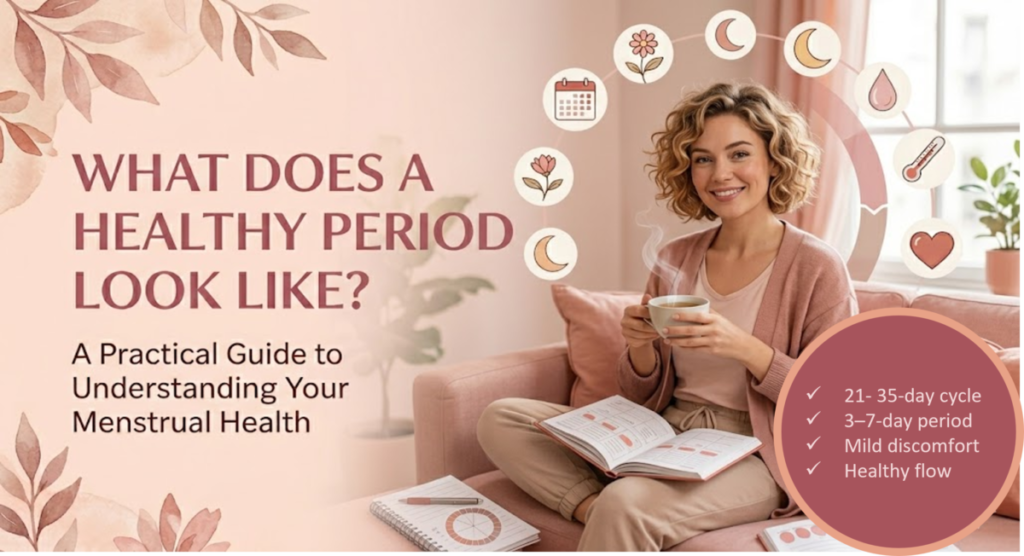
Is Your Period Healthy? A Simple Guide to Menstrual Health
When it comes to menstrual health, many women are surprised by how little information they received growing up.
You may have learned that periods happen once a month and that cramps are part of the experience. But what about everything else?
-
How long should a period last?
-
How much bleeding is normal?
-
What color should menstrual blood be?
-
Are blood clots normal?
-
Should periods hurt?
-
What does a healthy period actually look like?
The truth is that healthy periods can vary from woman to woman. However, there are some common patterns that can help you better understand your body’s signals.
Let’s explore what a healthy period typically looks like and how cycle tracking can help you become more familiar with your own rhythm.
Your Period Is More Than Bleeding
Menstruation is the shedding of the uterine lining that was built up during the previous cycle.
If pregnancy does not occur, hormone levels fall and the body begins a new cycle by releasing this lining.
Although we often think of menstruation as simply “bleeding,” menstrual flow actually contains:
-
Blood
-
Endometrial tissue (uterine lining)
-
Cervical mucus
-
Vaginal secretions
This is why menstrual flow can vary in color, texture, and consistency throughout the period.
How Long Should a Healthy Period Last?
For most women, menstrual bleeding lasts between:
3–7 days
Some women consistently bleed for 3–4 days, while others naturally bleed for 6–7 days.
What matters most is that your pattern is relatively consistent from cycle to cycle.
A period that suddenly becomes much longer or much shorter than usual may be worth paying attention to.
How Much Blood Is Normal During a Period?
Many women assume they lose far more blood than they actually do.
In reality:
-
Average menstrual blood loss is approximately 30 mL
-
Blood loss greater than 80 mL is generally considered excessive
Of course, few women measure their menstrual blood loss directly.
Instead, you may notice clues such as:
Typical Flow Pattern
Many healthy periods follow a pattern like this:
Day 1
Light to moderate bleeding begins.
Day 2–3
The heaviest flow often occurs.
Day 4–5
Flow gradually decreases.
Day 6–7
Light bleeding or spotting may continue before stopping completely.
Every woman is different, but many periods naturally follow this rise-and-fall pattern.
What Color Should Menstrual Blood Be?
Menstrual blood is not always the same color throughout a period.
Changes in color are often completely normal. A healthy period may include several of these colors based on the day of the period
Bright Red
Fresh blood is typically bright red.
This is common during the heavier days of menstruation.
Deep Red
Darker red blood is also common and usually reflects blood that has remained in the uterus or vagina slightly longer before leaving the body. It may occur on the heaviest day of your period.
Brown Blood
Brown blood is often older blood that has taken longer to exit the body.
Many women notice brown blood:
-
At the beginning of a period
-
At the end of a period
Pink Blood
Light pink bleeding or spotting may occasionally occur at the beginning or end of menstruation.
What Should Menstrual Blood Texture Look Like?
Just as menstrual blood can vary in color, it can also vary in texture.
Fluid or Silky
Many women notice a smooth, flowing texture on moderate-flow days.
This is one of the most common healthy patterns.
Slightly Dense
Heavier flow days may appear thicker or more concentrated.
This can be completely normal.
Small Clots
Small blood clots occasionally occur during menstruation.
They are often:
-
Dark red
-
Soft
-
Small in size
Many women notice small clots during heavier bleeding days.
Tissue Fragments
Menstrual flow may occasionally contain small pieces of shed uterine lining.
This can appear:
-
Gel-like
-
Stringy
-
Jelly-like
In small amounts, this is often simply part of the normal shedding process.
Are Blood Clots Normal?
One of the most common questions women ask is:
“Should I be worried about blood clots?”
Small occasional clots can be a normal part of menstruation, particularly during heavier flow days.
However, consistently passing very large clots or experiencing unusually heavy bleeding may warrant discussion with a healthcare professional.
As always, your usual pattern matters.
Cycle tracking can help you recognize whether something has changed.
Should a Healthy Period Hurt?
This is perhaps one of the most misunderstood aspects of menstrual health.
Many women have been told that severe menstrual pain is simply part of being a woman.
Yet there is an important difference between discomfort and debilitating pain.
During a healthy cycle, some women may experience:
-
Mild cramping
-
Pelvic heaviness
-
A feeling of pressure in the lower abdomen
-
Lower energy levels
-
Increased desire to rest
These experiences can be part of menstruation.
However, pain that:
-
Prevents normal daily activities
-
Keeps you home from work or school
-
Causes vomiting or fainting
-
Requires strong pain medication every month
deserves attention and should not simply be accepted as normal.
What About Energy and Mood?
Your period is not only about bleeding.
Hormonal changes can also influence:
-
Energy levels
-
Mood
-
Appetite
-
Sleep
-
Exercise performance
Many women naturally feel:
-
More tired
-
More reflective
-
More in need of rest
during menstruation.
Others notice very few changes.
Both experiences can be completely normal.
A Healthy Period Is More Than One Cycle
One of the biggest misconceptions about menstrual health is that every cycle should look exactly the same.
In reality, healthy cycles often contain small variations.
For example:
-
One cycle may be 26 days long.
-
The next may be 29 days long.
-
Flow may be slightly heavier one month.
-
Cramping may be more noticeable after a stressful month.
The goal is not perfection.
The goal is recognizing your typical pattern.
Supporting a Healthy Period
While every woman’s cycle is unique, many lifestyle factors can influence menstrual health.
Adequate sleep, stress management, regular physical activity, balanced nutrition, and overall well-being all play important roles in supporting the body’s natural hormonal rhythms.
Many women also choose to incorporate movement practices that promote body awareness and regular physical activity.
One such approach is the Aviva Method®, a series of dynamic exercises that focus on coordinated movement and pelvic mobility.
What Does Research Suggest?
Research examining women who practiced the Aviva Method regularly found improvements in menstrual well-being, including reductions in:
-
Menstrual pain
-
Premenstrual symptoms (PMS)
These findings suggest that regular, consistent practice of the Exercise sequence of the Aviva Method may help some women experience greater comfort throughout their cycle.
What Do Practitioners Often Report?
Beyond the published research, many Aviva Method practitioners have shared personal observations about changes they noticed while practicing consistently.
Some women report that their periods became:
-
More regular and predictable
-
Closer to commonly recognized healthy cycle lengths
-
More consistent from month to month
Others describe changes in their menstrual bleeding patterns, such as:
-
Fewer bleeding days
-
Menstrual flow that felt more balanced
-
Previously heavy bleeding becoming less excessive
Women with delayed periods also frequently report that regular practice appeared to help stimulate the onset of menstruation.
Additionally, many practitioners describe improvements in:
-
Menstrual comfort
-
PMS symptoms
-
Mood fluctuations during the cycle
-
Awareness of ovulation signs
Individual results vary, and these experiences should not be considered a guarantee of any specific outcome.
Reducing Stress During Menstruation
Menstruation is often a time when the body asks for a little more rest, nourishment, and self-care.
Many women find that slowing down, prioritizing sleep, gentle movement, relaxation practices, and stress management can help them feel more comfortable during this phase of the cycle.
Because emotional well-being and stress can influence how we experience our cycles, some women also enjoy incorporating relaxation and mindfulness practices into their menstrual self-care routine.
Explore the Menstrual Phase Hypnorelax
To support women through each phase of the menstrual cycle, I created a Cycle Syncing Hypnotic Relaxation Series.
Each audio is designed specifically for a different phase of the cycle and combines:
-
Guided relaxation
-
Breathing exercises
-
Visualization
-
Mindfulness practices
-
Gentle inner reflection
The intention is to create a calm space where you can slow down, reconnect with your body, and cultivate greater awareness of your cycle.
For the menstrual phase, the Hypnorelax session focuses on rest, renewal, and letting go. Many women describe this phase as a natural invitation to pause, reflect, and replenish their energy before a new cycle begins.
If you’re looking for a gentle way to support your mind during your period, consider trying the Menstrual Phase Hypnorelax and notice how it fits into your personal self-care routine.
Just as every cycle is unique, every woman’s experience with relaxation practices is unique. Approach the experience with curiosity and without expectations, allowing yourself the opportunity to simply listen and reconnect with your body’s natural rhythm.
A Personal Journey
One reason cycle tracking can be so valuable is that it allows you to observe these changes for yourself.
Rather than relying on memory alone, recording your cycle can help you notice whether factors such as exercise, stress levels, sleep habits, nutrition, or movement practices appear to influence your symptoms and overall cycle experience.
Every woman responds differently.
What helps one person may not have the same effect for another.
The goal is not to achieve a “perfect” cycle but to better understand your body’s unique patterns and discover the habits that support your well-being.
If you’d like to become more familiar with your cycle, consider using a cycle tracking journal.
The goal isn’t to create a perfect chart.
It’s to become a curious observer of your body’s natural rhythm.
Healthy Period Summary
A healthy period commonly includes:
| Cycle Sign | Common Healthy Pattern |
|---|---|
| Cycle length | 21–35 days |
| Average cycle length | Around 28 days |
| Bleeding duration | 3–7 days |
| Average blood loss | Approximately 30 mL |
| Heavy blood loss | More than 80 mL |
| Blood color | Bright red, deep red, brown, or pink |
| Blood texture | Fluid, silky, slightly dense |
| Clots | Small occasional clots may occur |
| Menstrual pain | Mild to moderate discomfort may occur |
Remember that your cycle is unique.
The most useful comparison is often not someone else’s period, but your own patterns over time.
In Part 3, we’ll explore another fascinating cycle sign: cervical mucus and what it can reveal about ovulation, fertility, and hormonal changes throughout the month.