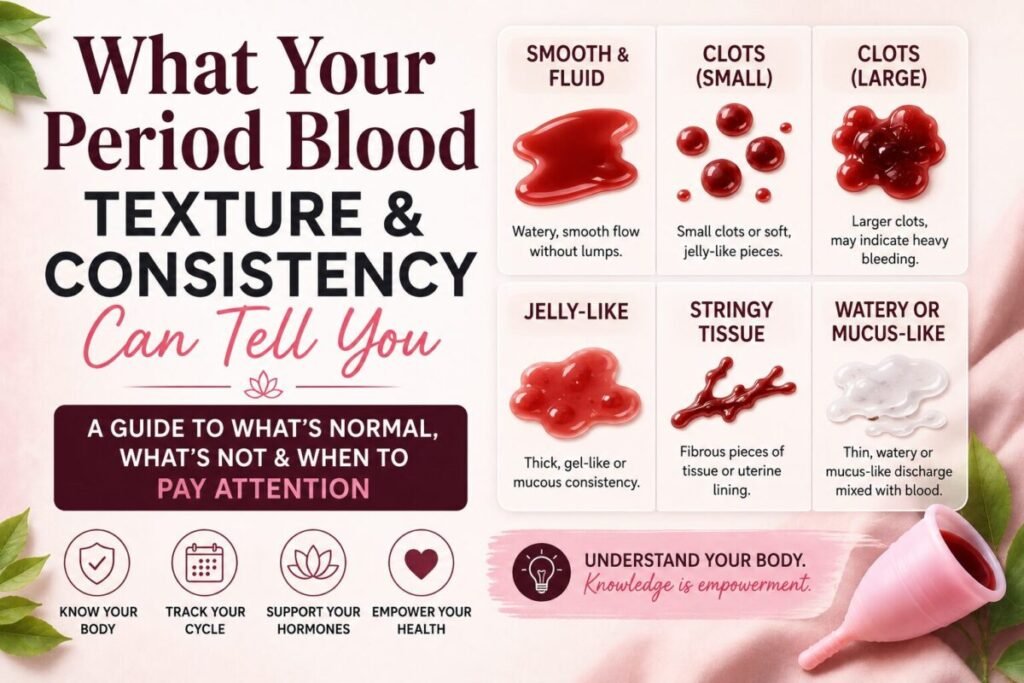
What Does the Consistency of Your Period Blood Mean?
While most women pay attention to the color of their menstrual blood, the texture and consistency of menstrual flow can provide valuable information as well.
Because menstrual fluid contains blood, uterine tissue, cervical mucus, proteins, enzymes, and vaginal secretions, its appearance naturally changes throughout a period.
Some variations are completely normal, while others may be worth monitoring, especially if they represent a significant change from your usual pattern.
Normal Smooth Menstrual Flow
A healthy menstrual flow often appears:
Smooth
Fluid
Easy flowing
Bright red to dark red in color
The consistency is often slightly thicker than water but not excessively thick or clotted.
Many women notice this type of flow during the middle days of menstruation when shedding of the uterine lining is most active.
This generally reflects the normal breakdown and release of endometrial tissue.
Blood Clots: Why Do They Form?
Blood clots are one of the most common sources of concern during menstruation.
Fortunately, small menstrual clots are often completely normal.
What Causes Menstrual Clots?
Under normal circumstances, the body releases natural anticoagulants that help menstrual blood remain fluid as it leaves the uterus.
However, during heavier bleeding, the body may not be able to release anticoagulants quickly enough to keep all of the blood from clotting.
As a result, some blood thickens and forms clots before leaving the body.
These clots often contain:
Blood
Endometrial tissue
Proteins involved in clotting
Menstrual clots are therefore not necessarily “just blood.”
Small Clots
Small clots are often:
Dark red
Soft
Jelly-like
Smaller than a coin
These commonly occur during heavier flow days and are often considered a normal part of menstruation.
Many healthy women occasionally pass small clots.
Large Clots
Larger clots deserve more attention.
Particularly if they are:
Larger than approximately 2.5 cm (1 inch)
Frequent
Accompanied by heavy bleeding
Accompanied by significant pain
Large clots may occur alongside conditions such as:
Fibroids
Adenomyosis
Endometriosis
Heavy menstrual bleeding
Hormonal disturbances affecting endometrial growth
However, clots alone cannot identify the underlying cause.
The broader pattern of symptoms is often more important than clot size alone. Consulting a healthcare professional can help identify any underlying causes and provide appropriate guidance.
Jelly-Like Menstrual Blood
Many women describe portions of their menstrual flow as:
Jelly-like
Gel-like
Thick
Slippery
In many cases, this simply reflects a mixture of:
Blood
Endometrial tissue
Cervical mucus
The uterine lining is a complex tissue, and small pieces may be shed together rather than as individual cells.
This can create a gelatinous appearance that is often completely normal.
Stringy Menstrual Blood
Some women notice:
Thin strands
String-like tissue
Fibrous fragments
These often represent:
Small pieces of uterine lining
Cervical mucus mixed with blood
Small clots stretching as they leave the body
Most of the time this is a normal variation of menstrual shedding.
Menstrual Tissue Fragments
Many women are surprised to discover that menstruation involves the shedding of actual tissue.
Remember that menstruation is the breakdown and release of the uterine lining that was built during the previous cycle.
As a result, small tissue fragments may occasionally appear as:
Soft pieces
Jelly-like material
Thin strands
Small fleshy fragments
In small amounts, this is often part of the normal shedding process.
What Is a Decidual Cast?
A decidual cast is a rare phenomenon in which a larger piece of the uterine lining is shed in one piece rather than gradually.
The tissue may temporarily retain the shape of the uterine cavity.
Women who experience a decidual cast often describe:
Sudden severe cramping
Passage of a larger piece of tissue
Immediate relief after passage
Decidual casts are uncommon but can occasionally occur:
During hormonal fluctuations
After changes in hormonal contraception
In some ectopic pregnancies
Medical evaluation is recommended whenever a large piece of tissue is passed unexpectedly.
Watery Menstrual Blood
Watery menstrual blood is often lighter in appearance and less dense than usual.
Several harmless explanations exist.
For example:
Very light menstrual flow
Fresh blood moving rapidly out of the uterus
Blood diluted by cervical mucus
However, persistently watery menstrual blood may occasionally occur alongside:
Iron deficiency
Anemia
Significant nutritional deficiencies
Hormonal changes
Perimenopause
The consistency of menstrual blood alone cannot diagnose any of these conditions, but persistent changes may warrant further evaluation.
Mucus-Like Menstrual Blood
Many women occasionally notice:
Slippery menstrual blood
Mucous strands
Clear or cloudy mucus mixed with blood
This often occurs because cervical mucus mixes with menstrual blood as it passes through the cervix and vagina.
Because cervical mucus production varies throughout the cycle, the amount present during menstruation may also vary.
In most cases, this is completely normal.
A Holistic Perspective on Menstrual Blood
Throughout history, many healing traditions have paid close attention to menstrual blood.
Long before laboratory testing existed, practitioners relied on observation.
Color, consistency, flow patterns, and accompanying symptoms were all considered valuable sources of information.
Traditional Chinese Medicine (TCM), naturopathy, and various traditional healing systems continue to use these observations today.
It is important to understand that many of these interpretations come from clinical experience and traditional frameworks rather than definitive scientific evidence.
For this reason, they should be viewed as observations rather than diagnostic conclusions.
Traditional Observations
Within Traditional Medicine, practitioners may observe patterns such as:
Pale Pink or Watery Blood
Traditionally associated with patterns of deficiency, low vitality, fatigue, or inadequate nourishment.
Some practitioners report seeing this pattern more often in women who experience:
Fatigue
Low energy
Poor appetite
Feeling run down
Modern medicine does not currently recognize pale menstrual blood as a reliable diagnostic marker for these conditions.
Very Bright Red Blood
Some TCM practitioners associate unusually bright red menstrual blood with what they describe as “heat” patterns.
This may be accompanied by symptoms such as:
Feeling unusually warm
Irritability
Thirst
Inflammatory conditions
However, blood color alone cannot determine whether inflammation is present.
Dark Blood and Clotting
Traditional practitioners often associate dark blood and increased clotting with reduced flow, stagnation, or stress-related patterns.
Many holistic clinicians report observing this combination alongside symptoms such as:
PMS
Menstrual pain
Breast tenderness
Emotional stress
While these observations may be clinically interesting, scientific studies have not established a direct cause-and-effect relationship.
Purple-Tinted Blood
Within TCM, very dark or purple-toned blood accompanied by large clots is often interpreted as a pattern of significant stagnation, and the liver cannot manage estrogen effectively.
Some practitioners report observing this appearance more frequently among women with conditions such as:
Endometriosis
Fibroids
Adenomyosis
However, the color of menstrual blood alone cannot diagnose these conditions.
Why These Observations May Still Be Worth Noticing
The fact that a clinical observation has not yet been fully proven does not necessarily mean it is incorrect.
Throughout medical history, many patterns were observed long before the biological mechanisms behind them were understood.
At the same time, observations alone do not prove causation.
The most balanced approach is to view menstrual blood color and consistency as one piece of information among many.
They may provide clues, but they should always be interpreted alongside:
Cycle length
Bleeding patterns
Symptoms
Medical history
Professional healthcare evaluation
When Should You Speak With a Healthcare Professional?
Consider seeking medical advice if you experience:
Bleeding between periods
Cycles shorter than 24 days or longer than 38 days
No period for more than three months (when not pregnant)
Extremely heavy bleeding
Large recurring clots
Severe menstrual pain
Gray discharge
Foul-smelling discharge
Bleeding after menopause
Bleeding during pregnancy
Sudden changes in your normal cycle pattern
Your menstrual cycle is an important indicator of overall reproductive health, and significant changes deserve attention.
The Value of Cycle Tracking
One unusual period is rarely enough to tell a complete story.
Patterns observed over time are often far more informative.
Tracking your cycle can help you notice:
Changes in bleeding patterns
Variations in blood color
Clotting
PMS symptoms
Ovulation signs
Changes in cycle length
The influence of stress, illness, sleep, nutrition, and exercise
Rather than focusing on a single cycle, cycle tracking allows you to see the bigger picture.
Final Thoughts
Menstrual blood comes in many different colors and textures.
Bright red, dark red, brown, pink, and even occasional black blood can all be part of a normal menstrual cycle.
Likewise, small clots, tissue fragments, and changes in consistency often reflect the natural process of shedding the uterine lining.
The most important factor is not achieving a “perfect” period but understanding your own normal pattern.
Your menstrual cycle is one of the body’s most visible monthly health signals.
The more familiar you become with its rhythms, the better equipped you are to recognize changes, ask informed questions, and make decisions that support your overall well-being.
Observe with curiosity, track with consistency, and remember that your cycle is not simply something to endure—it is a valuable source of information about your body.