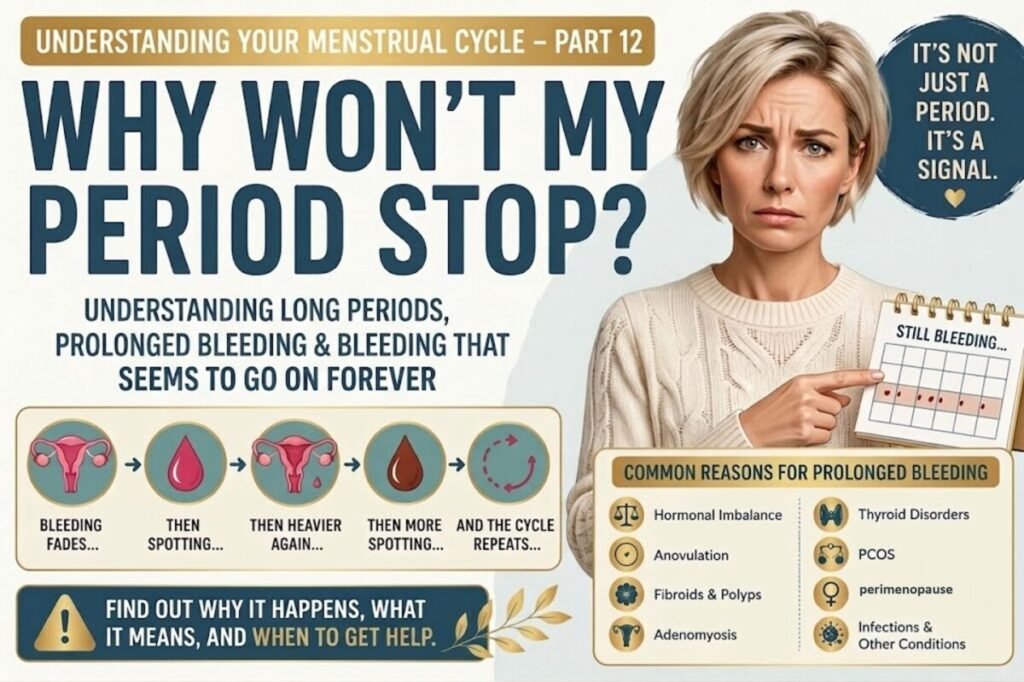
Understanding Menometrorrhagia: Long Periods, Prolonged Bleeding, and Bleeding That Seems to Go On Forever
Have you ever had a period that seemed like it was finally ending…
only to notice more blood the next day?
Perhaps the heavy flow stopped after a few days…
Then came brown discharge…
Then spotting…
Then fresh red blood again…
Then another day of spotting…
And suddenly your “period” has lasted 10, 12, or even 14 days.
If this sounds familiar, you’re not alone.
One of the most common questions women ask is:
“Why won’t my period stop?”
Many women describe it like this:
“It gets lighter, then heavier again.”
“I think it’s over, but then I start spotting.”
“The bleeding never completely stops.”
“It’s not heavy anymore, but I keep bleeding for days.”
Understanding why this happens requires looking deeper into the physiology of the menstrual cycle.
Because prolonged bleeding is often not a problem of “too much blood.”
It is often a problem of how the uterine lining is being shed.
What Is Considered a Long Period?
A typical menstrual period lasts:
- 3–7 days
Many healthy women occasionally bleed:
- 7–8 days
without any underlying disease.
However, bleeding becomes more concerning when:
- it lasts longer than 7 days
- spotting continues after the main flow
- bleeding repeatedly stops and starts
- bleeding occurs most days of the cycle
- periods become progressively longer
The medical term for prolonged menstrual bleeding is:
Menometrorrhagia or prolonged abnormal uterine bleeding, depending on the pattern.
What Does a “Period That Won’t Stop” Actually Look Like?
Women often imagine prolonged bleeding means:
- heavy bleeding every day
But that’s rarely how it looks.
More commonly it follows a pattern like:
Day 1–3: Heavy bleeding, Day 4–5: Moderate bleeding, Day 6: Light bleeding, Day 7: Brown spotting, Day 8: Nothing, Day 9: Fresh red blood again, Day 10: Spotting, Day 11: Brown discharge, Day 12: Finally finish
Or:
Day 1–4: Normal period, Day 5–14: Continuous spotting
Or:
Day 1–5: Period, Day 6–9: Spotting, Day 10: Heavier bleeding returns, Day 11–14: Spotting again
This “stop-start” pattern often provides important clues about what is happening hormonally.
How Is a Normal Period Supposed to End?
To understand prolonged bleeding, we first need to understand how menstruation normally ends.
After the uterine lining sheds:
- Blood vessels constrict
- Bleeding slows
- Tissue repair begins
- New endometrium starts forming
Think of it like wound healing.
The uterus must:
- break down tissue
- clear old tissue
- stop bleeding
- rebuild itself
When any of these processes become disrupted, bleeding may continue longer than expected.
The Most Common Cause:
The Lining Is Not Shedding Efficiently
One of the most common explanations is surprisingly simple:
The endometrium is not detaching and shedding in an organized manner.
Instead of:
- shedding once
- stopping
- healing
it sheds in patches.
Some areas detach.
Others remain attached.
Then those remaining areas detach later.
The result?
Bleeding that:
- fades
- returns
- fades again
- returns again
Many women describe this as:
“My body can’t seem to finish the period.”
While not a formal medical diagnosis, this description often reflects what is physiologically happening.
The Critical Role of Ovulation
One of the biggest reasons this occurs is:
Anovulation
Anovulation means ovulation did not occur.
This is extremely important because ovulation produces progesterone.
Without ovulation:
- progesterone remains low
- estrogen continues acting alone
This creates several problems.
Why Missing Ovulation Can Cause Never-Ending Periods
When ovulation occurs:
the corpus luteum produces progesterone.
Progesterone:
- stabilizes the uterine lining
- organizes tissue structure
- regulates blood vessel development
- prepares the lining for pregnancy
Without progesterone:
the lining often becomes:
- thicker
- more fragile
- poorly organized
Eventually it begins breaking down.
But instead of a clean, coordinated shedding process:
it sheds chaotically.
This can create:
- prolonged bleeding
- intermittent spotting
- recurring bleeding
- brown discharge for days
Estrogen Breakthrough Bleeding
Doctors often refer to this pattern as:
Estrogen breakthrough bleeding.
Here’s what happens:
Estrogen continues stimulating the lining.
The lining becomes increasingly thick.
At some point:
parts of the lining outgrow their blood supply.
These areas begin breaking down unpredictably.
The uterus sheds small sections at different times.
This creates:
- prolonged bleeding
- irregular bleeding
- spotting
- bleeding that repeatedly restarts
Women often say:
“I feel like my uterus can’t decide whether I’m still on my period.”
Why Is Brown Discharge So Common at the End?
Brown blood is usually older blood.
It often means:
- blood is leaving the uterus slowly
- small amounts are being released over time
When the lining sheds gradually rather than efficiently:
old blood may remain in the uterus longer.
As it oxidizes:
it turns brown.
This is why prolonged periods often transition into:
- brown spotting
- brown discharge
- intermittent dark bleeding
Can Blood Clots Make a Period Last Longer?
Sometimes.
Large clots may indicate:
- heavy bleeding
- incomplete shedding
- fibroids
- adenomyosis
- hormonal imbalance
When large amounts of tissue and blood accumulate:
the uterus may require more time to expel everything.
Women often report:
“After passing a clot, the bleeding improved.”
This can occur because retained tissue has finally been expelled.
Fibroids and Long Periods
Fibroids are one of the most common causes of prolonged bleeding.
Fibroids are benign growths within the uterine muscle.
Depending on location, they can:
- distort the uterine cavity
- increase endometrial surface area
- interfere with contractions
- impair blood vessel closure
The uterus may struggle to stop bleeding efficiently.
As a result:
periods often become:
- longer
- heavier
- clotty
Adenomyosis:
A Major Cause of Bleeding That Won’t End
Adenomyosis is frequently overlooked.
In adenomyosis:
endometrial tissue grows into the muscular wall of the uterus.
This causes:
- chronic inflammation
- enlarged uterus
- abnormal contractions
- increased blood vessel formation
Many women describe:
“My period goes on forever.”
This is one of the classic symptoms.
Endometrial Polyps
Polyps are small growths in the uterine lining.
Because they contain fragile blood vessels, they may:
- bleed independently
- continue bleeding after menstruation
- trigger spotting
The result can be:
- prolonged bleeding
- bleeding between periods
- recurrent spotting
Perimenopause and Long Periods
Perimenopause is one of the most common causes of prolonged bleeding.
As ovarian function becomes less predictable:
ovulation becomes inconsistent.
Some cycles:
- ovulate normally
Others:
- do not ovulate at all
This creates:
- fluctuating estrogen
- lower progesterone
- unstable endometrial development
The result may be:
- periods lasting 10–14 days
- spotting after menstruation
- recurrent bleeding
Thyroid Disorders
Many women are surprised to learn the thyroid influences menstruation.
Hypothyroidism can:
- impair ovulation
- alter estrogen metabolism
- disrupt progesterone production
This can lead to:
- longer periods
- heavier periods
- irregular bleeding
PCOS and Long Periods
Many women think PCOS only causes missing periods.
In reality, PCOS frequently causes:
- prolonged bleeding
- irregular bleeding
- bleeding that starts and stops
The mechanism is usually:
anovulation.
Without regular ovulation:
the endometrium becomes unstable and sheds unpredictably.
Can Cancer Cause Prolonged Bleeding?
Yes.
Most prolonged bleeding is NOT caused by cancer.
However, persistent abnormal bleeding should never be ignored.
Potential causes include:
- endometrial cancer
- cervical cancer
- uterine cancer
Warning signs include:
- bleeding after menopause
- bleeding after sex
- bleeding between periods
- worsening abnormal bleeding
- bleeding that develops suddenly after years of normal cycles
This is one reason every woman experiencing persistent abnormal bleeding should seek medical evaluation.
The goal is not to assume cancer.
The goal is to rule it out.
Why Do Doctors Take Long Periods Seriously?
Because prolonged bleeding can indicate:
- hormonal imbalance
- structural abnormalities
- thyroid disease
- ovulatory dysfunction
- precancerous changes
- cancer
In addition, ongoing bleeding may eventually cause:
- iron deficiency
- fatigue
- dizziness
- anemia
When Should You See a Doctor?
Seek medical attention if:
- bleeding lasts longer than 7 days consistently
- periods become progressively longer
- spotting continues most of the month
- bleeding repeatedly stops and restarts
- large clots occur regularly
- you experience fatigue or dizziness
- bleeding occurs after menopause
- bleeding occurs after sex
Frequently Asked Questions
Why does my period get lighter and then heavier again?
Often because different parts of the uterine lining are shedding at different times. Hormonal imbalance, fibroids, adenomyosis, and anovulatory cycles commonly contribute. It’s time to consult with a gynecologist to reveal the underlying conditions.
Why do I keep spotting after my period ends?
The lining may not have completed the shedding process. Hormonal factors, polyps, fibroids, adenomyosis, thyroid disorders, or infections may contribute. It’s time to consult with a gynecologist to reveal the underlying conditions.
Why am I still bleeding on day 10?
Bleeding beyond 7 days is generally considered prolonged and warrants evaluation, especially if it occurs repeatedly. It’s time to consult with a gynecologist to reveal the underlying conditions.
Can stress cause long periods?
Stress can interfere with ovulation, which may disrupt progesterone production and contribute to prolonged bleeding. However, if you experience prolonged bleeding repeatedly better to consult with a gynecologist to reveal the underlying conditions.
Can lack of ovulation make a period last longer?
Yes. Anovulatory cycles are among the most common causes of prolonged bleeding and spotting. However, if you experience prolonged bleeding repeatedly better to consult with a gynecologist to reveal the underlying conditions.
Key Takeaway
A period that won’t stop is often not simply “more menstruation.”
In many cases, it reflects a disruption in the complex process of:
- ovulation
- progesterone production
- endometrial development
- tissue breakdown
- tissue repair
The result is often a lining that sheds incompletely, irregularly, or unpredictably.
While hormonal imbalance is a common cause, prolonged bleeding can also be associated with fibroids, adenomyosis, polyps, thyroid disorders, PCOS, perimenopause, and, more rarely, cancer.
Your period should eventually come to a clear conclusion.
If it repeatedly seems unable to do so, your body may be sending an important message that deserves investigation rather than dismissal.