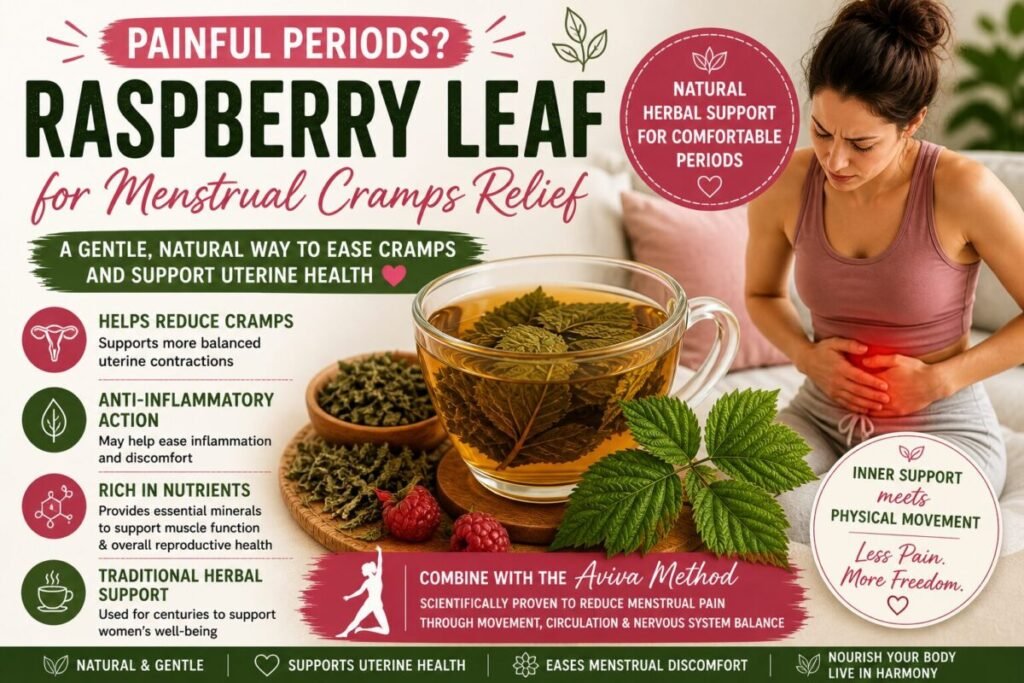
How Raspberry Leaf May Help Reduce Menstrual Cramps Naturally
Cramping.
Lower abdominal pain.
Tension before or during your period.
If you experience this, you’re not alone.
Menstrual cramps are one of the most common challenges women face—and they are often linked to:
- uterine muscle contractions
- prostaglandin activity (pain signaling)
- circulation in the pelvic area
One traditional herbal support for this is
Rubus idaeus (raspberry leaf / málnalevél).
What Is Raspberry Leaf?
Raspberry leaf comes from the red raspberry plant and has been used traditionally for:
- menstrual support
- uterine health
- pregnancy preparation
 It is considered a uterine tonic
—meaning it supports the function of the uterus rather than forcing strong changes
(Barnes et al., 2007).
 Active Compounds
 Active Compounds
Raspberry leaf contains:
- Fragarine → supports uterine muscle tone
- Tannins → astringent, tissue-supporting
- Flavonoids → antioxidant, anti-inflammatory
- Minerals (magnesium, calcium, iron)
These contribute to its supportive effect on menstrual comfort
(Ulbricht et al., 2010).
How Does Raspberry Leaf Help with Menstrual Cramps?
1. Supports More Balanced Uterine Contractions
 1. Supports More Balanced Uterine Contractions
Fragarine is believed to:
- tone uterine muscles
- support more coordinated contractions
This may help:
- reduce spasmodic, painful contractions
- improve comfort during menstruation
(Barnes et al., 2007)
2. May Reduce Cramping Intensity
 2. May Reduce Cramping Intensity
By improving muscle tone and coordination:
the uterus may contract more efficiently
→ which can reduce pain intensity
This is similar to how well-functioning muscles create less strain
3. Mild Anti-Inflammatory Support
 3. Mild Anti-Inflammatory Support
Flavonoids may help:
- reduce inflammatory signaling
- support tissue comfort
This can contribute to:
- reduced menstrual discomfort
(Ulbricht et al., 2010)
4. Provides Mineral Support for Muscle Function
 4. Provides Mineral Support for Muscle Function
Raspberry leaf contains:
- magnesium → muscle relaxation
- calcium → contraction balance
These minerals support:
- proper muscle function
- reduced cramping tendency
(Gardner et al., 1998)
How to Use Raspberry Leaf
 How to Use Raspberry Leaf
Tea (Most Common)
- 1–2 teaspoons dried leaves
- 250 ml hot water
- steep 10–15 minutes
Cycle-Based Approach
Raspberry leaf works best when used in alignment with your menstrual cycle.
Recommended Timing to Sync with Your Cycle
 Recommended Timing to Sync with Your Cycle
 1 Week Before Your Period (Luteal Phase / PMS)
 1 Week Before Your Period (Luteal Phase / PMS)
- Start with 1 cup per day
Why this matters:
This phase is when the uterus is preparing for menstruation.
Raspberry leaf may help:
- support uterine muscle tone
- reduce tension buildup
- prepare the body before cramping begins
During Your Period (Menstrual Phase)
- Increase to 2–3 cups per day
During menstruation, it may:
- support more coordinated uterine contractions
- help manage heavier flow
- provide more active support for cramping
Safety & Important Considerations
 Safety & Important Considerations
 Pregnancy
 Pregnancy
- Do NOT use during pregnancy,
except:- after week 37, and only with professional guidance
Reason:
Raspberry leaf may stimulate uterine activity
Interactions
Limited known interactions, but:
If taking medication:
consult your doctor or pharmacist
A Holistic Approach to Menstrual Pain
Raspberry leaf supports the body internally.
But menstrual pain is also strongly influenced by:
- circulation
- muscle tension
- nervous system state
Physical Support Matters
 Physical Support Matters
The Aviva Method is a movement-based approach that has shown beneficial effects in reducing menstrual pain.
It works by:
- improving pelvic circulation
- supporting muscle coordination
- influencing nervous system balance
These factors are directly linked to menstrual cramping.
Why This Combination Works
- Raspberry leaf → internal, muscular and tissue support
- Aviva Method → physical, circulatory and neuromuscular support
Together:
they address menstrual pain from both inside and outside
Can You Grow Raspberry Leaf at Home?
 Can You Grow Raspberry Leaf at Home?
Yes—very easily.
Growing Tips
- prefers sunlight
- grows well in gardens or large pots
- low maintenance
Environmental Benefits
- supports pollinators (bees)
- contributes to biodiversity
- produces edible fruit
Final Thoughts
Raspberry leaf is not a painkiller but a gentle, meaningful support for menstrual cramps.
It may help by:
- improving uterine muscle function
- reducing cramping intensity
- supporting overall menstrual comfort
And when combined with movement-based approaches like the
Aviva Method,
it offers a more complete, body-based solution.
References (APA Style – Full)
 References (APA Style – Full)
Barnes, J., Anderson, L. A., & Phillipson, J. D. (2007).
Herbal Medicines (3rd ed.). Pharmaceutical Press.
Gardner, E. J., McGuffin, M., & Hobbs, C. (1998).
American Herbal Products Association Botanical Safety Handbook. CRC Press.
Parsons, M., Simpson, M., & Ponton, T. (1999).
Raspberry leaf and its effect on labour: Safety and efficacy. Australian College of Midwives Journal, 12(3), 20–25.
Simpson, M., Parsons, M., Greenwood, J., & Wade, K. (2001).
Raspberry leaf in pregnancy: Its safety and efficacy. Complementary Therapies in Nursing and Midwifery, 7(2), 120–126.
Ulbricht, C., et al. (2010).
An evidence-based systematic review of raspberry leaf. Journal of Dietary Supplements, 7(3), 278–323.
Blumenthal, M., et al. (2000).
Herbal Medicine: Expanded Commission E Monographs. American Botanical Council.
Mills, S., & Bone, K. (2013).
Principles and Practice of Phytotherapy (2nd ed.). Churchill Livingstone.
European Medicines Agency (EMA). (2014).
Assessment report on Rubus idaeus folium.
McFarlin, B. L., Gibson, M. H., O’Rear, J., & Harman, P. (2010).
Herbal use by nurse-midwives. Journal of Midwifery & Women’s Health, 55(1), 24–30.