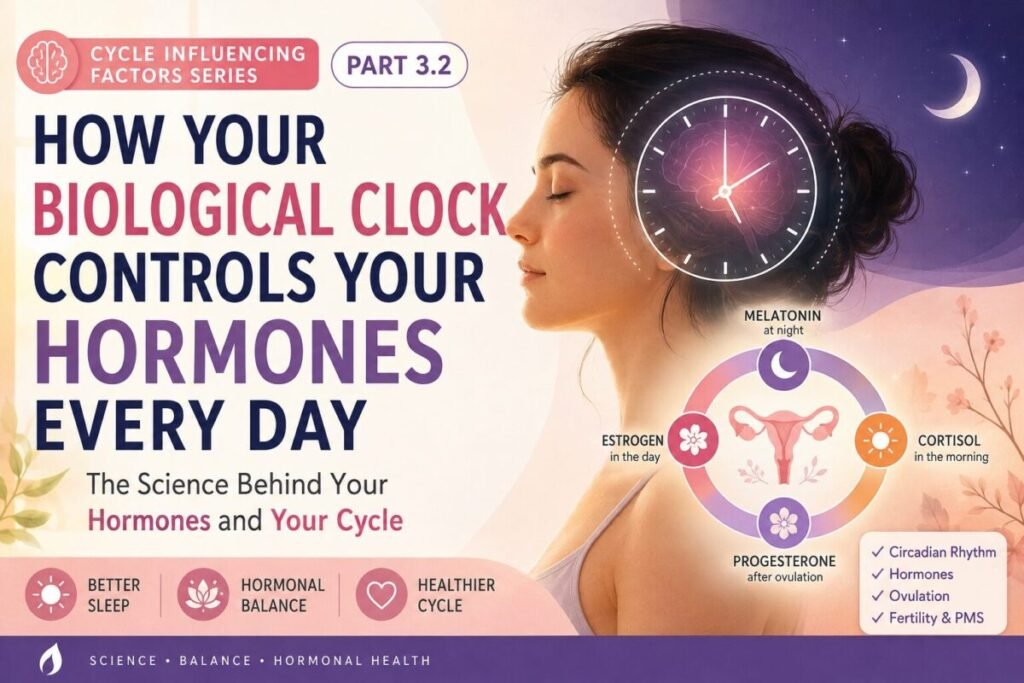
How Your Biological Clock Affect Your Hormones and cycle
Cycle Influencing Factors Series
In Part 1, we explored what circadian rhythms are and how your body’s master clock coordinates your daily hormone production. Now let’s look at how this clock communicates with your reproductive hormones and why disrupting your daily rhythm can affect ovulation, fertility, PMS, and menstrual regularity.
The fascinating part is that your menstrual cycle isn’t controlled by your ovaries alone. Every month begins in your brain, and every single day your biological clock helps determine how smoothly that process unfolds.
Your Brain Runs on Timers
Your reproductive hormones are controlled by the hypothalamic-pituitary-ovarian (HPO) axis.
Think of it as a three-level communication system.
The hypothalamus sends hormonal signals.
The pituitary gland responds by releasing FSH and LH.
The ovaries produce estrogen and progesterone.
This communication never stops. It changes from minute to minute and day to day.
What many people don’t realize is that the hypothalamus also contains the suprachiasmatic nucleus (SCN)—the body’s master circadian clock.
Because these systems sit so close together and constantly exchange information, disturbances in your biological clock can influence reproductive hormone signaling.
The Morning Cortisol Rise Is Part of a Healthy Cycle
Many people think cortisol is simply a “bad stress hormone.”
It isn’t.
Cortisol follows one of the strongest circadian rhythms in the body.
Normally:
cortisol rises shortly before waking
peaks within about 30–45 minutes after waking
gradually declines throughout the day
reaches its lowest level during the evening and early night
This daily rhythm helps:
increase alertness
regulate blood sugar
support energy production
synchronize other hormones
communicate timing information to reproductive tissues
Problems occur when this rhythm becomes disrupted.
Instead of having one healthy morning peak, cortisol may remain elevated throughout the day or spike repeatedly because of chronic stress, shift work, irregular schedules, or insufficient sleep.
Persistently elevated cortisol can interfere with GnRH release from the hypothalamus, which then alters LH and FSH secretion.
Over time this may contribute to:
delayed ovulation
irregular cycles
increased PMS symptoms
reduced fertility
changes in menstrual timing
The issue is rarely one bad night—it is the loss of a consistent daily rhythm.
Melatonin Does More Than Help You Sleep
Melatonin is often called the “sleep hormone,” but it has many other important jobs.
Its production begins after darkness falls.
Light entering the eyes tells the SCN whether it is day or night.
When darkness arrives, the SCN signals the pineal gland to begin releasing melatonin.
Melatonin helps:
prepare the body for sleep
lower body temperature
synchronize circadian rhythms
regulate antioxidant defenses
influence reproductive hormone function
Interestingly, melatonin receptors are found in the ovaries.
Research suggests melatonin may help:
protect developing eggs from oxidative stress
support follicle development
influence ovulation timing
contribute to reproductive health
Although scientists continue to study these effects, it is clear that melatonin plays a role beyond simply making you sleepy.
Why Light at Night Matters
Modern life exposes us to artificial light long after sunset.
Phones.
Tablets.
Televisions.
Computer screens.
Bright LED lighting.
All of these can send confusing signals to your biological clock.
Blue-enriched light is especially powerful because it suppresses melatonin production.
If melatonin release is delayed every evening, your entire circadian rhythm may gradually shift later.
Over weeks or months, this can contribute to:
difficulty falling asleep
shorter sleep duration
circadian misalignment
elevated evening cortisol
disrupted reproductive hormone rhythms
This is one reason sleep experts recommend reducing bright light exposure during the hour or two before bedtime.
Your Body Temperature Follows a Daily Rhythm
Body temperature also follows a predictable circadian pattern.
It gradually rises during the day.
It peaks during the late afternoon and early evening.
Then it slowly falls during the evening before sleep.
This drop in core temperature helps signal that it is time to rest.
If your body remains too warm late at night—for example after vigorous evening exercise, a very hot environment, or prolonged bright light exposure—it may become more difficult to fall asleep.
This daily temperature rhythm also works alongside reproductive hormones.
During the menstrual cycle, progesterone naturally raises basal body temperature after ovulation.
Because circadian rhythms already regulate temperature throughout the day, both systems interact.
This is one reason fertility awareness methods recommend measuring basal body temperature immediately after waking, before daily circadian changes begin to influence readings.
Your Hormones Expect Consistency
One of the most important jobs of the circadian system is creating predictability.
Your body expects:
regular light exposure
regular meals
regular movement
regular sleep
regular wake-up times
When these daily cues occur consistently, the SCN keeps the entire hormonal system synchronized.
When daily schedules constantly change, internal clocks begin drifting apart.
The liver may be on one schedule.
The adrenal glands on another.
The ovaries on another.
Over time this internal desynchronization can make hormonal regulation less efficient.
This doesn’t necessarily cause disease, but it increases the workload on systems already trying to maintain hormonal balance.
Small Daily Habits Matter More Than Perfection
Many people assume improving circadian rhythms requires major lifestyle changes.
Fortunately, that usually isn’t true.
Small daily habits repeated consistently often have a greater impact than occasional “perfect” routines.
Simple examples include:
waking at a similar time each day
getting natural morning light
eating meals at regular times
limiting bright light before bed
maintaining a consistent bedtime whenever possible
These habits reinforce your biological clock day after day.
Your circadian system loves repetition.
And when your internal clock functions well, your reproductive hormones often function more smoothly as well.
Coming Up in Part 3
Now that you understand how your biological clock influences reproductive hormones, we’ll explore why some people are naturally morning larks while others are night owls, how chronotypes affect menstrual health, and what happens to your cycle during jet lag, shift work, and frequent schedule changes.