The Role of Circadian Rhythm on Hormonal Health
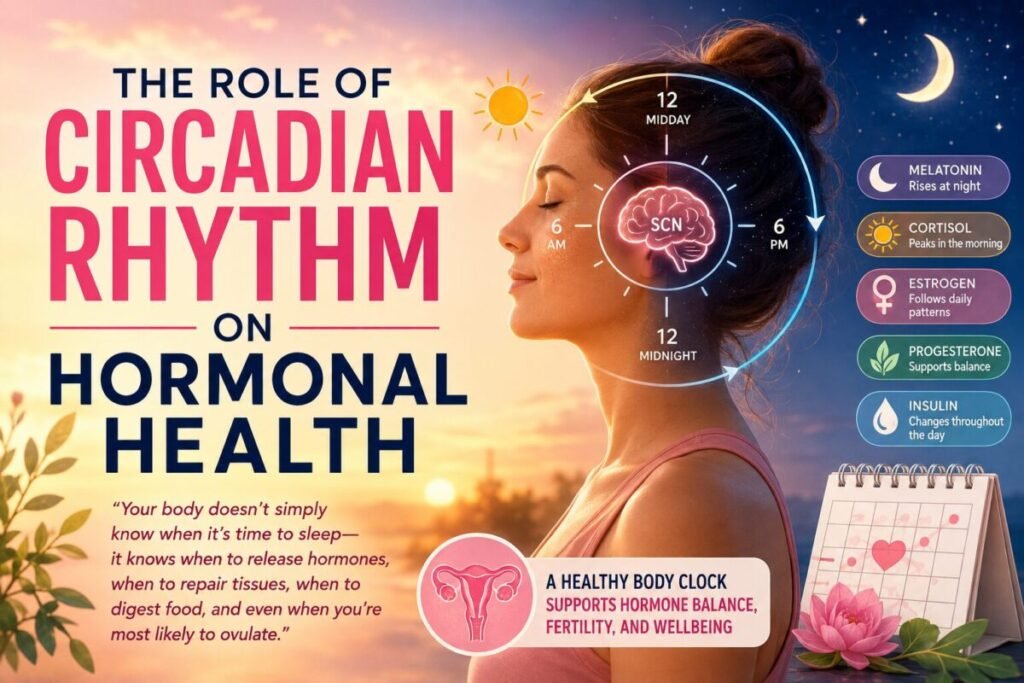
“Your body doesn’t simply know when it’s time to sleep—it knows when to release hormones, when to repair tissues, when to digest food, and even when you’re most likely to ovulate. Behind all of this is an extraordinary internal timekeeper known as your circadian rhythm.”
Have you ever wondered why you naturally feel sleepy at night, become more alert in the morning, or notice that traveling across time zones temporarily affects your period?
Perhaps you’ve experienced irregular cycles after working night shifts, staying up late for weeks, or recovering from jet lag.
These changes are not simply caused by lack of sleep.
They’re often the result of disrupting your body’s internal biological clock.
Most people associate circadian rhythms only with sleep, but they influence almost every system in the body—including your reproductive hormones.
From estrogen and progesterone to cortisol, melatonin, insulin, thyroid hormones, and even the hormones that trigger ovulation, many of these follow predictable daily rhythms that are coordinated by your biological clock.
When this internal timing system becomes disrupted, the effects can extend far beyond feeling tired. Your menstrual cycle, fertility, metabolism, mood, immune system, and overall hormonal balance may all be affected.
In this article, we’ll explore what circadian rhythms are, how your biological clock works, and why maintaining a healthy daily rhythm is one of the most powerful ways to support hormonal health.
What Are Circadian Rhythms?
Circadian rhythms are natural biological cycles that repeat approximately every 24 hours.
The word circadian comes from the Latin words circa (“about”) and diem (“day”), meaning “about a day.”
Nearly every living organism has circadian rhythms—from tiny bacteria to plants, animals, and humans.
These rhythms help organisms anticipate predictable changes in their environment instead of simply reacting to them.
In humans, circadian rhythms regulate hundreds of physiological processes, including:
-
the sleep-wake cycle
-
hormone secretion
-
body temperature
-
metabolism
-
digestion
-
blood pressure
-
immune function
-
cognitive performance
-
mood
-
reproductive function
Rather than operating independently, these systems work together according to a carefully coordinated daily schedule.
Think of your body as a large orchestra.
Each organ represents a different musician.
Your hormones are the instruments.
Your circadian clock is the conductor ensuring that every section performs at exactly the right moment.
When the conductor is keeping perfect time, the orchestra creates beautiful music.
When the timing falls apart, even excellent musicians struggle to stay coordinated.
Your body functions in much the same way.
Your Master Clock: The Suprachiasmatic Nucleus (SCN)
At the center of your circadian system is a tiny structure inside the brain called the suprachiasmatic nucleus, often abbreviated as the SCN.
Although it contains only about 20,000 neurons, the SCN acts as the master clock for your entire body.
It is located within the hypothalamus, just above where the optic nerves cross.
This location is no coincidence.
The SCN receives direct information from specialized light-sensitive cells in your eyes through a pathway called the retinohypothalamic tract.
These retinal cells contain a pigment called melanopsin, which is especially sensitive to blue wavelengths of light.
Unlike the rods and cones responsible for vision, these cells primarily measure environmental light levels.
Every morning, sunlight entering your eyes sends a message to the SCN:
“It’s daytime.”
The SCN then coordinates countless processes throughout your body.
It tells your brain when to suppress melatonin, stimulates the morning rise in cortisol, influences body temperature, regulates digestion, coordinates metabolism, and synchronizes hormone release.
In effect, the SCN acts as your body’s central timekeeper.
Your Body Has Thousands of Clocks
Although the SCN is the master clock, it isn’t the only clock in your body.
Researchers now know that almost every organ contains its own “peripheral clock.”
Your liver has one.
Your pancreas has one.
Your muscles have one.
Your fat tissue has one.
Even your ovaries and uterus contain molecular clock genes that help regulate reproductive function.
These peripheral clocks follow the timing established by the SCN but also respond to local signals such as food intake, physical activity, and body temperature.
Imagine an orchestra again.
The conductor keeps everyone together, but each musician still follows their own sheet of music.
When the conductor and musicians stay synchronized, the performance flows beautifully.
If one section speeds up or slows down, the harmony begins to break down.
The same principle applies to your body’s circadian system.
Circadian Rhythms Are More Than Sleep
Many people think circadian rhythms only determine when they feel sleepy.
Sleep is actually just one visible result of circadian timing.
Throughout a normal day, your internal clock coordinates countless changes.
Early morning:
-
Cortisol gradually rises.
-
Melatonin falls.
-
Body temperature begins increasing.
-
Alertness improves.
Mid-morning:
-
Mental performance often peaks.
-
Reaction time improves.
-
Concentration increases.
Afternoon:
-
Physical performance usually reaches its highest levels.
-
Muscle strength often peaks.
-
Coordination improves.
Evening:
-
Body temperature gradually falls.
-
Melatonin production begins.
-
Your brain prepares for sleep.
Night:
-
Tissue repair increases.
-
Growth hormone is released.
-
Immune activity becomes more active.
-
Memory consolidation occurs.
-
Reproductive hormone regulation continues.
Each event happens according to an internal schedule that repeats day after day.
Circadian Rhythms and Women’s Hormones
This daily timing is particularly important for female reproductive health.
Your menstrual cycle lasts about a month, but it depends on hormones that fluctuate not only across weeks but also throughout each day.
The hypothalamus communicates continuously with the pituitary gland and the ovaries through the hypothalamic-pituitary-ovarian (HPO) axis.
The SCN helps coordinate this communication by synchronizing many of the hormones involved.
For example:
-
Cortisol normally rises before you wake up.
-
Melatonin rises after darkness.
-
Insulin sensitivity changes throughout the day.
-
Body temperature follows a daily rhythm.
-
Gonadotropin-releasing hormone (GnRH) pulses occur according to carefully timed patterns.
-
Luteinizing hormone (LH) release depends on precise coordination within the brain.
When circadian rhythms become disrupted, these carefully timed hormonal signals may become less synchronized.
Over time, this may contribute to:
-
irregular menstrual cycles
-
delayed ovulation
-
more severe PMS symptoms
-
reduced fertility
-
metabolic disturbances
-
hormonal imbalance
This doesn’t mean one late night will disrupt your cycle.
However, repeated circadian disruption over weeks or months can place chronic stress on the endocrine system.
Your Hormones Follow a Daily Schedule
One of the most fascinating discoveries in chronobiology is that hormones don’t simply rise and fall randomly.
They follow remarkably predictable daily patterns.
For example:
Melatonin begins rising in the evening after darkness.
Cortisol reaches its highest level shortly after waking.
Growth hormone is released primarily during deep sleep.
Insulin sensitivity is generally highest earlier in the day.
Body temperature gradually increases during the day before falling again in the evening.
Even reproductive hormones are influenced by circadian timing.
The body doesn’t simply produce hormones.
It produces them at the right time.
Timing is just as important as the hormones themselves.
Why This Matters for Your Menstrual Cycle
Your menstrual cycle depends on extraordinary precision.
Every month, your brain and ovaries coordinate a complex sequence of hormonal events:
-
follicles begin growing
-
estrogen rises
-
the LH surge triggers ovulation
-
progesterone increases after ovulation
-
menstruation begins if pregnancy does not occur
Each event depends not only on hormone levels but also on correct timing.
A healthy circadian rhythm helps create the internal environment that allows these processes to occur efficiently.
When your biological clock becomes disrupted, your reproductive system may need to work harder to maintain this delicate balance.
For many women, improving circadian health becomes an important—but often overlooked—part of supporting hormonal balance naturally.
Key Takeaways
-
Circadian rhythms are approximately 24-hour biological cycles that regulate nearly every function in the body.
-
The suprachiasmatic nucleus (SCN) acts as the master biological clock.
-
Every major organ contains its own peripheral clock that follows the SCN’s timing.
-
Circadian rhythms regulate much more than sleep—they also influence hormone secretion, metabolism, immunity, digestion, body temperature, and reproductive health.
-
Female reproductive hormones depend on precise daily timing, making circadian health an important part of menstrual cycle regulation.
Coming Next
In Part 2, we’ll explore exactly how your biological clock influences estrogen, progesterone, melatonin, cortisol, ovulation, fertility, and the hormones of the hypothalamic-pituitary-ovarian axis—and why light exposure can directly affect your reproductive health.