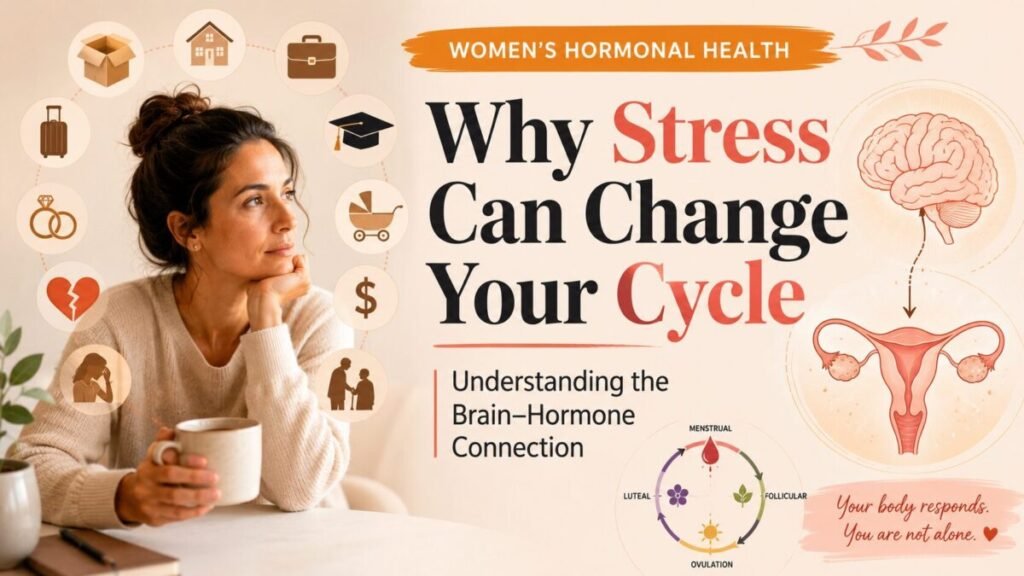
Why Your Cycle Changes During Stressful Life Events
Have you ever noticed that your period changed after a stressful event?
Perhaps your cycle became longer after moving to a new city.
Maybe your period arrived late during exam season.
Perhaps your PMS became much worse after a breakup, a job change, or a difficult family situation.
Many women notice changes in their menstrual cycles during stressful periods of life and immediately wonder:
Is something wrong with my hormones?
Am I entering perimenopause?
Could I have PCOS?
Why is my cycle suddenly different?
While cycle changes can sometimes indicate an underlying medical condition, stress is one of the most common reasons menstrual cycles become temporarily disrupted.
What surprises many women is that stress is not limited to feeling anxious or overwhelmed.
Your body responds to many life events as forms of stress—even positive ones.
A wedding, a promotion, moving into a new home, or planning a long-awaited trip can all activate the body’s stress response.
Your menstrual cycle often reflects these changes.
Let’s explore why.
Your Menstrual Cycle Is Sensitive to Your Environment
Your menstrual cycle is not controlled by your ovaries alone.
It begins in the brain.
The hypothalamus and pituitary gland communicate continuously with the ovaries through what is known as the hypothalamic-pituitary-ovarian (HPO) axis.
This delicate communication system regulates:
Follicle development
Ovulation
Estrogen production
Progesterone production
Menstruation
At the same time, your brain is also monitoring your environment.
It constantly asks:
Am I safe?
Do I have enough resources?
Is this a good time for reproduction?
Do I need to prioritize survival?
When your brain perceives significant stress, it may temporarily shift resources away from reproduction and toward survival.
This is a normal biological response.
The result can be:
Delayed ovulation
Longer cycles
Irregular periods
Spotting
Missed periods
Increased PMS symptoms
For some women, the changes are subtle.
For others, they can be dramatic.
Why Life Changes Can Affect Your Cycle
Many women assume that only negative experiences affect hormones.
In reality, any major life adjustment requires adaptation.
Even exciting events can place significant demands on the nervous system.
Your body responds to change itself—not simply whether the event is positive or negative.
This is why both joyful and difficult life events can influence your cycle.
Moving House or Relocating
Moving is consistently ranked among life’s most stressful events.
Even when the move is exciting, it often involves:
Financial pressure
Packing and organizing
Administrative tasks
Sleep disruption
Travel
Leaving familiar surroundings
Adapting to a new environment
Many women notice:
Delayed ovulation
Longer cycles
Temporary irregularity
Changes in cervical mucus patterns
Often, cycles return to normal once life settles down.
Starting a New Job
A new job may bring excitement and opportunity.
It may also involve:
Learning new responsibilities
Meeting new colleagues
Increased mental workload
Performance pressure
Schedule changes
Your body may perceive this adjustment period as stress.
Some women notice:
Longer cycles
Increased PMS
More fatigue during the luteal phase
Changes in sleep patterns that indirectly affect hormonal balance
Exams and Academic Pressure
Students frequently report cycle changes during exam periods.
Common contributing factors include:
Psychological stress
Sleep deprivation
Increased caffeine intake
Irregular eating patterns
Reduced physical activity
The combination can affect ovulation timing.
It is not uncommon for ovulation to occur later than usual, leading to a delayed period.
Many women experience a return to their typical cycle pattern once exams are finished.
Relationship Difficulties and Breakups
Human beings are deeply social creatures.
Relationship stress can be one of the most emotionally demanding experiences we face.
Whether it involves:
Conflict
Separation
Divorce
Uncertainty about the future
the emotional impact can be profound.
Chronic activation of the stress response may contribute to:
Irregular cycles
Worsened PMS
Increased mood symptoms
Changes in menstrual flow
Many women also experience disrupted sleep and appetite during emotionally challenging periods, which can further influence hormonal balance.
Grief and Loss
Few experiences affect the body more deeply than grief.
The loss of a loved one, miscarriage, infertility struggles, or other significant losses can place enormous emotional and physical demands on the nervous system.
During grief, women may experience:
Delayed ovulation
Longer cycles
Missed periods
Increased fatigue
Changes in menstrual symptoms
These responses do not mean something is wrong.
They often reflect the body’s attempt to cope with an overwhelming experience.
Healing takes time.
So does hormonal recovery.
Wedding Planning
Many women are surprised when cycle changes occur before a wedding.
After all, weddings are supposed to be happy events.
However, wedding planning often includes:
Financial decisions
Family dynamics
Time pressure
Perfectionism
Major life transitions
The combination can create substantial stress.
Some women experience delayed ovulation or unexpected cycle changes during the months leading up to the wedding.
Caring for Children
Parenthood is rewarding.
It is also demanding.
Parents often experience:
Interrupted sleep
Constant responsibility
Emotional labor
Reduced recovery time
Many mothers notice that their cycles become less predictable during particularly stressful parenting seasons.
Sleep deprivation alone can significantly affect hormonal regulation.
Caring for Aging Parents
This is a frequently overlooked source of stress.
Many women find themselves simultaneously supporting:
Children
Careers
Aging parents
This “sandwich generation” experience can create chronic emotional and physical strain.
Over time, chronic stress may contribute to:
Increased PMS
More irregular cycles
Fatigue
Sleep disturbances
Financial Stress
Financial uncertainty can create a persistent sense of threat.
Unlike a short-term challenge, financial stress often remains present day after day.
This prolonged activation of the stress response can influence:
Cortisol production
Sleep quality
Eating habits
Emotional well-being
All of these factors can affect the menstrual cycle.
Travel and Major Schedule Changes
Travel often combines multiple stressors:
Disrupted sleep
Jet lag
Time-zone changes
Dietary changes
Physical fatigue
For some women, this may delay ovulation or temporarily alter cycle length.
The effect is usually temporary.
Why Some Women Experience Cycle Changes and Others Don’t
Stress affects everyone differently.
Several factors influence stress resilience:
Genetics
Personality
Previous life experiences
Sleep quality
Nutritional status
Social support
Existing health conditions
Two women can experience the same event and have completely different cycle responses.
This is normal.
Your cycle is uniquely yours.
Comparing your experience to someone else’s is rarely helpful.
What Should You Do If Your Cycle Changes During a Stressful Period?
First, avoid panic.
A temporary cycle change during a stressful life event is common.
Instead:
Continue Tracking Your Cycle
Pay attention to:
Cycle length
Ovulation signs
Basal body temperature
Cervical mucus
PMS symptoms
Most importantly, record major life events.
You may discover patterns that would otherwise be easy to miss.
Track Stressors
When cycle tracking, consider adding notes about:
Work pressure
Relationship stress
Travel
Illness
Family challenges
Major life transitions
This often provides valuable insights.
Track What Helps
Also note:
Meditation
Deep breathing
Heart coherence
Yoga
Tai Chi
Walking
Aviva Method practice
Relaxation recordings
Sleep quality
Over time, you may identify which strategies support your cycle most effectively.
The Aviva Method and Stress Resilience
Many women begin practicing the Aviva Method to support hormonal balance, fertility awareness, or menstrual health.
However, they often notice another benefit:
They feel emotionally better.
The large rhythmic movements, coordinated arm patterns, music, and full-body engagement can help release accumulated tension and improve mood.
Movement itself is one of the body’s natural stress-regulation tools.
The Aviva Method combines movement, rhythm, breathing, and body awareness in a way that many women find uplifting and energizing.
Importantly, Aviva practice traditionally ends with relaxation, helping the nervous system shift toward recovery and restoration.
Many women find that regular practice supports not only their cycles but also their emotional well-being.
You may also wish to combine your practice with my free Hypnotic Relaxation audio or the Premium Cycle-Syncing Hypnotic Relaxation Series to create additional opportunities for recovery during stressful periods.
When Should You Speak With Your Healthcare Provider?
Stress-related cycle changes are common.
However, it is important to seek medical advice if you experience:
No period for three months or longer
Extremely heavy bleeding
Severe pain
Bleeding between periods
Sudden dramatic cycle changes
Concerns about fertility
Other unusual symptoms
A healthcare professional can help rule out underlying conditions and identify the true cause of your symptoms.
Key Takeaways
Major life events can affect your menstrual cycle—even when those events are positive.
Moving, relationship changes, grief, exams, career transitions, parenting challenges, financial stress, and travel can all influence hormonal balance through the body’s stress response.
The resulting changes may include:
Delayed ovulation
Longer cycles
Irregular periods
Increased PMS
Temporary missed periods
In many cases, these changes are temporary and improve as stress levels decrease.
Your cycle is not just a reproductive process.
It is also a valuable reflection of how your body is responding to the demands of life.
By tracking your cycle, supporting your nervous system, prioritizing recovery, and practicing effective stress-management techniques, you can gain powerful insights into your hormonal health and build greater resilience through life’s inevitable challenges.