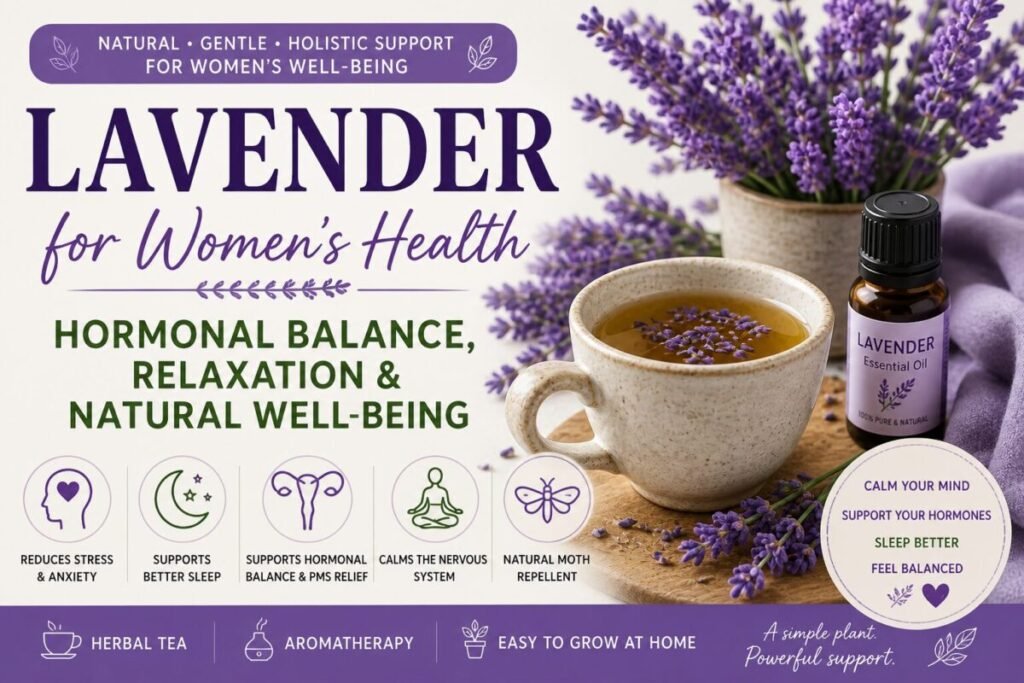
How Lavender Supports Women’s Hormonal Health, Relaxation & Balance Naturally
Feeling tense, overwhelmed, or unable to fully relax?
Struggling with PMS, sleep issues, or emotional ups and downs?
These are not random problems.
They are often connected to:
- your nervous system
- your stress levels
- and your hormonal balance
One gentle, natural plant that supports all three is Lavandula angustifolia (lavender).
Why the Nervous System Matters for Hormonal Health
Your hormones don’t work in isolation.
They are deeply influenced by:
- stress
- sleep quality
- nervous system balance
When your body is in a constant “stress mode”:
- cortisol increases
- ovulation may be disrupted
- PMS symptoms may worsen
👉 This is where calming plants like lavender become powerful allies.
Lavender: A Natural Support for Calm and Balance
Lavender has been used for centuries for:
- relaxation
- sleep support
- emotional balance
Its effects are mainly due to its essential oil components, especially:
🌿 Key Active Compounds
- Linalool
- Linalyl acetate
- Lavandulol
- Terpinen-4-ol
👉 These compounds influence the nervous system and brain signaling
(Cavanagh & Wilkinson, 2002)
How Lavender Works in the Body
Lavender doesn’t sedate or force sleep—it helps your body shift into a calmer state.
🧠 1. Calms the Nervous System
Lavender interacts with the GABA system in the brain (similar pathway to anti-anxiety medications, but much gentler).
👉 This can:
- reduce anxiety
- promote relaxation
- support emotional stability
(López et al., 2017)
😌 2. Reduces Stress Hormones
Lavender may help lower cortisol levels and reduce the body’s stress response.
👉 This supports:
- hormonal balance
- better cycle regulation
- reduced PMS symptoms
🌙 3. Supports Sleep Quality
Lavender improves:
- sleep onset (falling asleep faster)
- sleep depth
- overall restfulness
(Hwang & Shin, 2015)
🔄 4. Supports Hormonal Balance (Indirectly)
By calming the nervous system, lavender helps:
- regulate stress hormones
- support reproductive hormone signaling
👉 This is especially relevant for:
- PMS
- irregular cycles
- stress-related hormonal imbalance
🌸 When Is Lavender Especially Helpful?
- PMS (mood swings, tension)
- stress and anxiety
- sleep difficulties
- emotional overwhelm
- cycle-related nervous tension
🍵 How to Use Lavender as Herbal Tea
Lavender tea is one of the gentlest ways to support relaxation.
How to Prepare Lavender Tea
Ingredients:
- 1–2 teaspoons dried lavender flowers
- 250 ml hot water
Instructions:
- Pour hot (not boiling) water over flowers
- Cover and steep for 5–10 minutes
- Strain and drink
👉 Covering helps preserve essential oils.
How Much Can You Drink?
- ✔️ 1–2 cups per day
- Best in the evening or before sleep
How Long Can You Use It?
- Safe for 1–2 weeks daily use
- Then take a short break
👉 Use intuitively, especially during stressful periods
🌸 Cycle-Based Use
- Luteal phase: reduces PMS tension
- Before sleep during menstruation: supports relaxation.
🌬️ Lavender in Aromatherapy
Lavender is one of the most widely used essential oils.
🧠 Emotional and Mental Effects
Inhalation affects the limbic system (emotional brain):
👉 Helps:
- reduce anxiety
- improve mood
- create calm
(Herz, 2009)
😴 Sleep Support
Lavender aromatherapy is strongly associated with improved sleep quality.
💆♀️ Physical Relaxation
- reduces muscle tension
- supports body relaxation
How to Use Lavender Aromatherapy
- Diffuser: 3–5 drops
- Pillow: 1 drop before sleep
- Bath: a few drops (diluted)
- Topical: diluted with carrier oil
🧺 Natural Moth Repellent
Yes—lavender has a natural moth-repelling effect.
👉 Why?
Its scent (especially linalool) repels insects.
How to use:
- dried lavender sachets in closets
- lavender oil on cotton pads
- linen sprays
✔️ Safe, natural alternative to chemicals
🌿 Can You Grow Lavender at Home?
Yes—and it’s actually quite easy.
🌱 Growing Lavender in a Pot
Lavender grows well in pots if you provide:
- plenty of sunlight (at least 6 hours/day)
- well-draining soil
- good airflow
💧 Care Tips
- Water moderately (does not like overwatering)
- Let soil dry between watering
- Use sandy or well-draining soil
✂️ Maintenance
- Trim after flowering
- Avoid excessive moisture
- Protect from extreme frost
👉 Lavender prefers dry, sunny conditions.
⚠️ Safety and Considerations
Lavender is generally safe, but:
- avoid excessive intake
- use caution during pregnancy
- essential oil should always be diluted
👉 If you take medication, consult your doctor before regular use.
🌿 A Holistic Approach: Body + Nervous System
Lavender supports your body internally and emotionally.
To complement this, movement supports physical and hormonal flow.
The Aviva Method helps:
- improve circulation in the lover abdomen
- stimulate hormonal glands
- support reproductive health
🌿 Why This Combination Works
- Lavender → calms nervous system
- Aviva Method → activates circulation and may harmonize the hormonal system
👉 Together:
calm nerves + balanced hormones = healthy system
📚 References
Cavanagh, H. M. A., & Wilkinson, J. M. (2002).
Biological activities of lavender essential oil. Phytotherapy Research, 16(4), 301–308.
Herz, R. S. (2009).
Aromatherapy facts and fictions. International Journal of Neuroscience, 119(2), 263–290.
Hwang, E., & Shin, S. (2015).
The effects of aromatherapy on sleep improvement. Journal of Alternative and Complementary Medicine, 21(7), 430–438.
López, V., Nielsen, B., Solas, M., Ramírez, M. J., & Jäger, A. K. (2017).
Exploring pharmacological mechanisms of lavender. Frontiers in Pharmacology, 8, 280.