Why are my period cramps worse some months?
You may have wondered about this.
Some women go through their menstrual cycle with only mild discomfort.
Others experience strong cramps that interfere with work, sleep, or daily activities.
Why does the same biological process feel so different from one person to another?
Menstrual pain is extremely common. Research suggests that between 50–90% of menstruating women experience dysmenorrhea at some point in their lives (Ju et al., 2014).
Yet the intensity of the pain varies greatly.
One important reason lies in the amount of prostaglandins produced during menstruation.
Why Do Some Women Produce More Prostaglandins?
During menstruation, the uterus sheds the lining that developed during the cycle.
This process triggers the release of signaling molecules called prostaglandins, which stimulate uterine contractions (Dawood, 2006).
However, the amount of prostaglandins produced is not the same in every woman.
In some women, significantly higher levels can be measured in the uterine lining and menstrual fluid.
This difference is one of the main reasons why some women feel only mild discomfort while others experience strong cramps.
So the question becomes:
What influences prostaglandin production?
Several biological factors may contribute.
1. Thicker Uterine Lining
Prostaglandins are mainly released when the uterine lining breaks down at the beginning of menstruation.
If a thicker endometrium develops during the cycle:
more tissue breaks down during menstruation
more inflammatory mediators are released
more prostaglandins may be produced
This can trigger stronger uterine contractions (Dawood, 2006).
2. Higher Inflammatory Activity
Prostaglandins are part of the body’s inflammatory signaling system.
If the body already has higher inflammatory activity, prostaglandin production may also increase during menstruation.
Factors that may contribute include:
chronic stress
lack of sleep
certain dietary patterns
hormonal imbalances
These influences can affect how strongly the uterus responds during the menstrual cycle (Iacovides et al., 2015).
3. Hormonal Balance (Estrogen and Progesterone)
The balance between estrogen and progesterone affects how the uterine lining develops during the cycle.
When estrogen activity is relatively higher:
the endometrium may become thicker
more tissue must be shed during menstruation
prostaglandin production may increase
This can lead to stronger uterine contractions.
4. Greater Sensitivity of the Uterine Muscle
The amount of prostaglandin is not the only factor.
The sensitivity of the uterine muscle also matters.
In some women, the uterine muscle reacts more strongly to prostaglandins, leading to:
more powerful contractions
increased uterine pressure
stronger cramping sensations (Dawood, 2006).
5. Reduced Pelvic Blood Circulation
During strong uterine contractions, blood vessels in the uterine muscle may become temporarily compressed.
This can reduce blood flow and lead to short-term oxygen shortage in the tissue, a process called ischemia (Iacovides et al., 2015).
If pelvic circulation is already less active, this oxygen shortage may occur more easily, increasing the sensation of pain.
Risk Factors for Strong Menstrual Pain
Research has identified several factors associated with a higher risk of dysmenorrhea (Ju et al., 2014):
younger age
early menarche (early first menstruation)
heavy menstrual bleeding
family history
smoking
high stress levels
low levels of physical activity
In some cases, menstrual pain may also be caused by underlying conditions such as:
Endometriosis
Adenomyosis
Uterine Fibroids
This is called secondary dysmenorrhea, and medical evaluation may be necessary.
Why Natural Approaches May Help
Understanding these biological mechanisms helps explain why certain natural approaches may reduce menstrual discomfort.
If pain is influenced by factors such as:
increased muscle tension
reduced pelvic circulation
nervous system overactivation
then strategies that support the body’s natural regulation may provide relief.
Examples include:
heat therapy, which improves blood flow
gentle movement, which supports pelvic circulation
breathing and relaxation, which calm the nervous system
stress reduction, which may influence hormonal balance
These approaches do not block prostaglandins directly like medications do.
Instead, they work by improving the physiological environment in which the uterus functions.
Can movement reduce period pain?
If part of the pain mechanism involves strong muscle contractions and reduced circulation, then movement-based approaches may have an important role.
The Exercises of the Aviva Method?
activate the hips and pelvis
improve pelvic circulation
support rhythmic movement in the pelvic region
may help reduce tension, improve circulation, increase the heat in the lower abdomen, and support the body’s natural processes.
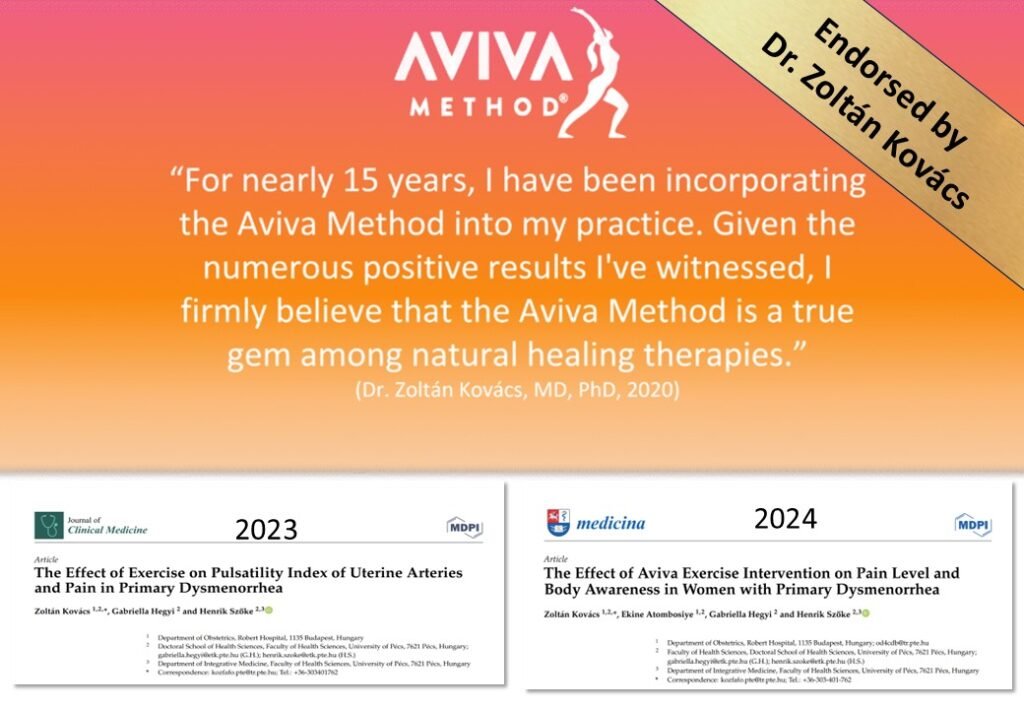
For some women, this is where targeted pelvic movement practices such as the Exercises of the Aviva Method become especially relevant. ((Kovács et al., 2024, 2025)
References
Dawood, M. Y. (2006). Primary dysmenorrhea: Advances in pathogenesis and management. Obstetrics & Gynecology, 108(2), 428–441.
Iacovides, S., Avidon, I., & Baker, F. C. (2015). What we know about primary dysmenorrhea today. Human Reproduction Update, 21(6), 762–778.
Ju, H., Jones, M., & Mishra, G. (2014). The prevalence and risk factors of dysmenorrhea. Epidemiologic Reviews, 36(1), 104–113.
Kovács, Z., Atombosiye, E., Hegyi, G., & Szőke, H. (2024).
The effect of Aviva exercise intervention on pain level and body awareness in women with primary dysmenorrhea. Medicina, 60(1), 184. Kovács, Z. (2025).
The effects of Aviva exercise on premenstrual syndrome symptoms, primary dysmenorrhea, body awareness and uterine artery circulation. PhD research program, University of Pécs.