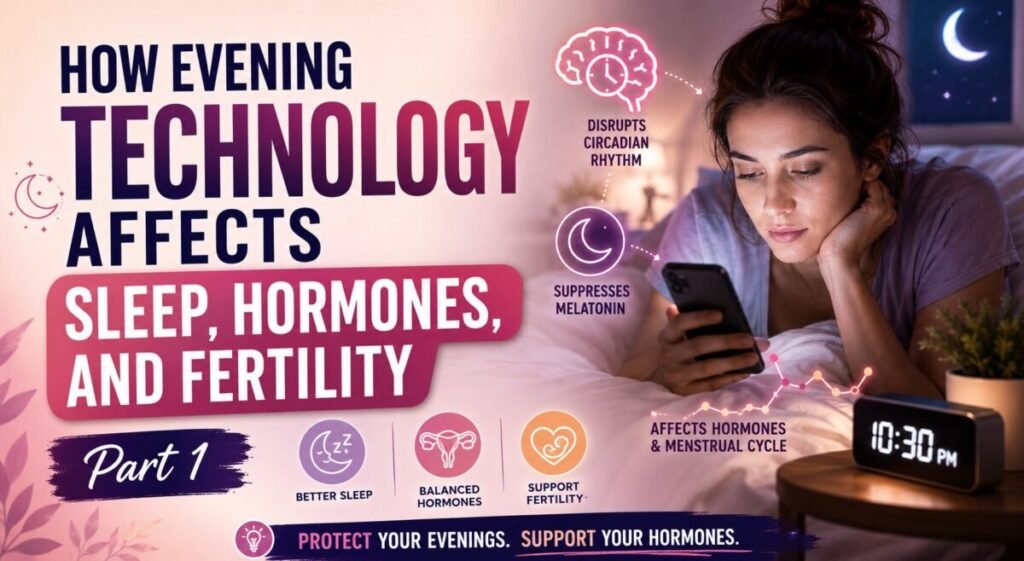
How Evening Technology Affects Sleep, Hormones, and Fertility (Part 1)
Keywords: blue light hormones, blue light menstrual cycle, screens before bed, melatonin fertility, phone before sleep, circadian rhythm hormones
Introduction
Most of us know that scrolling through our phones before bed isn’t the best habit.
You’ve probably heard that blue light from screens can make it harder to fall asleep. But what many people don’t realize is that the effects extend far beyond feeling tired the next day.
Your evening screen habits may influence your menstrual cycle, ovulation, fertility, PMS, and long-term hormonal health.
That doesn’t mean your smartphone is “destroying your hormones.” The relationship is much more nuanced than that. However, when late-night screen use consistently delays sleep and disrupts your body’s internal clock, it can gradually affect the delicate hormonal rhythms that regulate your reproductive system.
In this article, we’ll explore why light is one of the most powerful signals your brain receives, how blue light affects melatonin production, and why protecting your evenings may be one of the simplest ways to support healthy hormones.
Your Brain Can’t Tell the Difference Between the Sun and Your Phone
For millions of years, humans lived according to the natural cycle of daylight and darkness.
Sunrise told the brain it was time to become alert.
Sunset signaled that it was time to prepare for sleep.
Although our lives have changed dramatically, our biology has not.
Deep inside your brain is a tiny structure called the suprachiasmatic nucleus (SCN), often referred to as your body’s master clock. It continuously receives information about light through specialized cells in the retina.
When your eyes detect bright light, the SCN tells your body:
“Stay awake. It’s daytime.”
When darkness arrives, the SCN sends a different message:
“Night has begun. Start preparing for sleep.”
For thousands of years, this system worked beautifully.
Today, however, many of us continue exposing ourselves to bright artificial light long after sunset.
Why Blue Light Matters
Not all light affects your brain equally.
Blue wavelengths—similar to those naturally present in morning sunlight—are especially effective at promoting alertness.
They help:
increase attention
improve reaction time
enhance mood
suppress melatonin production
During the day, this is exactly what we want.
At night, however, the same signal can confuse the brain.
Your smartphone, tablet, computer, television, and many LED lights all emit blue-enriched light.
When you use these devices late into the evening, your brain may interpret that light as an extension of daytime.
Instead of preparing for sleep, it continues promoting wakefulness.
Melatonin: More Than the “Sleep Hormone”
Melatonin is often called the sleep hormone, but its role goes far beyond making you feel sleepy.
As darkness falls, the pineal gland begins releasing melatonin into the bloodstream.
Melatonin helps:
prepare the brain for sleep
lower core body temperature
synchronize circadian rhythms
support immune function
act as a powerful antioxidant
protect cells from oxidative stress
For women, melatonin also plays important roles within the reproductive system.
Researchers have found melatonin inside ovarian follicles, where it appears to help protect developing eggs from oxidative damage.
Scientists continue studying how melatonin influences ovarian function, egg quality, and fertility.
Although many questions remain, it is increasingly clear that melatonin is much more than simply a sleep hormone.
What Happens When You Use Screens Late at Night?
Imagine it’s 10:30 PM.
You climb into bed planning to sleep.
Instead, you spend an hour answering messages, checking social media, watching videos, or reading the news.
Your eyes continue sending bright-light signals to your brain.
As a result:
melatonin release is delayed
your biological clock shifts later
you become sleepy later than intended
total sleep time often decreases
sleep quality may decline
This doesn’t usually happen after one evening.
The problem develops when it becomes a daily habit.
Night after night, delayed sleep can gradually disrupt your circadian rhythm.
How Poor Sleep Influences Hormones
Your reproductive hormones don’t work independently.
They constantly communicate with your biological clock.
Poor or insufficient sleep may contribute to:
higher evening cortisol levels
reduced insulin sensitivity
changes in appetite-regulating hormones
altered secretion of LH and FSH
delayed ovulation
irregular menstrual cycles
Over time, these changes may increase the likelihood of:
irregular periods
worsening PMS
heavier fatigue
increased stress
more difficult ovulation in susceptible women
This doesn’t mean that every woman who uses her phone before bed will develop hormonal problems.
Instead, think of sleep as one of many lifestyle factors that influence hormonal balance alongside nutrition, exercise, stress, and overall health.
Blue Light Is Only Part of the Story
Interestingly, blue light itself isn’t always the biggest problem.
Often, it’s what screens encourage us to do.
Think about what happens when you’re scrolling through social media.
One more video becomes five.
Five minutes becomes an hour.
Your bedtime gets pushed later and later.
At the same time, the content you’re viewing may stimulate your brain emotionally.
News, work emails, online arguments, exciting videos, or emotionally charged posts all increase mental alertness, making it even harder to fall asleep.
In other words, screens affect sleep through two pathways:
Light, which delays melatonin production.
Mental stimulation, which keeps the brain alert when it should be winding down.
Why This Matters for Your Menstrual Cycle
Your menstrual cycle depends on rhythm.
Hormones don’t simply rise and fall randomly.
They follow carefully timed daily and monthly patterns.
When your circadian rhythm becomes disrupted for weeks or months, your reproductive hormones may gradually lose some of that precise timing.
For some women, the effects are barely noticeable.
Others may experience:
longer cycles
delayed ovulation
worsening PMS
greater fatigue
increased stress
more irregular periods
Women with existing hormonal conditions—such as PCOS, hypothalamic amenorrhea, or perimenopause—may be especially sensitive to chronic sleep disruption.
Key Takeaways
Your body evolved to use light as one of its strongest biological signals.
Blue light during the day helps keep you awake, alert, and productive.
The same light in the evening can delay melatonin production, shift your biological clock, reduce sleep quality, and indirectly influence the hormones involved in ovulation and menstrual health.
Fortunately, this is one of the easiest lifestyle factors to improve.
Small changes in your evening light exposure can help support better sleep, healthier circadian rhythms, and more balanced hormone function over time.
Coming Next
In Part 2, we’ll explore practical, science-based strategies to reduce the effects of evening screen use without giving up technology completely.
You’ll learn:
whether blue-light glasses actually work
how much screen time is too much
the best time to stop using devices before bed
whether Night Shift and blue-light filters are enough
how to create an evening routine that supports both sleep and hormonal health.