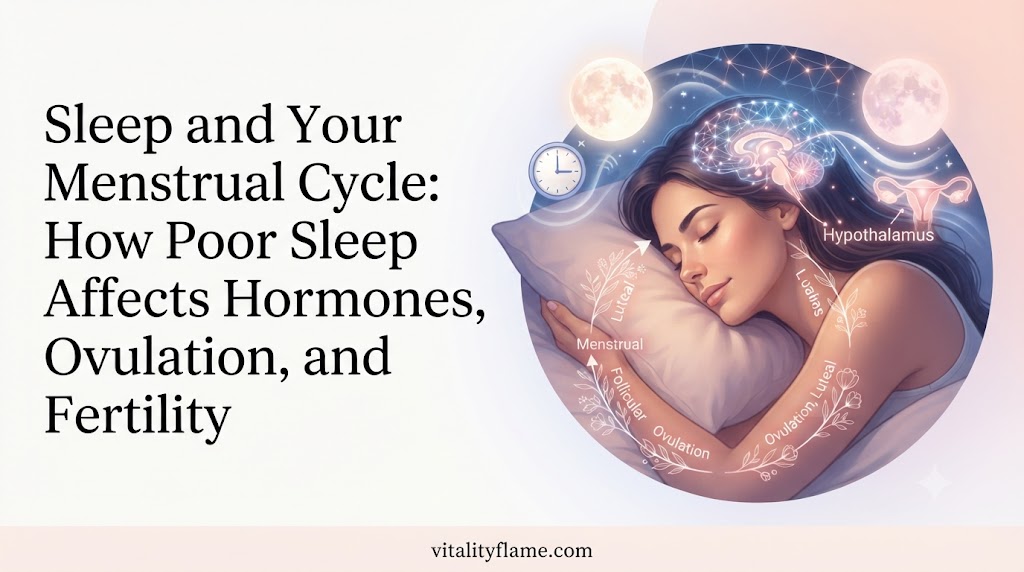
Sleep and Your Menstrual Cycle: effect of Poor Sleeping Habits on the Menstrual Cycle
By now, you’ve learned that sleep is far more than a time for rest.
Every night, your brain carefully coordinates hormones that regulate stress, metabolism, immune function, and reproduction. When sleep is consistently poor, these systems gradually become less synchronized.
But what does that actually mean for your menstrual cycle?
Can poor sleep really change your period?
For many women, the answer is yes.
Sleep isn’t usually the only factor influencing your cycle. Nutrition, exercise, stress, age, medical conditions, medications, and genetics all play important roles. However, sleep is one of the few lifestyle factors that affects almost every hormonal system involved in reproduction.
Let’s look at how this can appear in everyday life.
Can Poor Sleep Delay Ovulation?
One of the most common effects of chronic sleep deprivation is delayed ovulation.
As we discussed in Part 2, sleep influences the communication between the brain and the ovaries through the hypothalamic-pituitary-ovarian (HPO) axis.
When the brain detects ongoing physical or emotional stress—including the biological stress caused by insufficient sleep—it may temporarily reduce reproductive activity.
Instead of releasing hormones according to their usual schedule, the brain may delay the hormonal signals needed for ovulation.
As a result:
-
Ovulation may occur several days later than expected.
-
Your menstrual cycle may become longer.
-
Your period may arrive later than usual.
-
Ovulation may occasionally not occur at all (an anovulatory cycle).
One delayed cycle is usually not a cause for concern. Most women experience occasional cycle variations throughout their reproductive years.
However, if sleep problems continue for weeks or months, repeated delays in ovulation may become more noticeable.
Why Your Period May Become Irregular
Many women notice that periods become less predictable during stressful periods of life.
Although stress often receives the blame, poor sleep frequently contributes as well.
Irregular sleep schedules, frequent nighttime awakenings, shift work, or chronic insomnia can all interfere with the precise hormonal timing required for a regular menstrual cycle.
You may notice:
-
cycles that are longer or shorter than usual
-
variation in cycle length from month to month
-
occasional skipped periods
-
unexpected spotting
-
changes in menstrual flow
Because reproductive hormones work together like an orchestra, disrupting one part of the system can affect the timing of the entire cycle.
Why PMS May Feel Worse After Poor Sleep
Many women notice that PMS feels more intense after several nights of poor sleep.
This isn’t simply because they’re tired.
Sleep influences several factors that contribute to premenstrual symptoms.
Poor sleep may increase:
-
cortisol levels
-
inflammation
-
emotional sensitivity
-
insulin resistance
-
fatigue
-
pain sensitivity
At the same time, disrupted sleep may reduce the calming influence of progesterone if ovulation has been affected.
Together, these changes can amplify many common PMS symptoms, including:
-
mood swings
-
irritability
-
anxiety
-
breast tenderness
-
bloating
-
headaches
-
food cravings
-
low energy
-
difficulty concentrating
Poor sleep and PMS often create a frustrating cycle.
Poor sleep worsens PMS.
Worsening PMS then makes it harder to sleep.
Breaking this cycle by improving sleep can sometimes reduce symptom severity even without changing other aspects of your lifestyle.
Can Poor Sleep Make Period Pain Worse?
Research suggests that sleep and pain have a two-way relationship.
Pain makes it harder to sleep.
Poor sleep also lowers the body’s pain threshold.
In other words, when you’re sleep deprived, your nervous system becomes more sensitive to painful stimuli.
This doesn’t necessarily mean menstrual cramps become biologically stronger.
Instead, your brain may perceive the pain more intensely.
Sleep deprivation can also increase inflammation and muscle tension, both of which may contribute to discomfort during menstruation.
Many women therefore report that cramps feel more manageable after several nights of good-quality sleep.
Sleep and Fertility
Ovulation is one of the most carefully coordinated hormonal events in the body.
Because sleep influences cortisol, insulin, melatonin, LH, FSH, and progesterone, it also plays an indirect role in fertility.
Poor sleep doesn’t automatically cause infertility.
Many women become pregnant despite irregular sleep.
However, chronic sleep deprivation may make conception more difficult by:
-
delaying ovulation
-
increasing anovulatory cycles
-
reducing progesterone production after ovulation
-
disrupting hormonal communication between the brain and ovaries
-
increasing chronic inflammation
-
worsening insulin resistance
Emerging research also suggests that melatonin may help protect developing eggs from oxidative stress within the ovaries, although scientists are still studying exactly how this influences fertility.
For couples trying to conceive, improving sleep is often one of the simplest lifestyle changes that can support overall reproductive health.
Sleep and PCOS
Women with polycystic ovary syndrome (PCOS) often experience sleep disturbances more frequently than women without PCOS.
Several factors contribute to this relationship.
PCOS is commonly associated with:
-
insulin resistance
-
elevated androgens
-
inflammation
-
higher rates of anxiety
-
increased risk of sleep apnea
Poor sleep can worsen insulin resistance, making hormonal balance even more difficult to achieve.
Although improving sleep won’t cure PCOS, better sleep may support healthier metabolism, reduce stress hormones, and complement other lifestyle strategies such as balanced nutrition and regular physical activity.
Sleep and Endometriosis
Many women living with endometriosis struggle with poor sleep.
Chronic pelvic pain often makes falling asleep and staying asleep more difficult.
Unfortunately, sleep deprivation may also increase pain sensitivity and inflammation, creating another vicious cycle.
Pain disrupts sleep.
Poor sleep increases pain sensitivity.
This ongoing cycle can affect physical health, emotional well-being, and quality of life.
While improving sleep doesn’t treat endometriosis itself, supporting healthy sleep habits may help improve recovery, resilience, and daily functioning.
Sleep During Perimenopause
Sleep often becomes more challenging during perimenopause.
Fluctuating estrogen and progesterone levels can contribute to:
-
nighttime awakenings
-
hot flashes
-
night sweats
-
anxiety
-
lighter sleep
-
early morning waking
Many women assume these sleep problems are simply an unavoidable part of aging.
Although hormonal changes certainly play a role, sleep habits still matter.
Maintaining a consistent sleep schedule, managing evening light exposure, reducing stress, and supporting circadian rhythms can often improve sleep quality during this transition.
Because sleep and hormones influence one another, better sleep may also help reduce the impact of some perimenopausal symptoms.
Sleep Also Affects Your Mood
Your menstrual cycle isn’t only about reproductive hormones.
It also influences emotional health.
During REM sleep, the brain processes emotional experiences and strengthens emotional regulation.
When REM sleep is repeatedly disrupted, it becomes harder to manage stress, frustration, and anxiety.
Many women notice that poor sleep makes them feel:
-
more emotionally reactive
-
less patient
-
more anxious
-
mentally exhausted
-
overwhelmed by everyday challenges
These emotional changes can become particularly noticeable during the late luteal phase, when hormonal fluctuations already make some women more vulnerable to mood changes.
One Healthy Habit Can Influence Many Others
One of the most fascinating aspects of sleep is that improving it often creates a ripple effect throughout your health.
When you consistently sleep well, you may notice that it becomes easier to:
-
make healthier food choices
-
exercise regularly
-
cope with stress
-
maintain steady energy levels
-
regulate appetite
-
recover after physical activity
-
maintain a consistent daily routine
Each of these habits also supports hormonal balance.
Rather than acting in isolation, they reinforce one another.
This is why sleep is often considered one of the foundational pillars of overall health.
The Good News: Your Body Wants to Return to Balance
Reading about all these possible effects might feel overwhelming.
Fortunately, the body is remarkably adaptable.
Many sleep-related hormonal changes are functional rather than permanent.
Once sleep becomes more regular and restorative, hormone rhythms often begin to recover.
You don’t need perfect sleep every night.
Life happens.
Travel, illness, work, parenting, and stressful periods can temporarily disrupt even the healthiest routines.
What matters most is your long-term sleep pattern.
Small improvements practiced consistently often produce meaningful benefits over time.
Looking Ahead
Understanding how sleep affects your menstrual cycle is only the first step.
The next question is:
How can you actually improve your sleep naturally?
The good news is that many of the factors influencing sleep are within your control.
Simple habits—such as managing light exposure, eating at the right times, exercising regularly, reducing stress, and creating a calming bedtime routine—can strengthen your body’s natural sleep mechanisms and support healthier hormonal rhythms.
In Part 4, we’ll explore practical, science-based strategies you can begin using today to improve your sleep, support your circadian rhythm, and promote healthier hormonal balance naturally.