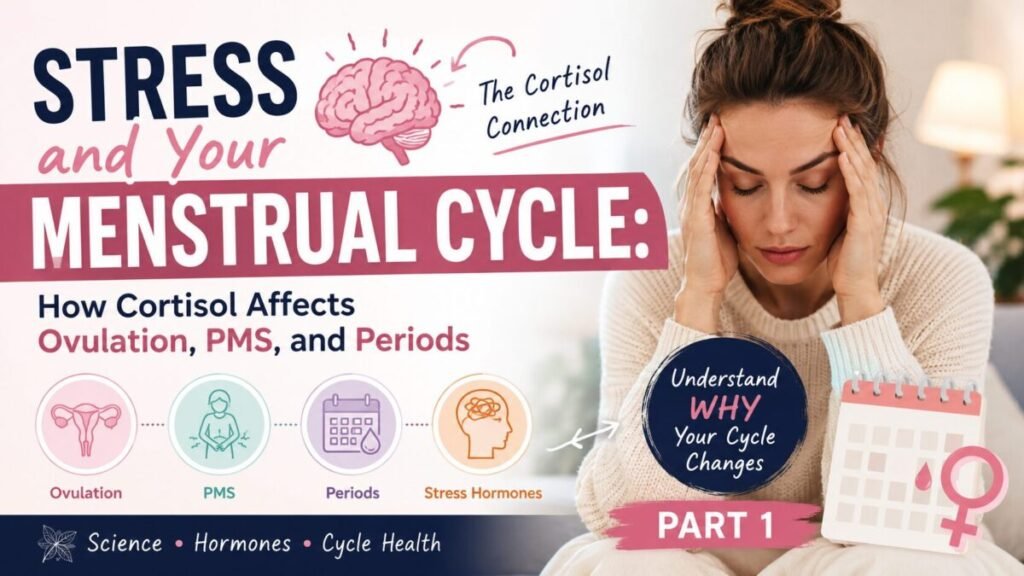
Stress and Your Menstrual Cycle: How Cortisol Affects Ovulation, PMS, and Periods
Have you ever noticed that your period arrived late after a particularly stressful month?
Perhaps your cycle suddenly became irregular during exams, a major work project, a move, relationship difficulties, financial worries, illness, or another challenging period of life.
Maybe your PMS became worse than usual. Perhaps your periods became heavier, lighter, more painful, or disappeared altogether.
If so, you’re not imagining it.
Stress is one of the most common reasons women experience changes in their menstrual cycle.
In fact, many women first notice that something is “off” through their cycle before they recognize how much stress they are carrying.
Your menstrual cycle is not isolated from the rest of your body. It reflects what is happening throughout your entire system—including your brain, nervous system, hormones, immune system, metabolism, sleep patterns, and emotional wellbeing.
When stress levels rise, your body may temporarily shift resources away from reproduction and toward survival. This can influence ovulation, hormone production, cycle length, menstrual symptoms, and fertility.
In this article, you’ll learn:
What stress actually is
How the body’s stress response works
The role of cortisol, often called the “stress hormone”
How stress affects ovulation and menstrual cycle regularity
Why PMS may worsen during stressful periods
Why some women are more affected than others
Common signs that stress may be influencing your cycle
Let’s start by understanding what stress really is.
What Is Stress?
Stress is the body’s natural response to a situation that is perceived as challenging, demanding, threatening, or destabilizing.
Importantly, stress does not only occur during emergencies.
Your body can react to many different types of stressors, including:
Psychological Stressors
Work pressure
Exams
Deadlines
Financial concerns
Relationship difficulties
Caregiving responsibilities
Worry and anxiety
Physical Stressors
Illness
Injury
Pain
Surgery
Sleep deprivation
Overtraining
Undereating
Environmental Stressors
Noise
Pollution
Overcrowding
Constant digital stimulation
Major Life Changes
Moving
Divorce
Grief
Pregnancy
Childbirth
Starting a new job
Menopause transition
Interestingly, your body often responds similarly whether the threat is physical or emotional.
The same stress response that once helped our ancestors escape danger can also be triggered by a difficult email, an argument, financial uncertainty, or months of poor sleep.
Not All Stress Is Bad
When discussing stress, it’s important to recognize that not all stress is harmful.
Researchers often distinguish between:
Eustress
“Eustress” refers to positive, motivating stress.
Examples include:
Planning a wedding
Starting a new job
Training for an event
Learning a new skill
Becoming a parent
Although these situations can feel demanding, they are often perceived as meaningful challenges rather than threats.
Distress
Distress occurs when demands exceed our ability to cope.
This type of stress is more likely to cause:
Anxiety
Exhaustion
Sleep disturbances
Mood changes
Hormonal disruption
The menstrual cycle is typically more affected by prolonged distress than by short-term, manageable stress.
Acute Stress vs. Chronic Stress
Another important distinction is between acute and chronic stress.
Acute Stress
Acute stress is short-term stress.
Examples include:
Giving a presentation
Taking an exam
Missing a train
Having a difficult conversation
Acute stress activates the body’s stress response temporarily. Once the challenge passes, the body usually returns to normal.
For most women, occasional acute stress has little long-term impact on the menstrual cycle.
Chronic Stress
Chronic stress occurs when the body remains under pressure for weeks, months, or even years.
Examples include:
Ongoing work stress
Financial hardship
Chronic illness
Relationship conflict
Long-term sleep deprivation
Caregiver burnout
This is where menstrual cycle changes become more likely.
Unlike acute stress, chronic stress continuously activates hormonal pathways that can interfere with reproductive function.
To understand why this happens, we need to look at the body’s stress response system.
The Stress Response: Your Body’s Built-In Survival System
When your brain detects a potential threat, it immediately activates several systems designed to keep you safe.
The first system involved is the autonomic nervous system.
This system has two major branches:
Sympathetic Nervous System
Often called the “fight-or-flight” system.
When activated, it prepares the body for action by:
Increasing heart rate
Raising blood pressure
Increasing alertness
Directing blood flow toward muscles
Releasing stress hormones
Parasympathetic Nervous System
Often called the “rest-and-digest” system.
It helps the body:
Relax
Digest food
Recover
Repair tissues
Restore balance
Healthy stress regulation depends on the ability to move between these two states.
When stress becomes chronic, many people spend too much time in a sympathetic “always on” state and not enough time in recovery mode.
Meet the HPA Axis: The Body’s Stress Command Center
One of the most important systems involved in stress is the Hypothalamic-Pituitary-Adrenal Axis, often called the HPA axis.
Although the name sounds complicated, the concept is fairly simple.
The HPA axis is the communication pathway between:
The hypothalamus in the brain
The pituitary gland
The adrenal glands located above the kidneys
When a stressor is perceived:
Step 1
The hypothalamus releases CRH (Corticotropin-Releasing Hormone).
Step 2
CRH signals the pituitary gland to release ACTH (Adrenocorticotropic Hormone).
Step 3
ACTH tells the adrenal glands to produce cortisol.
This process happens automatically and continuously helps the body adapt to challenges.
In short:
Stress → CRH → ACTH → Cortisol
This hormonal cascade is a normal and essential survival mechanism.
The problem arises when the stress response never truly switches off.
Cortisol: The Stress Hormone
Cortisol is often called the stress hormone, but it is actually much more than that.
Cortisol helps:
Regulate energy production
Maintain blood sugar levels
Control inflammation
Support immune function
Regulate blood pressure
Influence mood and cognition
Promote alertness
Without cortisol, we could not function normally.
Under healthy conditions, cortisol follows a daily rhythm.
Levels are highest in the morning, helping us wake up and become alert.
They gradually decline throughout the day and become lowest at night, allowing restful sleep.
However, chronic stress can disrupt this natural rhythm.
Instead of rising and falling appropriately, cortisol patterns may become dysregulated.
This disruption can affect multiple body systems—including the reproductive system.
And this is where the menstrual cycle enters the story.
Why Stress Can Change Your Cycle
Your body constantly evaluates whether conditions are favorable for reproduction.
From a biological perspective, ovulation and pregnancy require significant energy and resources.
If the brain perceives that resources are limited or that survival is the priority, reproductive functions may temporarily become less important.
This communication occurs through another hormonal system called the Hypothalamic-Pituitary-Ovarian (HPO) Axis.
The HPO axis regulates:
Follicle development
Ovulation
Estrogen production
Progesterone production
The menstrual cycle
Unfortunately, the HPA axis (stress system) and HPO axis (reproductive system) constantly communicate with each other.
When cortisol remains elevated for extended periods, it can interfere with the hormonal signals that support ovulation.
This is one of the primary reasons stress can affect the menstrual cycle.
In Part 2, we’ll explore exactly how stress influences ovulation, delayed periods, PMS, spotting, menstrual flow, and fertility—and why some women experience significant cycle changes while others notice very little difference.
How exactly does stress affect ovulation, periods, PMS, and fertility?
The answer lies in the complex communication between your stress hormones and your reproductive hormones.
The Conversation Between Stress Hormones and Reproductive Hormones
Your body does not operate through separate systems.
The brain, nervous system, immune system, metabolism, and reproductive system constantly communicate with one another.
The menstrual cycle depends on a delicate hormonal conversation known as the:
Hypothalamic-Pituitary-Ovarian (HPO) Axis
This system regulates:
Follicle development
Ovulation
Estrogen production
Progesterone production
Menstrual cycle timing
Fertility
Under normal conditions:
Step 1
The hypothalamus releases GnRH (Gonadotropin-Releasing Hormone).
Step 2
GnRH signals the pituitary gland to release:
FSH (Follicle Stimulating Hormone)
LH (Luteinizing Hormone)
Step 3
FSH and LH stimulate the ovaries.
The ovaries then produce:
Estrogen
Progesterone
Together, these hormones coordinate the menstrual cycle.
When everything is functioning optimally, ovulation occurs, progesterone rises after ovulation, and menstruation follows approximately two weeks later if pregnancy does not occur.
Stress can interfere with this process at multiple levels.
Why the Body May Delay Ovulation During Stress
From an evolutionary perspective, reproduction requires energy.
Pregnancy, childbirth, and breastfeeding are all energy-intensive processes.
If the brain perceives that resources are limited or that survival is threatened, it may temporarily reduce reproductive investment.
This is not a defect.
It is a protective adaptation.
When cortisol remains elevated for prolonged periods, it can interfere with GnRH signaling from the hypothalamus.
Reduced GnRH signaling may alter the release of FSH and LH.
As a result:
Follicle development may slow down
Ovulation may occur later
Ovulation may not occur at all in some cycles
For many women, this is the most common way stress affects the menstrual cycle.
Why Stress Often Causes a Late Period
One of the most common questions women ask is:
“Can stress delay my period?”
The answer is yes.
However, stress usually delays ovulation first.
This distinction is important.
Many women assume menstruation is delayed directly.
In reality, the sequence often looks like this:
Stress → Delayed Ovulation → Delayed Period
For example:
A woman usually ovulates around Day 14 and has a 28-day cycle.
During a stressful month, ovulation may occur on Day 25 instead.
Since menstruation generally occurs about 12-16 days after ovulation, her cycle may suddenly become:
37 days
40 days
42 days
or even longer.
The period itself is not necessarily late.
Ovulation occurred later.
Understanding this concept helps explain why cycle length often changes during stressful periods.
Can Stress Stop Ovulation Completely?
Sometimes.
If stress is intense or prolonged, ovulation may not occur during a cycle.
This is called an:
Anovulatory Cycle
Anovulatory cycles are cycles in which ovulation does not occur.
Without ovulation:
No corpus luteum forms
Progesterone remains low
The hormonal pattern of the cycle changes
Some women may still experience bleeding.
However, that bleeding is often hormonally different from a typical menstrual period.
An occasional anovulatory cycle can happen even in healthy women.
However, frequent anovulation should be evaluated by a healthcare professional.
Can Stress Cause Missed Periods?
Yes.
Severe stress can sometimes lead to:
Stress-Induced Amenorrhea
Amenorrhea means the absence of menstruation.
This can occur when prolonged stress significantly suppresses reproductive hormone signaling.
Examples may include:
Major grief
Severe emotional trauma
Chronic overwork
Extreme academic pressure
Intensive athletic training
Significant sleep deprivation
Serious illness
In these situations, the brain may temporarily reduce reproductive activity until conditions improve.
This response is often reversible when the underlying stressors are addressed.
However, any prolonged absence of menstruation should be discussed with a healthcare professional to identify potential underlying causes.
Can Stress Cause Spotting Between Periods?
Many women notice unexpected spotting during stressful periods.
Stress-related hormonal fluctuations can sometimes contribute to:
Mid-cycle spotting
Premenstrual spotting
Irregular bleeding
Breakthrough bleeding
This may occur because stress influences:
Estrogen production
Progesterone production
Timing of ovulation
The result can be temporary instability in the uterine lining.
While occasional spotting may occur during stressful times, persistent or unexplained bleeding should always be evaluated by a healthcare professional.
Stress and Progesterone: Why PMS May Become Worse
Many women notice that stressful months are accompanied by:
More intense PMS
Increased irritability
Anxiety
Mood swings
Breast tenderness
Fatigue
Sleep disturbances
This is not surprising.
The hormonal changes caused by stress can influence the luteal phase—the second half of the cycle after ovulation.
If ovulation is delayed, disrupted, or weaker than usual, progesterone production may also be affected.
Progesterone plays important roles in:
Mood regulation
Sleep quality
Nervous system calming
Endometrial stability
When progesterone levels are suboptimal, some women experience more pronounced premenstrual symptoms.
This does not mean stress is the only cause of PMS.
However, stress can significantly amplify symptoms in women who are already susceptible.
Why Stress Can Make PMDD Feel Worse
Women with Premenstrual Dysphoric Disorder (PMDD) often report that stressful periods worsen symptoms.
Although PMDD is not caused by stress, stress may increase sensitivity to hormonal fluctuations.
Chronic stress can also contribute to:
Poor sleep
Emotional exhaustion
Increased anxiety
Reduced stress resilience
Together, these factors may make PMDD symptoms feel more severe and harder to manage.
Stress, Inflammation, and Menstrual Symptoms
Stress affects more than hormones.
It also influences the immune system and inflammatory pathways.
Short-term stress can temporarily help the body respond to challenges.
Chronic stress, however, may contribute to low-grade inflammation throughout the body.
Researchers have found that chronic stress can increase the production of inflammatory signaling molecules known as cytokines.
Inflammation may contribute to:
Increased menstrual discomfort
Greater fatigue
Worsening PMS symptoms
Headaches
Mood changes
Although inflammation is only one piece of the puzzle, it helps explain why stressful periods often feel physically harder as well as emotionally harder.
Stress, Sleep, and Your Menstrual Cycle
Stress rarely affects the menstrual cycle alone.
It often affects sleep at the same time.
Many women experiencing chronic stress notice:
Difficulty falling asleep
Frequent awakenings
Restless sleep
Feeling tired despite spending enough time in bed
Unfortunately, poor sleep can further increase cortisol levels.
This creates a cycle:
Stress → Poor Sleep → Higher Stress → More Hormonal Disruption
Because sleep is essential for hormonal regulation, this cycle may contribute to:
Irregular ovulation
PMS worsening
Increased fatigue
Cycle irregularities
We’ll explore this topic in much greater detail in the next article of this series.
Stress Often Changes Lifestyle Habits Too
Stress does not only affect hormones directly.
It often changes daily behaviors.
During stressful periods, many people experience:
Less sleep
More caffeine
More alcohol
Less physical activity
Emotional eating
Increased sugar intake
Skipping meals
Reduced self-care
These changes can further influence hormonal balance.
For example:
A woman who is stressed may sleep poorly, consume more caffeine, exercise less, and rely on highly processed convenience foods.
Each of these factors can independently influence hormonal health.
This is one reason stress-related cycle changes are often multifactorial rather than being caused by cortisol alone.
Your Cycle Is Listening to Your Stress Levels
Many women notice changes in their cycle before they consciously recognize how stressed they have become.
A delayed period.
New spotting.
Worsening PMS.
More painful periods.
Changes in cervical mucus.
Changes in ovulation timing.
These signs do not necessarily mean something is wrong.
Sometimes they are the body’s way of communicating that recovery, rest, and support are needed.
How to Reduce Stress and Support a Healthy Menstrual Cycle
At this point, you may be wondering:
“If stress can affect my hormones so much, what can I do about it?”
The good news is that your body is designed to recover.
The stress response is not the problem. The problem is when your body never gets the signal that the danger has passed.
Modern life often keeps us in a state of constant alert:
Work deadlines
Financial worries
Family responsibilities
Caring for children or aging parents
Relationship challenges
Sleep deprivation
Social media overload
The feeling that we must always be available
Your nervous system was designed to handle short bursts of stress—not months or years of continuous pressure.
The goal is not to eliminate all stress.
The goal is to help your nervous system regularly return to a state of safety, recovery, and restoration.
When that happens, your reproductive system can function more effectively.
Step 1: Improve Stress Awareness
Many women underestimate how much stress they are actually carrying.
A common response is:
“I’m not stressed.”
Yet the same woman may be experiencing:
Poor sleep
Increased PMS
Digestive issues
Headaches
Fatigue
Anxiety
Shorter patience
Increased sugar cravings
Cycle irregularities
Stress does not always feel like panic.
Sometimes it feels like:
Constant busyness
Mental overload
Never having enough time
Emotional exhaustion
Living on autopilot
The first step is awareness.
Ask yourself:
What is currently demanding the most energy from me?
What has changed in my life recently?
When did my cycle changes begin?
What was happening in my life at that time?
Many women discover that their cycle changes appeared shortly after:
Starting a new job
Moving house
Relationship difficulties
Fertility struggles
Pregnancy loss
Caring responsibilities
Financial uncertainty
Chronic illness
Major life transitions
Recognizing the connection is often the first step toward healing.
Step 2: Prioritize Sleep
Sleep is one of the most powerful regulators of the stress response.
When sleep becomes disrupted:
Cortisol regulation becomes impaired
Blood sugar control worsens
Inflammation increases
Emotional resilience decreases
PMS symptoms may worsen
Ovulation may become less predictable
Poor sleep and stress create a vicious cycle:
Stress causes poor sleep.
Poor sleep increases stress sensitivity.
Breaking this cycle can significantly improve hormonal health.
Helpful strategies include:
Going to bed at consistent times
Morning sunlight exposure
Limiting screens before bed
Reducing caffeine later in the day
Creating a calming evening routine
We will explore this topic in detail in the next article of this series.
Step 3: Use Movement to Regulate Stress
Movement is one of the body’s natural stress-relief mechanisms.
Physical activity helps:
Lower stress hormone levels
Improve mood
Support healthy blood sugar regulation
Improve sleep quality
Increase resilience to future stress
Importantly, the goal is not necessarily intense exercise.
Sometimes the most beneficial movement for stress relief includes:
Walking
Dancing
Gentle cycling
Yoga
Stretching
Nature walks
The Aviva Method and Stress Reduction
One often-overlooked benefit of the Aviva Method is its effect on emotional well-being and stress regulation.
Many women initially discover the Aviva Method because they are looking for support with:
Cycle irregularities
PMS
Fertility challenges
Hormonal balance
But they often notice something else as well:
They feel better emotionally after practicing.
The dynamic movements used in the Aviva Method naturally encourage stress release.
Large arm movements, rhythmic full-body motions, and moving to music can help:
Release accumulated tension
Improve circulation
Boost mood
Increase energy levels
Create a feeling of vitality and empowerment
Movement and music have long been recognized as powerful tools for emotional regulation.
When we move rhythmically, breathe deeply, and engage the whole body, we provide our nervous system with signals of safety and freedom of movement.
For many women, an Aviva practice feels less like exercise and more like a joyful reset.
Another unique feature is that the Aviva sequence traditionally ends with relaxation.
This transition from active movement into relaxation helps the body shift from a more activated state toward parasympathetic recovery—the “rest and restore” mode that supports healing, recovery, and hormonal balance.
Step 4: Practice Relaxation Daily
Relaxation is not a luxury.
It is a biological necessity.
Research consistently shows that relaxation techniques can help lower stress responses and improve overall well-being.
Examples include:
Deep Breathing
Slow diaphragmatic breathing helps activate the parasympathetic nervous system.
Even a few minutes can help reduce tension.
Heart Coherence Breathing
Heart coherence involves slow, rhythmic breathing.
A common approach is:
Inhale for 5 seconds
Exhale for 5 seconds
for several minutes.
Many women find this particularly effective during stressful periods.
Mindfulness Meditation
Mindfulness helps develop awareness of thoughts and emotions without becoming overwhelmed by them.
Regular practice may improve stress resilience and emotional regulation.
Gentle Yoga
Yoga combines movement, breathing, and relaxation.
Many women find it helpful for reducing stress-related tension and improving body awareness.
Guided Relaxation and Hypnosis
Guided relaxation can be especially useful for women who find it difficult to switch off their thoughts.
If you would like additional support, you can try my free Hypnotic Relaxation audio, designed to help calm the nervous system and encourage deep relaxation.
You may also enjoy my Premium Cycle-Syncing Hypnotic Relaxation Series, which provides guided relaxation practices tailored to the different phases of the menstrual cycle.
Many women find these recordings helpful for creating regular moments of rest and recovery within busy lives.
Step 5: Nourish Your Body
Chronic stress increases nutritional demands.
Your body uses more resources when managing prolonged stress.
Focus on:
Adequate protein
Healthy fats
Fruits and vegetables
Magnesium-rich foods
Omega-3 fatty acids
Regular meals
Avoid relying solely on:
Excess caffeine
Sugary snacks
Energy drinks
While these may provide temporary energy, they can sometimes worsen the stress cycle.
Cycle Tracking: One of the Most Powerful Stress Management Tools
If you are tracking your cycle, do not only record:
Period dates
Cervical mucus
Basal body temperature
Ovulation signs
Also record your stress levels.
Many women discover important patterns when they begin tracking:
Work deadlines
Travel periods
Family conflicts
Sleep disruption
Illness
Major life events
Alongside these stressors, record:
How stressed you felt
Which stress-management techniques you used
Whether you practiced breathing exercises
Whether you did the Aviva Method
Whether you meditated
Whether you listened to relaxation recordings
How your symptoms changed afterward
Over time, your cycle tracker becomes much more than a fertility or period tracker.
It becomes a personal health journal.
You may discover:
Which stressors affect you most
Which coping strategies help you recover fastest
How stress affects ovulation timing
How PMS changes during stressful months
Which habits improve your cycle
These insights are incredibly valuable because every woman responds differently to stress.
Key Takeaways
Stress is one of the most common reasons women experience changes in their menstrual cycle.
When stress becomes chronic, increased cortisol can interfere with the communication between the brain and ovaries, affecting ovulation, cycle length, PMS symptoms, and menstrual patterns.
Possible signs of stress-related cycle changes include:
Delayed ovulation
Longer cycles
Irregular periods
Missed periods
Spotting
Worse PMS
Increased menstrual symptoms
The encouraging news is that these changes are often reversible when stress levels decrease and the body receives the support it needs.
By prioritizing:
Sleep
Stress management
Relaxation
Nourishing nutrition
Appropriate movement
Cycle tracking
you can help support both your hormonal health and overall well-being.
Your menstrual cycle is not just a reproductive event.
It is a valuable monthly reflection of how your body is responding to the demands of life.
Learning to listen to those signals can provide powerful insights into your health, resilience, and hormonal balance.