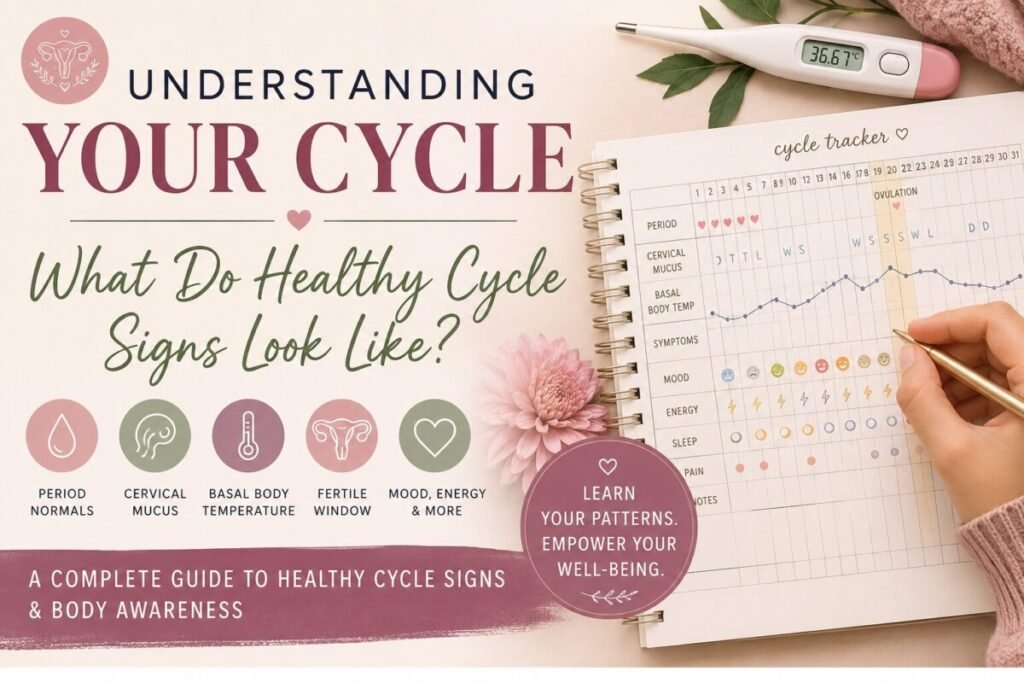
Have you ever wished your body came with an instruction manual?
Many women spend years experiencing menstrual cycles without fully understanding the signs their bodies provide each month. Changes in energy, mood, cervical mucus, sleep, appetite, and body temperature can seem random—until you begin tracking them.
The truth is that your menstrual cycle is more than just your period.
It is a dynamic rhythm influenced by the communication between your brain, hormones, ovaries, and reproductive system. Learning to recognize this rhythm can help you better understand your health, fertility, and overall well-being.
Whether you’re trying to conceive, hoping to better understand your hormones, navigating perimenopause, or simply curious about your body’s natural patterns, cycle tracking can be a valuable tool for self-awareness.
Why Track Your Cycle?
Imagine trying to understand a song by listening to only one note.
That’s often what happens when we pay attention only to the day our period starts and ignore everything else happening throughout the month.
Cycle tracking helps you notice patterns such as:
- Menstrual flow and bleeding patterns
- Cervical mucus changes
- Ovulation signs
- Basal body temperature shifts
- Mood and energy fluctuations
- Sleep quality
- Appetite changes
- Menstrual discomfort
Over time, these observations can help you better understand what is typical for your body.
The goal is not perfection.
The goal is awareness.
The Menstrual Cycle: More Than Just a Period
The menstrual cycle is a coordinated process involving communication between the hypothalamus, pituitary gland, and ovaries.
Each month, hormones work together to prepare the body for a possible pregnancy. If pregnancy does not occur, the uterine lining is shed during menstruation and the cycle begins again.
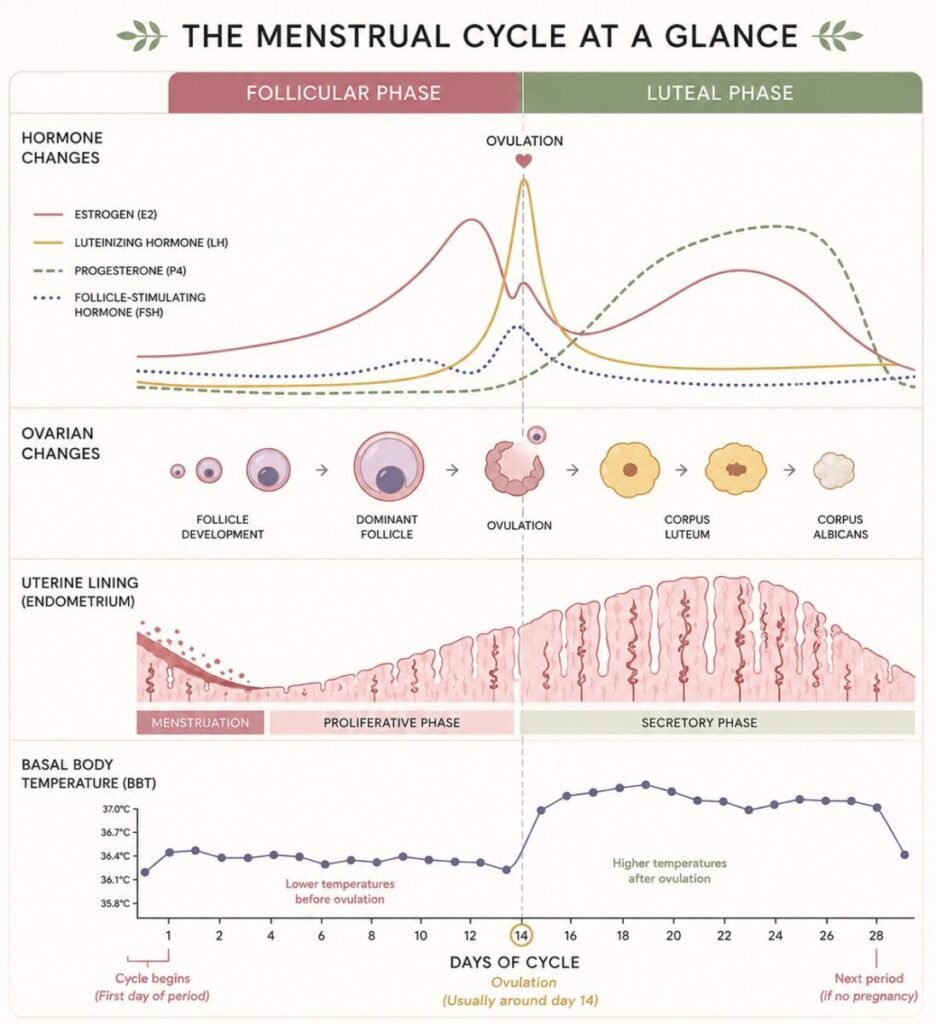
The cycle consists of two main phases:
Follicular Phase
The follicular phase begins on the first day of menstrual bleeding and continues until ovulation.
This phase is the most variable part of the cycle and is responsible for most differences in overall cycle length.
Many women experience a follicular phase lasting approximately 12 to 16 days, although individual variation is normal.
During this phase:
- Estrogen gradually rises
- A dominant follicle develops in the ovary
- Energy often increases
- Cervical mucus begins to change
Luteal Phase
The luteal phase begins after ovulation and continues until the next period.
Unlike the follicular phase, the luteal phase is relatively constant and typically lasts around 14 days.
During this phase:
- Progesterone becomes the dominant hormone
- Body temperature rises
- The uterine lining prepares for possible implantation
- Energy and mood patterns may shift
What Is Considered a Healthy Cycle Length?
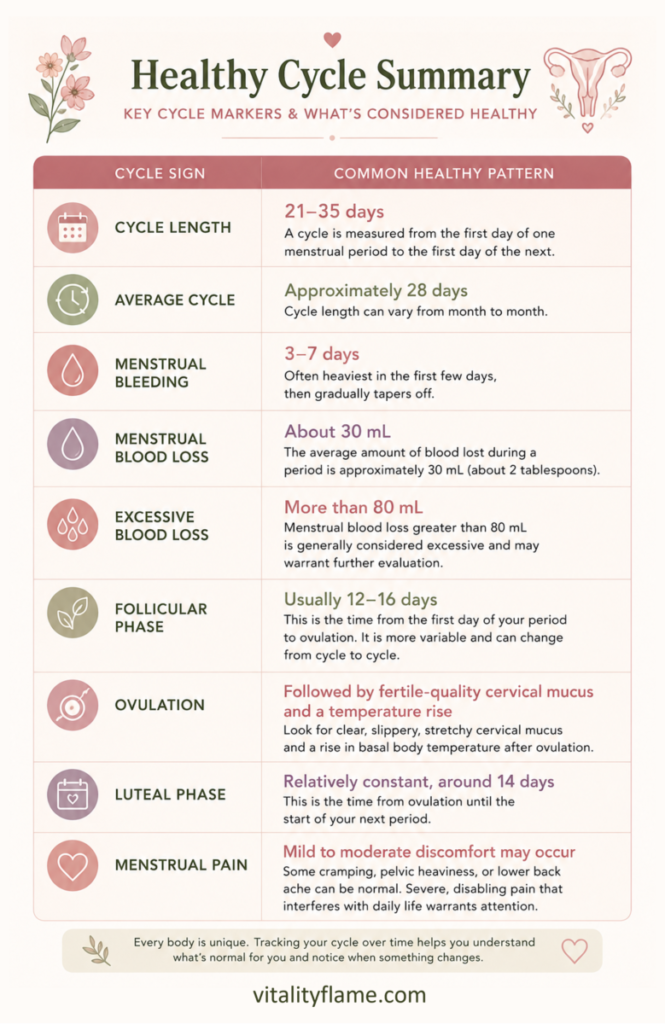
The average menstrual cycle lasts approximately 28 days.
Most healthy cycles occur between 21 and 35 days.
A menstrual cycle is measured from the first day of one menstrual period to the first day of the next.
Rather than aiming for a perfect 28-day cycle, it can be more helpful to observe whether your cycle follows a generally predictable pattern over time.
What Does a Healthy Period Look Like?
Menstrual bleeding typically lasts between 3 and 7 days.
Many women notice:
- Heavier flow during the first few days
- Gradually lighter flow toward the end
- Bright red or deep red blood at the beginning
- Darker red, brown, or pink blood toward the end
These variations are often a normal part of the menstrual process.
How Much Menstrual Blood Is Typical?
Many women wonder whether their periods are too light or too heavy.
Research suggests that the average amount of menstrual blood lost during a period is approximately 30 mL, which is roughly two tablespoons.
Blood loss greater than 80 mL is generally considered excessive.
Because most women do not measure menstrual blood directly, it can be helpful to observe practical signs such as:
- How many days bleeding lasts
- Whether protection needs to be changed unusually frequently
- The presence of large clots
- Whether bleeding interferes with daily activities
What About Menstrual Pain?
Many women are told that severe menstrual pain is simply part of being a woman.
However, there is an important difference between discomfort and debilitating pain.
During a healthy cycle, some women may experience:
- Mild to moderate cramping
- Pelvic heaviness
- A feeling of pressure in the lower abdomen
- Lower energy levels
- A greater need for rest
Pain that regularly prevents normal daily activities, keeps you in bed, causes vomiting or fainting, or requires strong pain medication deserves attention and should be discussed with a qualified healthcare professional.
What Does Healthy Menstrual Blood Texture Look Like?
Many women pay attention to the amount and colour of menstrual bleeding but rarely learn about menstrual blood texture. Just like blood colour, texture can vary throughout a period and from one cycle to another.
In a healthy menstrual cycle, menstrual blood is usually a mixture of:
- Blood
- Endometrial tissue (the uterine lining)
- Cervical mucus
- Vaginal secretions
Because of this, menstrual flow is not always identical in appearance from day to day.
Common Healthy Menstrual Blood Textures
Fluid or Silky
This is one of the most common textures.
Menstrual blood may appear:
- Smooth
- Flowing
- Easy to wipe or absorb
This texture is often seen on moderate-flow days.
Slightly Dense
Blood may appear:
- Thicker
- More concentrated
- Less watery
This can be common during heavier flow days and is not necessarily a concern.
Small Clots
Small clots can occur during menstruation.
They are often:
- Dark red
- Soft
- Smaller than a coin
Small occasional clots are generally considered a normal part of menstruation, particularly during heavier flow days.
Gel-like or Stringy
Some women notice:
- Jelly-like pieces
- Stringy tissue fragments
- Small pieces of shed endometrial lining
Occasional gel-like material can be a normal part of the shedding process.
When Might Texture Deserve Attention?
While variation is normal, you may wish to discuss your observations with a healthcare professional if you regularly notice:
- Very large clots (larger than approximately 2–3 cm or 1 inch)
- Extremely heavy bleeding
- Large amounts of tissue-like material
- Significant changes from your usual pattern
- Menstrual bleeding accompanied by severe pain
Healthy Cycle Summary
While every woman is unique, certain patterns are commonly associated with healthy ovulatory cycles.
Understanding Cervical Mucus
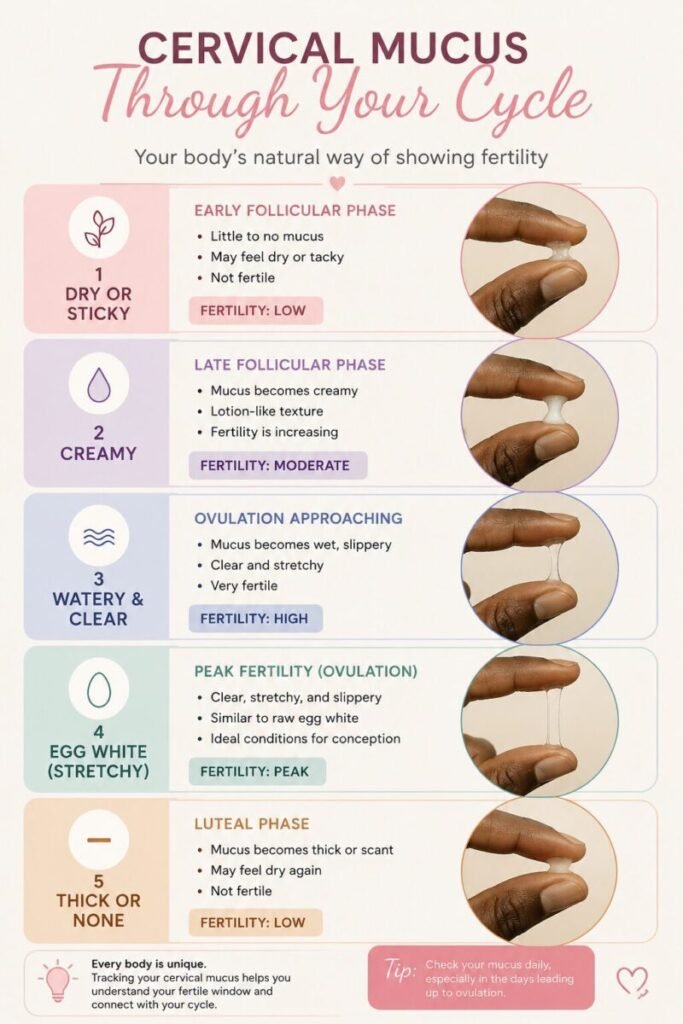
One of the most informative cycle signs is cervical mucus.
The appearance and texture of cervical mucus change throughout the cycle in response to hormones.
After Menstruation
You may notice:
- Dryness
- Sticky mucus
- Little or no visible mucus
As Ovulation Approaches
Mucus often becomes:
- Creamy
- Lotion-like
- More abundant
During the Fertile Window
The most fertile mucus is often:
- Clear
- Stretchy
- Slippery
- Similar to raw egg white
Many women notice a feeling of natural lubrication during this time.
After Ovulation
Mucus commonly becomes:
- Sticky
- Creamy
- Less abundant
- Dry
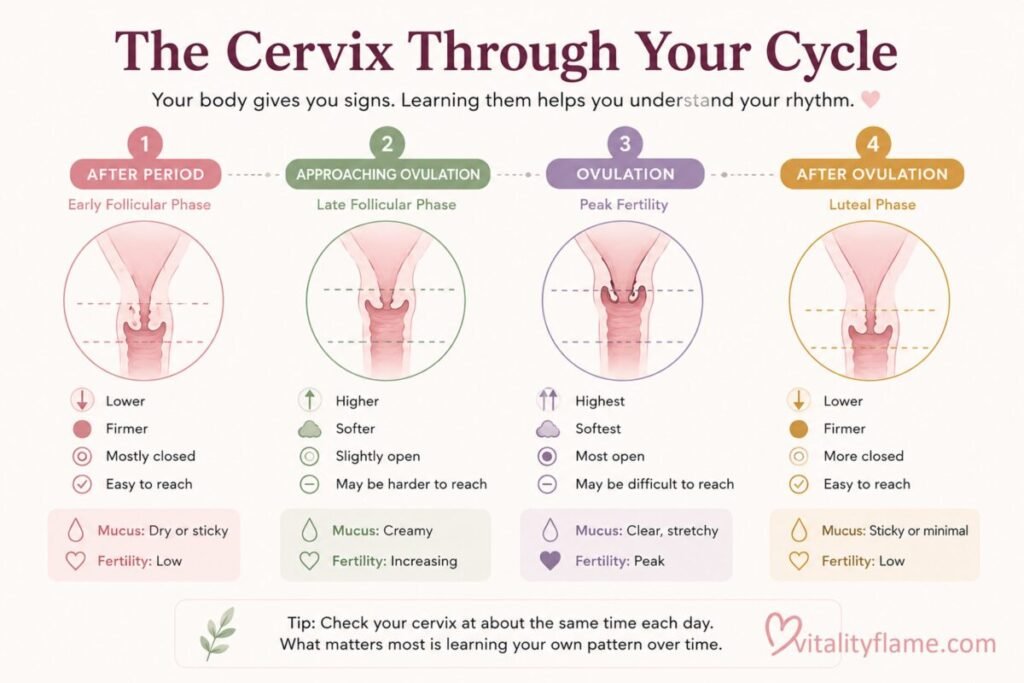
What About the Cervix?
While many women are familiar with tracking cervical mucus or basal body temperature, fewer realize that the cervix itself changes throughout the menstrual cycle.
The cervix is the lower part of the uterus that extends into the vagina. Its position, firmness, and openness are influenced by hormonal changes throughout the month.
Think of the cervix as another way your body communicates what phase of the cycle you’re in.
How Can You Check Your Cervix?
If you choose to track cervical position, try checking at approximately the same time each day.
Before You Begin
- Wash your hands thoroughly.
- Find a comfortable position, such as:
- Squatting
- Sitting on the toilet
- Standing with one foot elevated
- Gently insert one or two fingers into the vagina until you feel the cervix.
Many women describe the cervix as feeling somewhat like the tip of a nose, with a small dimple or opening in the center.
Don’t worry if it feels difficult to find at first. The cervix can sit at different heights throughout the cycle, and it often becomes easier to recognize after several cycles of observation.
What Does the Cervix Feel Like Throughout the Cycle?
During Menstruation
The cervix is often:
- Slightly lower
- Somewhat open to allow menstrual blood to pass
- Moderately firm
Many women notice little change during the bleeding days.
After Menstruation
As the fertile window is still some days away, the cervix is commonly:
- Lower
- Firmer
- More closed
Many women describe it as feeling similar to the tip of the nose.
Approaching Ovulation
As estrogen rises, the cervix begins to change.
It often becomes:
- Higher in the vagina
- Softer
- Slightly more open
Some women find it more difficult to reach because it sits higher.
The texture may feel more like the softness of lips rather than the firmness of the nose.
Around Ovulation
Near peak fertility, many women observe:
- A high cervix
- A soft cervix
- A more open cervical opening
- Abundant fertile cervical mucus
These changes help support sperm movement through the reproductive tract.
After Ovulation
As progesterone rises, the cervix typically returns to a less fertile state.
It often becomes:
- Lower
- Firmer
- More closed
Cervical mucus also usually becomes thicker, stickier, or less noticeable.
Understanding Basal Body Temperature Throughout the Cycle
Basal Body Temperature (BBT) is your body’s resting temperature, measured immediately after waking and before getting out of bed.
The reason many women track BBT is that progesterone, the hormone produced after ovulation, has a warming effect on the body.
This means your temperature can provide a valuable clue about whether ovulation has occurred.
However, BBT is not a crystal ball. It does not predict ovulation. Instead, it helps confirm that ovulation likely happened after a temperature shift is observed.
What Does a Typical BBT Pattern Look Like?
Before Ovulation
During the follicular phase, estrogen is the dominant hormone.
Temperatures are typically lower, often somewhere between:
- 36.1°C–36.5°C (97.0–97.7°F)
The exact number is less important than the overall pattern.
Some women naturally run cooler or warmer than others.
Around Ovulation
Many women notice:
- A brief dip in temperature
- No noticeable change
- Small fluctuations
Not everyone experiences a clear ovulation dip.
The most important sign is what happens afterward.
After Ovulation
Once progesterone rises, temperatures usually increase by approximately:
- 0.2–0.5°C
- (0.4–1.0°F)
Temperatures then remain elevated throughout the luteal phase.
This creates the classic biphasic chart, meaning there are two distinct temperature levels:
- Lower temperatures before ovulation
- Higher temperatures after ovulation
Before Menstruation
If pregnancy does not occur, progesterone falls.
Temperatures often drop shortly before or during menstruation.
The cycle then begins again.
Why Doesn’t Every Chart Look Like a Textbook?
Many fertility awareness books show beautifully smooth temperature charts.
Real life rarely looks that neat.
A healthy woman can have temperature fluctuations even when ovulation occurs normally.
What matters is the overall trend rather than individual readings.
Think of BBT like watching the tide.
One wave may rise or fall unexpectedly, but the overall direction tells the story.
How to Measure BBT for the Most Reliable Results
For the most consistent readings:
✓ Use a basal body thermometer.
✓ Measure immediately after waking.
✓ Measure before sitting up, talking, eating, drinking, or checking your phone.
✓ Measure at approximately the same time each morning.
✓ Aim for at least 3–4 hours of uninterrupted sleep beforehand.
✓ Record the result right away.
Many women use smartphone apps, fertility awareness charts, or cycle trackers to record their temperatures.
What Can Affect Your Temperature?
Even in healthy women, many everyday factors can influence BBT.
Sleep Changes
A later bedtime, early waking, interrupted sleep, insomnia, or caring for a child during the night can affect readings.
Stress
Physical and emotional stress may influence hormone production, sleep quality, and body temperature.
Alcohol
Alcohol consumption can increase body temperature and alter the following morning’s reading.
Illness
Even a mild cold, allergies, infection, or low-grade fever can significantly affect temperatures.
Travel
Time zone changes, jet lag, and disrupted sleep patterns may influence BBT.
Room Temperature
Very hot or very cold sleeping environments may have an effect in some individuals.
Medications
Certain medications can influence body temperature.
Exercise
Intense late-night exercise may affect some women’s readings.
Shift Work
Women working rotating shifts often find BBT tracking more challenging because sleep schedules vary significantly.
Why BBT Shouldn’t Be Used Alone
Because temperature can be influenced by so many factors, many fertility awareness educators recommend combining BBT with other observations.
For example:
- Cervical mucus
- Cervical position
- LH testing
- Cycle length patterns
When several signs point in the same direction, the overall picture is often clearer than relying on temperature alone.
Understanding Your Fertile Window
One of the most fascinating aspects of cycle tracking is discovering that fertility is not evenly distributed throughout the month.
The fertile window generally includes:
- The several days leading up to ovulation
- The day of ovulation
- Possibly the day after ovulation
This is because sperm can survive in fertile cervical mucus for several days, while an egg remains viable for approximately 12–24 hours after ovulation.
Common signs that ovulation may be approaching include:
- Increasing cervical mucus
- Slippery sensations
- Egg-white cervical mucus
- A higher, softer cervix
- A positive LH test
Cycle Awareness Beyond Fertility
Cycle tracking is about much more than fertility.
Many women begin tracking because they want to understand ovulation or their menstrual cycle, but over time they often discover something even more valuable: patterns.
Your cycle can influence many aspects of daily life, including:
- Mood
- Energy levels
- Sleep quality
- Appetite and cravings
- Digestion
- Exercise performance
- Concentration and productivity
- Social preferences
- Menstrual comfort
- PMS symptoms
At first, these changes may seem random. One month you feel energetic and focused, while another month you struggle with fatigue, cravings, irritability, or poor sleep.
However, when you consistently track your cycle, symptoms, and habits, connections often begin to emerge.
You may notice that certain lifestyle choices tend to make symptoms worse, while others help you feel your best.
For example, some women discover that:
- Poor sleep makes PMS symptoms feel more intense.
- Stressful periods are followed by changes in cycle length.
- Certain foods seem to worsen bloating or digestive discomfort.
- Regular exercise helps improve mood and energy.
- Eating balanced meals reduces cravings and energy crashes.
- Alcohol affects sleep quality and menstrual symptoms.
- Relaxation practices help reduce stress-related cycle disruptions.
These observations are not about perfection or following rigid rules. They are about learning how your body responds to different habits and circumstances.
Over time, cycle tracking can become a personal guidebook that helps you make more informed choices about nutrition, movement, rest, and self-care.
A Tool for Discovering Your Unique Patterns
To support this process, I created the Cycle & Symptom Tracking Journal.
The journal includes printable pages that allow you to track:
- Menstrual flow
- Cervical mucus
- Basal body temperature
- Mood
- Sleep
- Appetite
- Digestion
- Exercise and physical activity
- Symptoms
- Nutrition and hydration
- Supplements and medications
- Personal observations and life events
By recording these observations in one place, you may begin to recognize patterns that would otherwise go unnoticed.
Sometimes the most helpful insights come not from a single cycle, but from looking back over several months and seeing how your body responds to different seasons of life.
If you’re curious about your body’s natural rhythm, download the printable Cycle & Symptom Tracking Journal and start exploring your own patterns—one day, one cycle, and one observation at a time.
How Some Women Combine Cycle Tracking with the Aviva Method®
Many women choose to combine cycle tracking with movement practices that encourage body awareness and support an active, healthy lifestyle.
One approach some women explore is the Aviva Method®, a series of dynamic exercises focusing on pelvic mobility, coordination, and awareness of the reproductive area.
Research has found that women who practiced the exercises regularly experienced reductions in premenstrual symptoms and menstrual discomfort.
Beyond these research findings, many Aviva Method practitioners have shared personal observations about changes in their cycle patterns over time.
Some women report that during periods of regular practice:
- Their cycles became more regular and predictable
- Cycle length moved into commonly recognized healthy ranges
- Menstrual bleeding lasted a more typical number of days
- Menstrual flow felt more balanced
- Ovulation signs became easier to recognize
- Mood fluctuations felt less pronounced
While individual experiences vary, many women appreciate combining cycle tracking and movement practices because it helps them become more familiar with their body’s unique rhythm.
Your Cycle Is a Conversation
Your cycle is more than a monthly event.
It is an ongoing conversation between hormones, organs, and body systems that influences how you feel throughout the month.
The more consistently you observe your cycle signs, the more clearly that conversation often becomes.
Cycle tracking is not about judging your body.
It is about listening to it.
And sometimes, the simple act of paying attention can teach you more about your health than you ever expected.
Ready to start noticing your own patterns? Download the Cycle & Body Signals Tracker and begin exploring your unique rhythm—one cycle at a time.