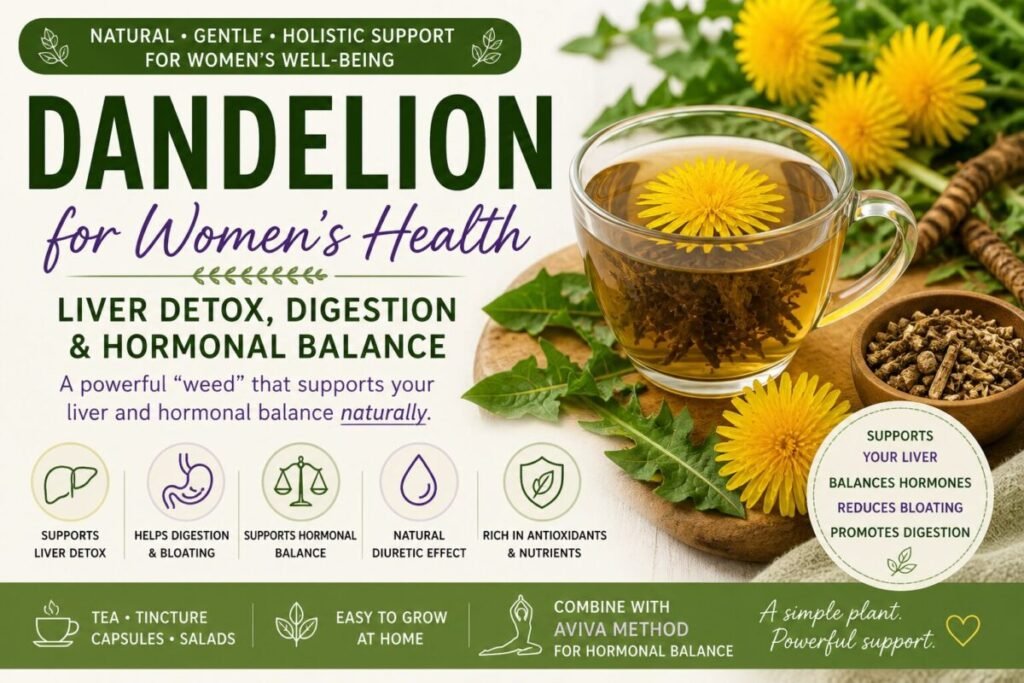
How Dandelion Supports Liver Detox & Women’s Hormonal Balance Naturally
You see it everywhere.
In gardens.
Between sidewalk cracks.
In fields and lawns.
Most people call it a weed.
But Taraxacum officinale (dandelion) is actually a powerful medicinal herb—used for centuries to support digestion, liver function, and overall balance.
And here’s what many people don’t realize:
 By supporting your liver, dandelion may also support your hormonal balance.
What Is Dandelion?
Dandelion is a nutrient-rich medicinal plant where every part can be used:
- leaves
- root
- flowers
Traditionally, it has been used for:
- liver support
- digestion
- fluid balance
- gentle detoxification
(Schütz et al., 2006)
 Active Compounds in Dandelion
 Active Compounds in Dandelion
Dandelion contains a wide range of bioactive compounds:
- Sesquiterpene lactones → stimulate digestion
- Taraxasterol → anti-inflammatory effects
- Inulin → supports gut microbiome
- Flavonoids (luteolin, apigenin) → antioxidant activity
- Phenolic acids (caffeic acid, chlorogenic acid) → cellular protection
These compounds contribute to its multi-system effects
(Schütz et al., 2006; González-Castejón et al., 2012)
How Does Dandelion Work in the Body?
Dandelion supports the body through liver, digestion, and metabolic pathways.
1. Supports Liver Function
 1. Supports Liver Function
Dandelion root has been shown to:
- stimulate bile production
- support liver detoxification pathways
This is essential because bile helps remove:
- toxins
- metabolic waste
- excess hormones
(Clare et al., 2009; You et al., 2010)
2. Supports Hormone Metabolism
 2. Supports Hormone Metabolism
The liver plays a key role in breaking down estrogen.
When liver function improves:
- hormone clearance becomes more efficient
- hormonal “build-up” may be reduced
This is why liver-supporting herbs are often used in hormonal support protocols
(Abenavoli et al., 2010)
3. Acts as a Gentle Diuretic
Dandelion leaf has demonstrated diuretic effects in humans.
This can help:
- reduce water retention
- support lymphatic and fluid balance
Importantly:
- it provides potassium → helping maintain electrolyte balance
(Clare et al., 2009)
4. Reduces Oxidative Stress
 4. Reduces Oxidative Stress
Dandelion extracts have shown strong antioxidant activity:
- neutralizing free radicals
- protecting liver cells
- reducing cellular damage
(Jeon et al., 2008; Hu & Kitts, 2005)
5. Anti-Inflammatory Effects
 5. Anti-Inflammatory Effects
Dandelion compounds may reduce inflammatory signaling pathways.
This is relevant because:
- chronic inflammation is linked to hormonal imbalance
(Jeon et al., 2008)
6. Supports Gut Health
 6. Supports Gut Health
Dandelion contains inulin, a prebiotic fiber that:
- nourishes beneficial gut bacteria
- supports digestion
- contributes to metabolic balance
Gut health plays a key role in estrogen metabolism
(González-Castejón et al., 2012)
Which Part Should You Use?
 Which Part Should You Use?
- Leaves → diuretic, digestion support
- Root → liver support, detox
- Flowers → mild antioxidant effects
How to Consume Dandelion

Root Tea (Liver Support)
- 1–2 teaspoons dried root
- 250 ml hot water
- simmer or steep 10–15 minutes
Leaf Tea (Bloating & Fluid Balance)
- 1–2 teaspoons dried leaves
- steep 5–10 minutes
Other Forms
- tincture
- capsules
- fresh leaves (salads)
How Much Can You Use?
- 1–3 cups daily
- or follow supplement instructions
 1–3 cups daily
How Long Can You Use It?
- Use for 2–3 weeks
- Then take a break
This supports natural regulation without overuse
Safety and Medication Interactions
 Safety and Medication Interactions
Dandelion is generally safe, but caution is needed:
Avoid or consult a professional if:
- gallstones or bile duct obstruction
- kidney disease
Possible interactions:
- diuretics
- lithium
- blood pressure medications
- drugs metabolized in the liver
Always consult your doctor or pharmacist if on medication
Is Dandelion Good for Bees?
 Is Dandelion Good for Bees?
Yes—dandelion is extremely valuable for pollinators.
It provides:
- early-season nectar
- essential pollen
Supporting dandelion growth helps:
- bees
- biodiversity
- ecosystem balance
Can You Grow Dandelion at Home?
 Can You Grow Dandelion at Home?
Yes—very easily.
Growing Tips
- thrives in most soils
- prefers sunlight
- low maintenance
Care
- moderate watering
- harvest leaves early
- allow natural growth
A Holistic Approach to Hormonal Balance
Dandelion supports:
- liver detox pathways
- digestion
- fluid balance
But hormonal balance is also physical.
The Aviva Method supports:
- pelvic circulation
- hormonal gland stimulation
- nervous system balance
Why This Combination Works
- Dandelion → internal biochemical support
- Aviva Method → physical and circulatory support
Together:
they support the body from multiple angles.
Final Thoughts
Dandelion is not just a weed.
It is a scientifically supported, multi-functional herb that helps:
- liver function
- digestion
- internal balance
And through this, it may support hormonal health.
Not by forcing change—but by creating the conditions where balance can naturally occur.
References
 References
Abenavoli, L., et al. (2010).
Milk thistle and liver diseases: Past, present, future. Phytotherapy Research.
Clare, B. A., Conroy, R. S., & Spelman, K. (2009).
The diuretic effect of Taraxacum officinale. Journal of Alternative and Complementary Medicine, 15(8), 929–934.
González-Castejón, M., et al. (2012).
Dandelion: A review of its phytochemical and pharmacological profile. Journal of Ethnopharmacology.
Hu, C., & Kitts, D. D. (2005).
Antioxidant activity of dandelion extracts. Journal of Agricultural and Food Chemistry
Jeon, H. J., et al. (2008).
Anti-inflammatory activity of dandelion. Journal of Ethnopharmacology.
Schütz, K., Carle, R., & Schieber, A. (2006).
Taraxacum—phytochemical review. Journal of Ethnopharmacology.
You, Y., Yoo, S., Yoon, H. G., et al. (2010).
In vitro and in vivo hepatoprotective effects of dandelion. Food and Chemical Toxicology.