Cycle Planning: Big Presentation, Wedding, Competition… and Your Period? Here’s What You Can Do.
Have you ever opened your calendar and felt that quiet drop in your stomach?
📌An important presentation.
📌A competition.
📌A long-awaited event.
📌An important exam — like your final qualification test.
📌A university entrance exam.
📌The final interview at your dream company.
And then you calculate the date.
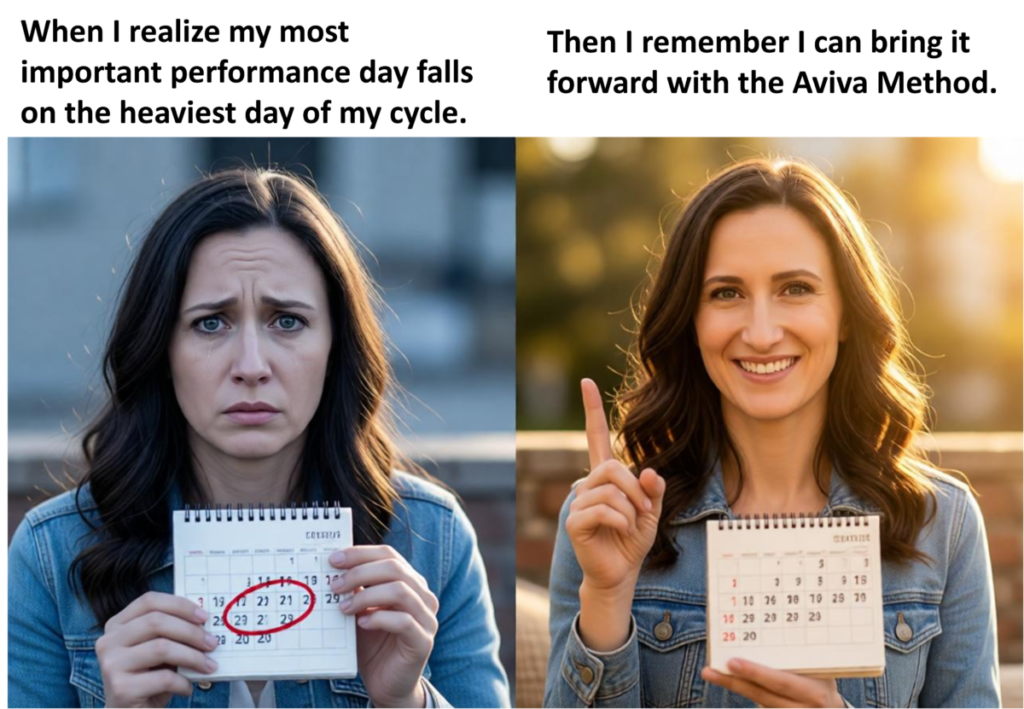
⚡️ And you realize: It will probably be the first, second, or third day of your period.
😖 That heavy day.
😖 The one with the cramping, the fog, the deep inward pull.
😨 These are not ordinary days.
😨 They are high-performance moments.
😨 And the last thing you want is the burden of your period.
You are not alone!
In recent years, more elite athletes have begun speaking openly about menstruation and its impact on performance. This cultural shift is important. For decades, women were expected to ignore their cycle, suppress symptoms, or simply “push through.”
But what if awareness could become an advantage?
What if the menstrual cycle were not something to endure — but something to understand and work with?
Your body is not working against you. It is following a rhythm.
🌈 And a good news!
You may can help on yourself in a safe natural way with the Aviva Method.
Cycle awareness is the firts step to schedule your cycle.
The menstrual cycle is a dynamic hormonal rhythm. Energy levels, focus, coordination, emotional resilience, and recovery capacity naturally fluctuate throughout the month.
In performance-based environments — whether in sport, business, academia, or the arts — timing matters.
Understanding the phases of the cycle can provide insight into:
- When energy tends to peak
- When recovery may require more attention
- When focus or resilience may naturally shift
Your menstrual cycle has four distinct phases:
- Menstruation
- Follicular phase
- Ovulation
- Luteal phase
Each phase is hormonally different — and many women can feel those differences in their body.
1. Menstruation – The Reset Phase
During menstruation, estrogen and progesterone levels are at their lowest.
The uterine lining is shedding.
Prostaglandins increase.
The uterus contracts to release tissue.
You may feel:
- lower physical energy
- increased pain sensitivity
- slower recovery
- inward focus
This is not dysfunction.
It is a physiological reset.
However, when menstruation coincides with a high-demand event, symptoms such as cramps, fatigue, or heavy bleeding can become more challenging.
2.Follicular Phase – Rebuilding and Rising Energy
After bleeding ends, estrogen gradually increases.
This phase supports:
- tissue repair
- improved cognitive clarity
- increasing physical capacity
- better tolerance to stress
Many women notice that training feels easier here.
Learning new skills may feel more accessible.
The system is rebuilding.
Ovulation – Peak Output Window
Around ovulation, estrogen peaks.
For many women, this correlates with:
- stronger muscle recruitment
- faster reaction time
- higher confidence
- social ease
- outward energy
Not every woman experiences this identically.
But statistically and anecdotally, this phase is often described as a performance peak.
Luteal Phase – Preparation and Sensitivity
After ovulation, progesterone rises.
This phase supports potential implantation — but it also shifts the nervous system toward a more inward state.
You may notice:
- increased body temperature
- higher resting heart rate
- emotional sensitivity
- fluid retention
- PMS symptoms in some cases
If stress levels are high, this phase can feel heavier.
Can the Timing of Menstruation Be Influenced?
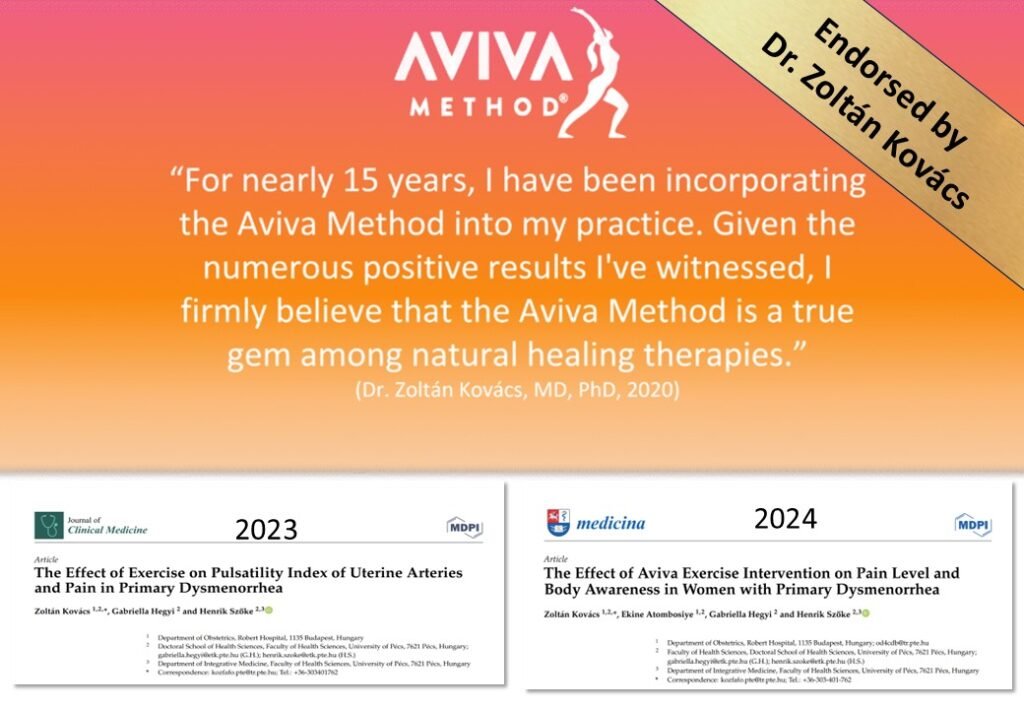
Since 1966, the Aviva Method has offered a natural, movement-based approach designed to support pelvic circulation and hormonal balance.
Many women report that when practicing the Aviva basic sequence between days 24–28 of their cycle (I will mention it as a freewill window), menstruation may begin the following day. In these cases, the cycle appears to shift slightly forward.
Of course, every body is different. The hormonal system is complex, and results are not identical for everyone. However, recurring feedback patterns suggest that conscious movement may influence cycle timing in some cases.
This raises an important possibility.
If menstruation can sometimes be brought forward by a few days, then with consistent practice, cycle tracking and strategy, some women not only can experience more predictable patterns over time but can align their period with important events.
Why Does the Body Respond More Quickly During The Freewill Window?
In this phase — typically the late luteal stage — the body is already approaching the natural onset of menstruation.
Hormone levels, especially progesterone, are declining.
The uterine lining is losing hormonal support.
Physiologically, the body is preparing either for implantation or for shedding.
Because of this, it is closer to transition.
Increasing circulation and activating the pelvic area (for example, through Aviva Method exercises) may:
- Support the natural shedding process of the uterine lining
- Help complete the cycle
- And in many cases, menstruation may begin the next day or within a few days
Important: we are not “forcing” the cycle.
During this time, the body is already hormonally prepared for transition — movement acts as support rather than as a trigger.
Why Is This Strategically Important?
Because if:
- An important event is approaching
- You have planned travel
- You are preparing for a competition, performance, or presentation
Then during this gateway window, there is a higher likelihood that you can gently support menstruation to begin a few days earlier — if your body is already hormonally at the end of the cycle.
Even More: What Happens If You Apply This Consciously Over Multiple Cycles?
If for 2–3 months you consistently:
- Practice during the appropriate window
- Gently encourage the end of the cycle slightly earlier
Your cycle timing may gradually shift forward by a few days.
Strategically, this means:
If you know that an important event is scheduled exactly on your expected period date, starting conscious cycle planning several months in advance may allow you to reposition your bleeding date to your highest perfoming biological phase.
A Necessary Reality Check
- The menstrual cycle is not a switch.
- Not every body responds the same way.
- Stress, sleep, travel, and hormonal health all influence timing.
This is fine-tuning, not absolute control.
But for many women, even having some influence over timing feels empowering.
It transforms the cycle from something unpredictable into something you can collaborate with.