A Science-Based and Experience-Based Overview
Can one movement method really support hormonal and reproductive health?
It’s a common question — and it deserves a clear, honest answer.
The Aviva Method is often associated with many potential benefits.
However, not all of them are supported by the same level of scientific evidence.
👉 So let’s separate clearly:
-
what is scientifically proven (including Aviva-specific research)
-
and what is supported by exercise science and practitioner experience
What Has Been Scientifically Proven About the Aviva Method
Recent research has specifically examined the effects of the Aviva Method.
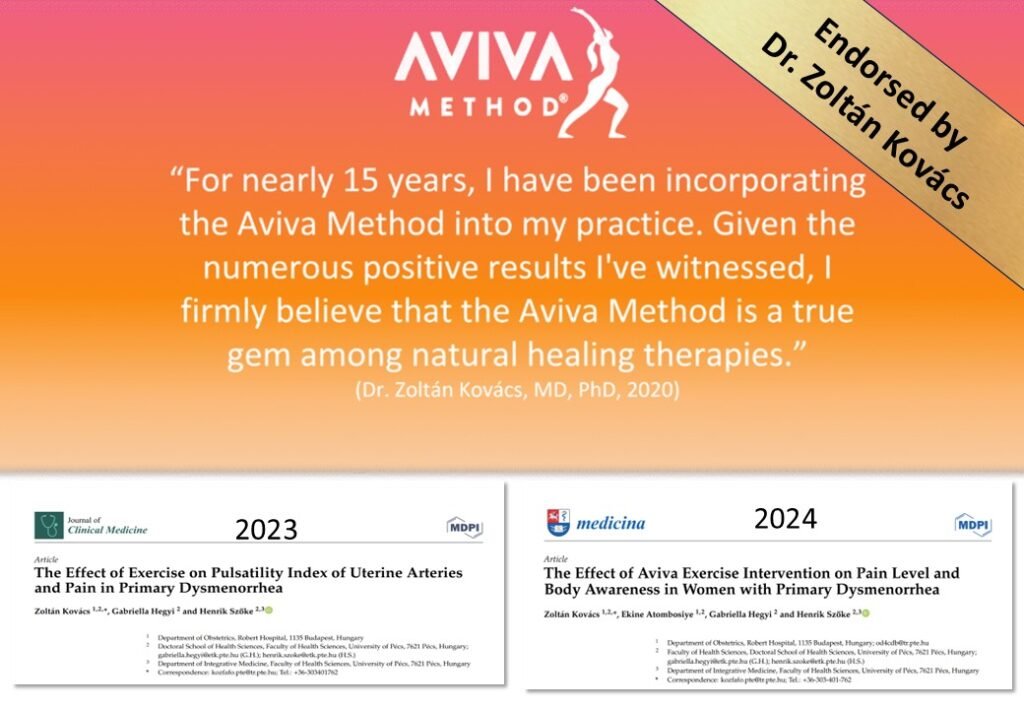
A 2024 study by Kovács et al. investigated women suffering from menstrual pain (primary dysmenorrhea).
The results showed that:
✔ regular Aviva practice significantly reduced PMS and menstrual pain
✔ improvements were observed over repeated cycles
👉 This is a key point:
This effect was observed using the Aviva Method itself, not just general exercise
(Kovács et al., 2024).
What Science Says About Movement and Menstrual Pain
Even beyond Aviva-specific research, there is strong scientific evidence that movement helps.
Studies show that:
✔ aerobic exercise
✔ stretching
✔ regular physical activity
which is also typical to Aviva Exercises, can significantly reduce menstrual pain
(Tsai et al., 2024; Dehnavi et al., 2018; Rigal et al., 2025).
One important mechanism:
👉 exercise helps remove prostaglandins and metabolic byproducts from the uterus
→ which directly contributes to pain reduction
(Dehnavi et al., 2018).
Circulation, Oxygenation and Tissue Support
A large body of research confirms that movement:
✔ improves blood circulation
✔ supports lymphatic flow
✔ increases oxygen and nutrient delivery
(Ciuceis et al., 2023; Green et al., 2018; Breyley-Smith et al., 2022).
👉 These processes are essential for:
-
tissue regeneration
-
reducing inflammation
-
supporting organ function
Vascular Function and Elasticity
Exercise also plays an important role in vascular health.
Research shows that regular physical activity can:
✔ improve vascular elasticity
✔ enhance endothelial function
(Tao et al., 2023; Biernat et al., 2024; Hong & Park, 2024; Wang et al., 2023).
Hormonal Regulation and Metabolic Effects
Regular physical activity has been associated with:
✔ improved hormonal balance
✔ reduced PMS symptoms
✔ better insulin sensitivity
✔ improved metabolic regulation
(Grei et al., 2020; Zouhal et al., 2021; Choudhury et al., 2021; Menniti et al., 2024).
👉 These effects are especially relevant in conditions like:
-
PMS (Sanchez et al., 2023)
-
cycle irregularities (Nazir & Saduh, 2024)
-
PCOS (Sabag et al., 2024; Jedel et al., 2011)
Pelvic Floor and Core Function
Targeted movement is known to:
✔ improve pelvic floor strength
✔ support continence
✔ enhance sexual function
(Bø, 2000; García-Sánchez et al., 2016; Kim et al., 2011; Smolarek-Kołecka et al., 2021).
Why the Aviva Method May Have Such Wide-Ranging Effects
The Aviva Method is not just random exercise.
It combines:
-
pelvic floor activation
-
rhythmic, dynamic movements
-
low-intensity aerobic stimulation
-
coordination-based patterns
-
stretching and mobility
-
elements of reflex stimulation
👉 This combination creates a targeted effect on the pelvic region and internal regulation systems.
What Comes from Practice and Experience
Beyond scientifically confirmed effects, many additional benefits are reported in practice.
These include:
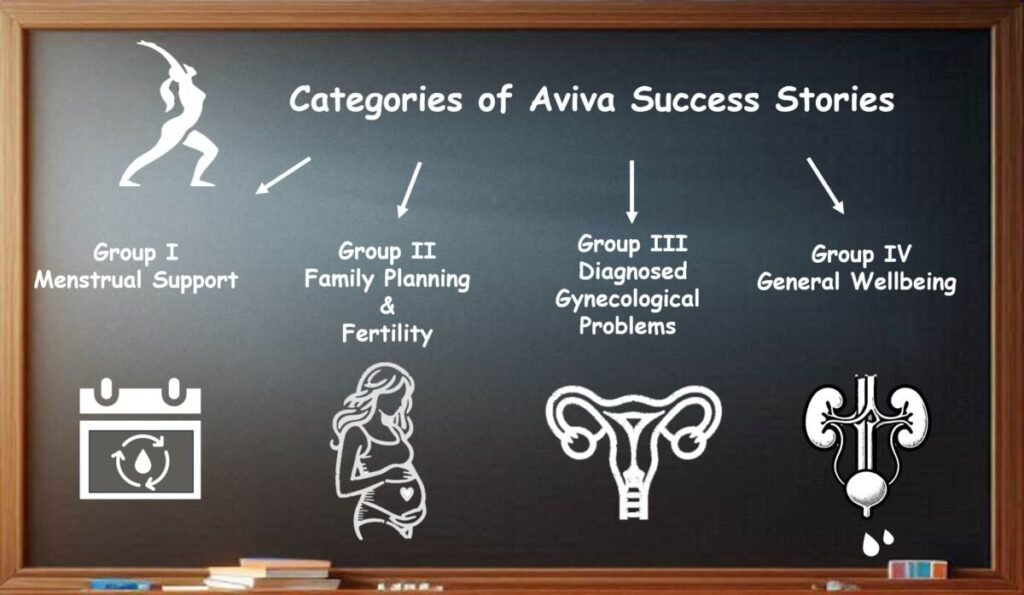
Cycle and Menstrual Support
-
more regular cycles
-
reduced discomfort
-
improved rhythm awareness
Fertility Support
-
improved body awareness
-
support for natural conception
-
supportive role alongside assisted reproduction
(Kovács Barbara Petera et al., 2024; Adibi et al., 2015; Masrour et al., 2019)
Hormonal and Gynecological Support
-
symptom relief in conditions like PCOS or cysts
(Karkera et al., 2023; Manni et al., 2005)
General Wellbeing
-
increased energy
-
improved libido (Hadizadeh-Talasaz et al., 2019)
-
support during menopause (Liu et al., 2022)
👉 Important to note:
These are based on:
-
practitioner experience
⚠️ They are not all clinically proven yet
At the same time, the consistency between the reported effects of the Aviva Method and well-established exercise science highlights a valuable opportunity for future studies to directly examine this method in clinical settings.
In Conclusion
✔ The Aviva Method has direct scientific evidence for reducing PMS and menstrual pain
(Kovács et al., 2024)
✔ It is consistent with well-established knowledge about:
-
movement and circulation
-
exercise and hormonal health
✔ It is supported by a wide range of exercise science literature
✔ It is also supported by consistent practitioner experience and client-reported outcomes (anecdotal evidence)
However:
⚠️ It is not a medical treatment
⚠️ It does not replace professional healthcare
⚠️ Not all claimed effects are scientifically proven
Final Thought
The Aviva Method works at the intersection of:
👉 science
👉 structured movement
👉 real-life experience
Its strength lies in:
-
combining proven movement types
-
applying them in a targeted way
-
supporting the body’s natural processes
💡 It’s not about miracles —
it’s about creating the conditions where the body can function better.
About the Author
Written by Dr. Demeter Zita, a PhD in Biology and Environmental Sciences, menstrual, fertility, menopeuse and hormone health coach, and certified Aviva Method instructor, supporting hormonal health through movement and body awareness.
Reference articles
Adibi, A., et al. (2015). Effects of lifestyle and exercise interventions on fertility outcomes. International Journal of Preventive Medicine. https://doi.org/10.4103/1735-1995.170622
Ahmad, A., et al. (2023). Physical activity and hormonal health: A systematic review.
Akandere, M., & Demir, B. (2011). The effect of exercise on depression levels.
Assis, T. R., et al. (2013). Pelvic floor muscle training and urinary incontinence outcomes.
Bahrami, N., et al. (2023). The effect of physical activity on reproductive outcomes. International Journal of Reproductive Medicine. https://doi.org/10.18502/ijrm.v21i3.13196
Baird, D. D., et al. (2007). Uterine fibroids and reproductive health.
Benham, J. L., et al. (2018). Exercise and metabolic health in women.
Berin, E., et al. (2019). Exercise interventions for menopausal symptoms.
Biernat, E., et al. (2024). Physical activity and vascular elasticity.
Bonaiuti, D., et al. (2002). Exercise and bone density in osteoporosis prevention.
Bø, K. (2000). Pelvic floor muscle exercise for stress urinary incontinence.
Breyley-Smith, H., et al. (2022). Physical activity and cardiovascular health. International Journal of Environmental Research and Public Health. https://doi.org/10.3390/ijerph19031386
Campos, C., et al. (2018). Exercise and prostate health.
Campbell, S., et al. (2007). Fibroids and reproductive function.
Choudhury, S., et al. (2021). Exercise and endocrine function.
Ciuceis, C., et al. (2023). Exercise and circulatory system adaptations.
Claes, H., & Baert, L. (1993). Varicocele and male reproductive health.
Cohen, P. G., et al. (2016). Erectile function and lifestyle interventions.
Dehnavi, Z. M., et al. (2018). The effect of aerobic exercise on primary dysmenorrhea. Journal of Education and Health Promotion. https://doi.org/10.4103/jehp.jehp_79_17
Dewey, K. G., et al. (1994). Maternal activity and lactation outcomes.
Duca, Y., et al. (2019). Physical activity and erectile function.
Ennour-Idrissi, K., et al. (2015). Exercise and hormonal balance.
Esfahani, M. S., et al. (2015). Exercise and breastfeeding outcomes.
Feron, F., et al. (2024). Neuroendocrine regulation and physical activity.
Flanczewski, M., et al. (2024). Exercise and gastrointestinal function.
García-Sánchez, E., et al. (2016). Pelvic floor training and continence.
Gaspar, A., et al. (2011). Vaginal health and hormonal changes.
Giudice, L. C., et al. (2024). Reproductive health and lifestyle interventions.
Green, D. J., et al. (2018). Vascular adaptation to exercise. Cold Spring Harbor Perspectives in Medicine. https://doi.org/10.1101/cshperspect.a029819
Grei, T., et al. (2020). Exercise and endocrine balance.
Hadizadeh-Talasaz, Z., et al. (2019). Exercise and sexual function in women.
Havaldar, E., et al. (2024). PCOS and lifestyle interventions.
He, Y., et al. (2013). Uterine fibroids and treatment approaches.
Hong, J., & Park, S. (2024). Vascular health and reproductive system function.
Hsiao, W., et al. (2012). Erectile dysfunction and physical health.
Huyghe, E., et al. (2018). Male fertility and lifestyle factors.
Jedel, E., et al. (2011). Exercise and PCOS management.
Karkera, A., et al. (2023). PCOS symptoms and lifestyle modification.
Kim, H., et al. (2011). Pelvic floor training effectiveness.
Klasson, K. T., et al. (2022). Exercise and endocrine regulation.
Kossman, D. A. (2011). Exercise and hormonal systems.
Kovács, Z., et al. (2024). The effect of Aviva exercise intervention on pain level and body awareness in women with primary dysmenorrhea.
Kovács Barbara Petera, B., et al. (2024). The effect of Aviva Method on reproductive health and fertility.
Latka, M., et al. (1999). Pregnancy outcomes and lifestyle factors.
Lie, M., et al. (2022). Exercise and menopausal symptom management.
Liu, Y., et al. (2017). Hormonal balance and hair growth.
Liu, Y., et al. (2022). Menopause and physical activity.
Manni, L., et al. (2005). Ovarian cysts and reproductive function.
Martins, C., et al. (2008). Exercise and appetite regulation.
Masrour, M. J., et al. (2019). Lifestyle factors and fertility. Journal of Family Medicine and Primary Care. https://doi.org/10.4103/jfmpc.jfmpc_212_19
McCarthy, D., et al. (2024). Appetite regulation and exercise.
Menniti, G., et al. (2024). Exercise and metabolic-hormonal balance.
Meston, C. M., & Gorzalka, B. B. (1996). Sexual arousal and physiological responses.
Montenegro, M. L., et al. (2018). Endometriosis and reproductive health.
Nazir, M., & Saduh, S. (2024). Menstrual cycle regulation and lifestyle.
Park, N. C., et al. (2019). Male reproductive health and exercise.
Patten, R. K., et al. (2020). Exercise interventions in PCOS.
Patten, S. B., et al. (2021). Physical activity and depression.
Piya-anant, M., et al. (2003). Pelvic organ prolapse risk factors.
Ramadani, N., et al. (2019). Lactation and maternal health.
Rigal, J., et al. (2025). Evidence and safety of therapeutic exercise for primary dysmenorrhea.
Sabag, A., et al. (2024). Lifestyle interventions in PCOS.
Salihu, H. M., et al. (2021). Exercise and mental health.
Sanchez, A., et al. (2023). Exercise and PMS symptom reduction.
Sardana, D., et al. (2014). Lifestyle interventions and reproductive outcomes. https://doi.org/10.4103/0974-1208.138872
Sea, J., et al. (2009). Prostate health and lifestyle.
Shrestha, R., et al. (2006). Fertility outcomes and physical health. https://doi.org/10.1007/s10815-006-9029-1
Smolarek-Kołecka, B., et al. (2021). Pelvic floor training outcomes.
Sundus, A., et al. (2025). Thyroid function and physical activity.
Tao, L., et al. (2023). Vascular function and exercise.
Tian, Y., et al. (2024). Thyroid health and lifestyle.
Tsai, S. Y., et al. (2024). Exercise interventions for dysmenorrhea.
Wang, X., et al. (2023). Vascular health and reproductive system interaction. https://doi.org/10.21037/atm-22-5813
Watanabe, D., et al. (2024). Exercise and bowel function.
Wen, J., et al. (2014). Erectile function and physical activity.
Weng, Q., et al. (2023). Ovulation and lifestyle interventions.
Wiggs, M. P., et al. (2021). Estrogen levels and exercise.
Zhang, Y., et al. (2024). Thyroid function and metabolism.
Zouhal, H., et al. (2021). Exercise and hormonal regulation.